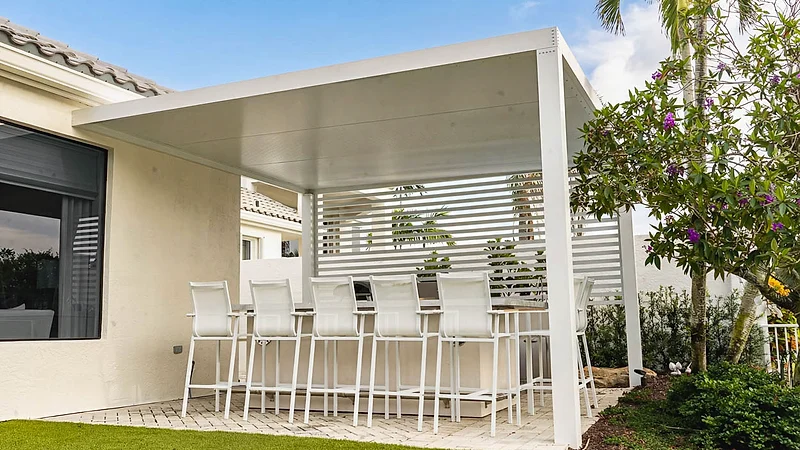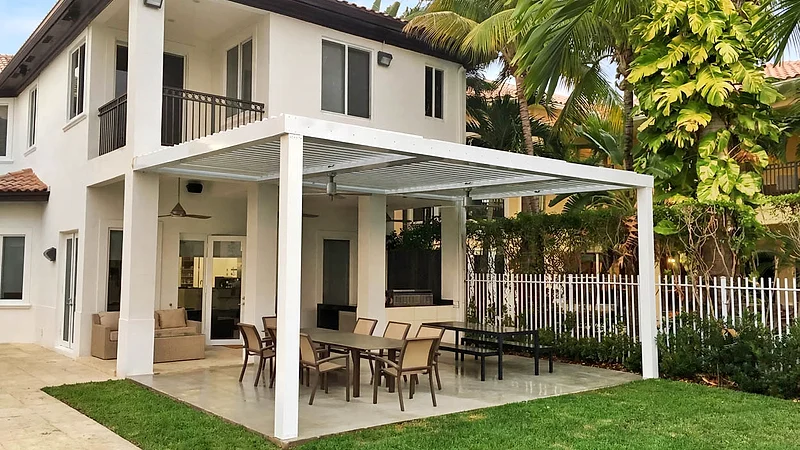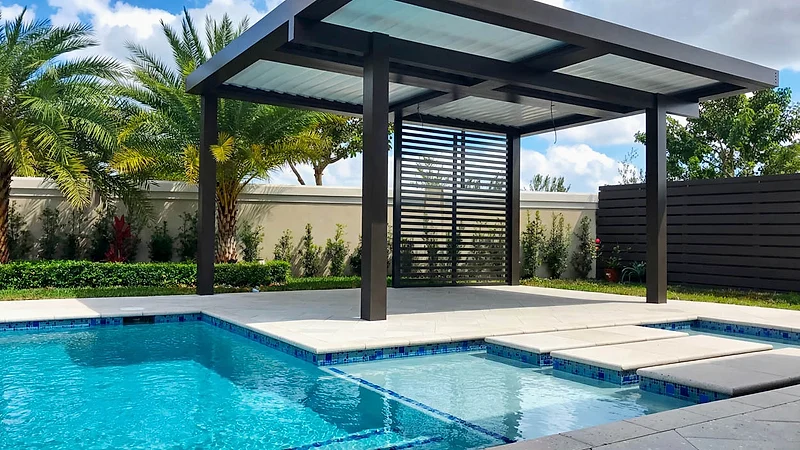
Both give you shade. Only one lets you stay outside while it rains. That difference decides the project faster than any feature list, and it explains the price gap.
Build the louvered roof if the space underneath has to keep working when it rains. Build the pergola if it does not. Everything else in this comparison — price, permits, drainage, wiring — follows from that one answer, which is why it is worth settling before you look at a single photo.
Both structures are powder-coated aluminum. Both give shade. Both hold up here. The real difference is that a pergola is a fixed filter and a louvered roof is a switch. A pergola's slats sit at the angle they were installed at; a louvered roof's blades rotate, so the same structure is open sky in the morning, full shade at two, and a closed roof when the afternoon storm arrives.
Our estimator prices a pergola at $8,500 and a motorized louvered roof at $18,000. That gap is the honest starting point. It is also not the whole difference, for reasons further down.
Most comparisons open with shade, which is where the two structures are most alike. That is why people read three of them and still cannot decide.
Rain is where they are not alike at all. With the blades closed, a louvered roof is a roof: the panels overlap, the perimeter beams work as gutters, and at least one post carries the water down and out. A pergola does not shed water in any position. Rain goes through it.
So the question is not architectural, it is behavioral: when a storm arrives at four in the afternoon, does everything under this structure have to keep working?
If what sits underneath is an outdoor kitchen, a television, upholstered furniture, or dinner on the table in August, the answer is yes, and a pergola will disappoint you inside one wet season. If it is a seating area beside the pool that you would be leaving anyway, the answer is no, and the roughly $9,500 difference is buying a capability you will not use. That is the fork, and very little else moves it. What the closed roof does in a real storm — and in wind — is covered in how a louvered roof behaves in Florida rain and high winds.
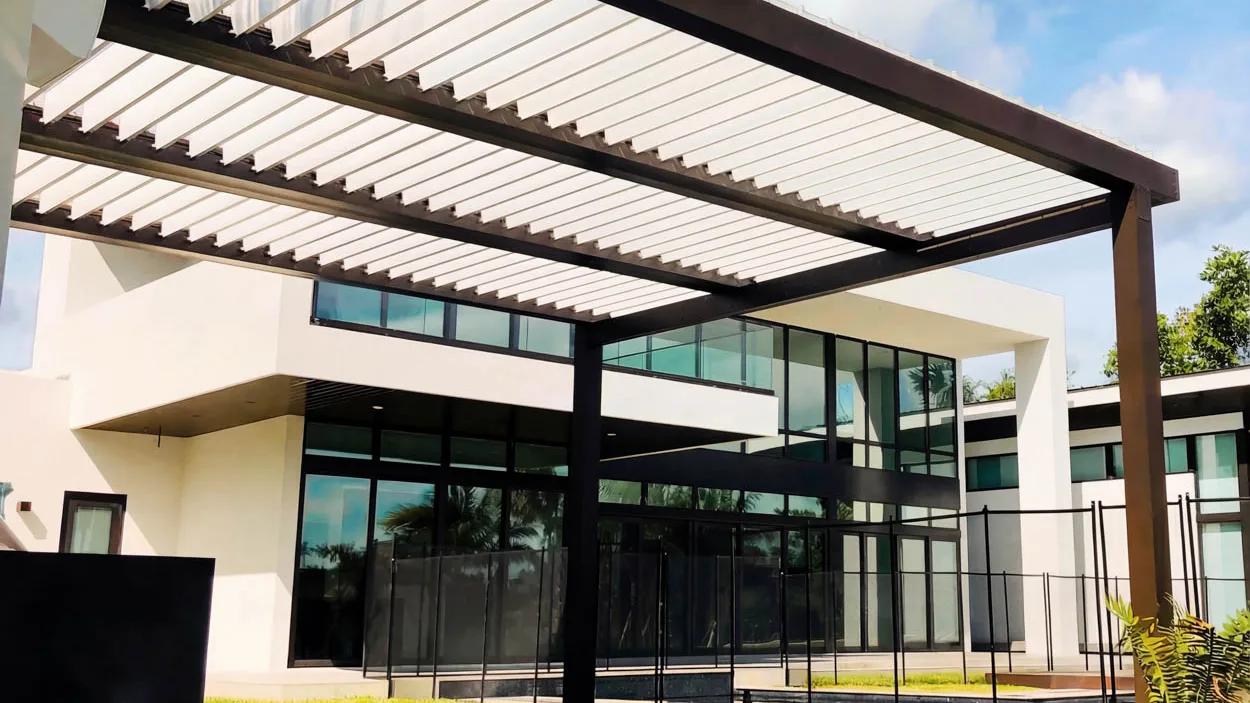
Fixed slats block sun coming from overhead. Florida backyards get used late in the day, when the sun is low and coming in from the side, under the structure rather than through it.
Fixed slats do nothing about low sun. Louvers rotate to a steep angle and block it from one direction, which is a different job than shading noon.
This is where a pergola most often disappoints: it is still hot at the hour the space actually gets used. That is not a build-quality problem, it is geometry, and it is solvable while the structure is still on paper — by which way the slats run, by a solid end panel on the west face, or by planning a screen into the structure from the start. A screen on one face of a pergola costs far less than a louvered roof and solves the afternoon problem without solving the rain problem. Be clear about which problem you actually have.
The estimator figures above are for the structures. Three things routinely move a louvered roof's real scope, and none of them apply to a pergola:
| What gets added | Why it only comes up with the louvered roof |
|---|---|
| Power to the structure | The motor needs a dedicated circuit. If the panel is on the far side of the house, that is trenching and conduit, not an extension cord. |
| Somewhere for the water to go | A closed roof produces runoff, and it leaves at the foot of a post. That discharge point has to be somewhere that genuinely drains. |
| Larger footings and anchorage | A closed roof catches wind like a sail. The uplift goes into the footings, so they are bigger and the anchorage is engineered rather than assumed. |
A pergola quote usually lands close to the structure price. A louvered roof quote is the structure price plus a site-dependent amount for those three items. Ask for them as separate lines, or the two numbers you are comparing are not the same kind of number.
Each side has its own breakdown: what changes a pergola's price and what moves the cost of a motorized louvered roof go through them item by item.
There is something between the two, and for a fair number of backyards it is the right answer: a fixed patio cover — insulated solid panels, or translucent ones — on the same aluminum posts and beams. It sheds rain. It has no motor, no circuit, no actuators, nothing to service. It costs less than a louvered roof.
What it costs you is the sky. Under a solid cover the space is permanently dim. Under translucent panels it is bright, and in July it is hot. Either way you cannot open it on the one February afternoon you want sun on the table.
So if the only reason you were looking at louvers was rain, a fixed cover is a cheaper answer to the same problem. If the reason was control — the same space being different things at different hours — a fixed cover does not do it, and you are back to the louvered roof. That is also the honest version of the is a motorized louvered roof worth it question: the motor is worth it when you are buying control, not when you are buying cover.
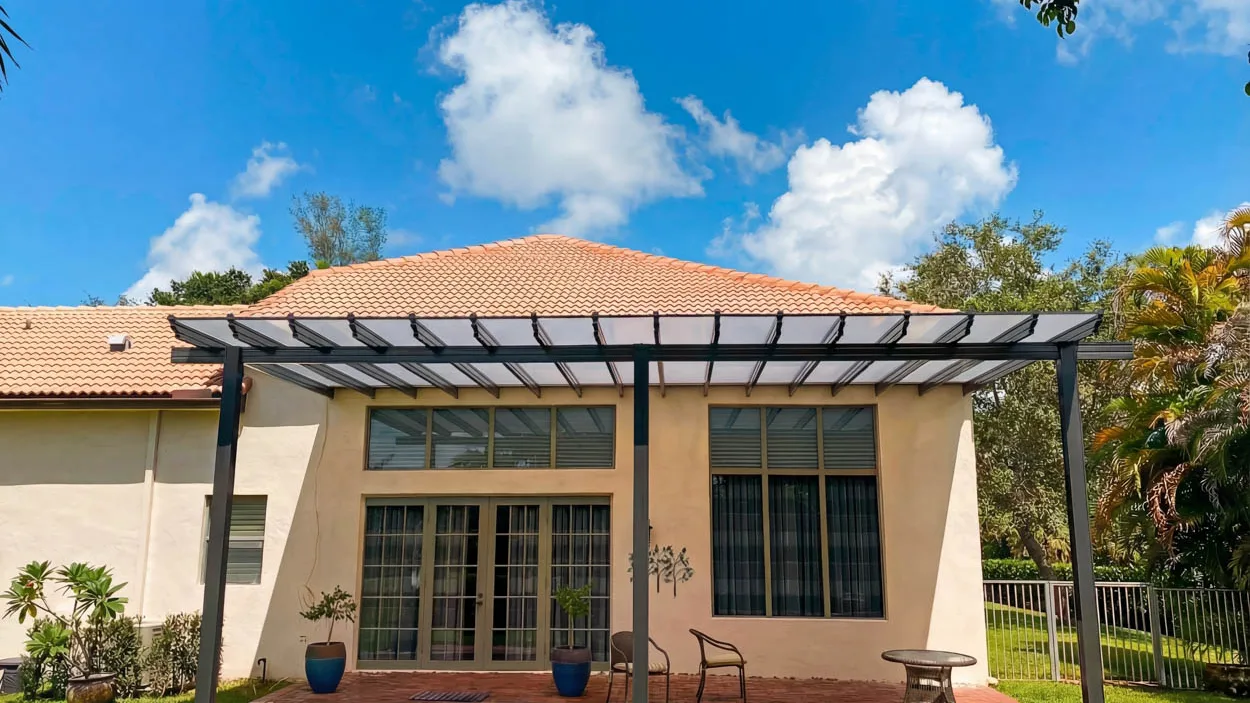
A pergola has no moving parts. What ages is the finish, the fasteners and, if it is attached, the connection to the house. Maintenance is washing it.
A louvered roof has motors, actuators, a controller, usually a rain sensor, and seals between the blades. None of it is exotic and all of it is serviceable, but all of it eventually needs service. Two questions are worth asking any installer before you sign:
The second answer decides whether a failed actuator is a short inconvenience or a season without a working roof. It predicts how you will feel about the system years from now far better than any spec sheet.
One item specific to here: leaves. Blade seals and the drainage channels in the beams have to be kept clear, and under oaks that is not optional. It is a short job a few times a year — but it is a job somebody has to do.
Two decisions do most of the work: which way the slats run relative to the afternoon sun, and whether the structure attaches to the house. The rest of the sequence — post placement, spans, finish, what the posts land on — is in the decisions to make before construction starts. If you are still weighing materials rather than structures, aluminum against wood over a Florida decade is the comparison to read first.
One thing to know before you plan around the price: a pergola cannot be converted into a louvered roof later in any economical way. The posts, beams and footings are sized for different loads, and there is no drainage to adapt. If the louvered roof is what you want and the budget is not there this year, building the pergola as a step toward it is the one sequence that does not work.
Answer these out loud:
Size is the wrong thing to cut, by the way. A structure that ends up a foot short in each direction stops covering the table it was built for, and that is the one thing you cannot correct once the footings are poured.
With a specific backyard in mind this stops being a spec comparison and becomes a site conversation: how the house sits, where the afternoon sun comes from, what is already under the slab, and where the water can go. Our aluminum pergola construction and motorized louvered roof systems pages show how each one is built, the gallery has both in finished backyards, and a project estimate starts with that walk-through rather than with a number.
Not economically. The posts, beams and footings of the two structures are sized for different loads, and a pergola has no drainage to adapt. Building the pergola first as a step toward the louvered roof is the one sequence that does not work.
With the blades closed the panels overlap and the water runs to the perimeter beams and down a post, so straight rain stays out. Wind-driven rain still comes in from the open sides, which is what side screens or end panels are for.
Both are permitted structures, and the review depends on your county rather than on Florida generally. A closed louvered roof is reviewed as a roof, so its wind uplift, its anchorage and its drainage are all part of the submission. Have the contractor pull the permit under their own license.
Little, but not none. The blade seals and the drainage channels in the beams have to be kept clear of leaf litter, which matters under oaks, and the motors and actuators are serviceable parts that eventually need service. Ask who services the system locally before you buy it.