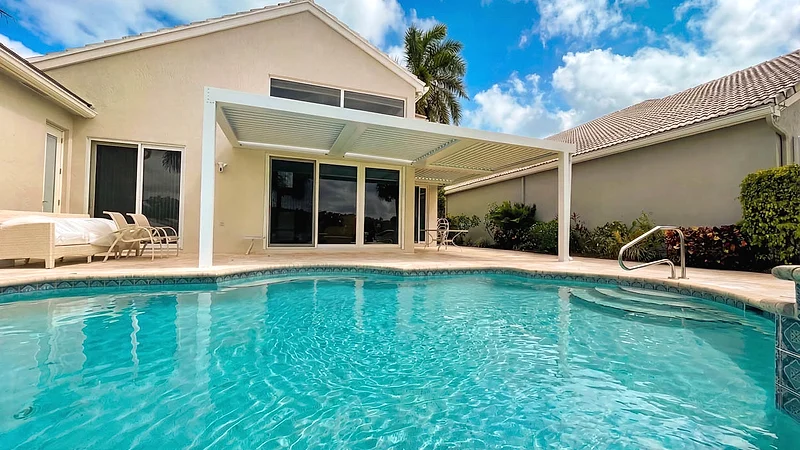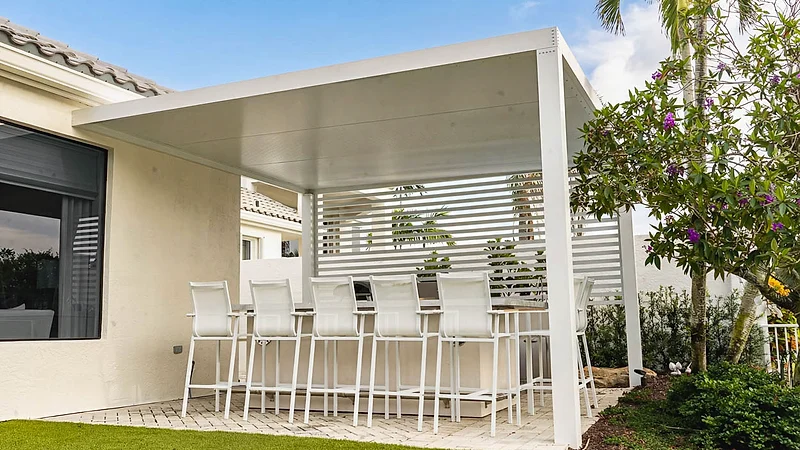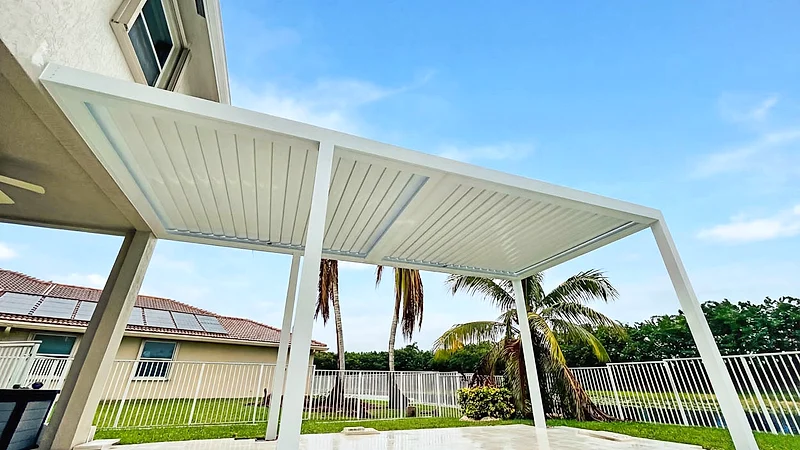
The motor is not what makes a louvered roof expensive or cheap. What decides it is whether the covered area is beyond the shade your house already throws at the hour you use the yard.
A motorized louvered roof is worth it when it converts hours the space is currently unusable into hours you will actually use it. It is not worth it when it covers ground the house already covers, or when the only thing it is solving is rain. Between them, those two cases account for most of the louvered roofs we are asked to price and then end up talking somebody out of.
Our estimator prices a motorized louvered roof at $18,000 and an aluminum pergola at $8,500. The $9,500 between them does not buy more cover. It buys control: the same structure being open sky at nine, full shade at two, and a closed roof at four. Whether that control is worth $9,500 in your backyard is a question about your backyard, not about the product, and it can be answered in an afternoon without talking to anyone.
A great many Florida homes were built with a covered lanai under the main roof. That changes the question completely. You are almost never deciding between cover and no cover. You are deciding whether to extend the usable footprint past the roofline the builder gave you.
So go out at the hour you actually use the yard — for most households that is somewhere between four and seven — and mark where the house's shade ends. Chalk, a hose, a row of chairs, anything. That line is the only measurement that matters at this stage.
Everything inside the line is already covered at the hour you care about. A louvered roof there changes very little, and we see it built there more often than anywhere else, usually because the posts are easier to set against the existing structure and the drawing looks tidy. Everything outside the line is the area where a roof creates usable space that does not exist today. That is what you are buying.
Two things distort the line and are worth checking before you trust it:
The honest version of "is it worth it" is arithmetic, and it is arithmetic only you can do.
Count the occasions in a normal year when the yard would have been used and was not, and you know why: it was too hot at five, it rained at six, the table was in full sun, the furniture was wet from the morning. Not a feeling — a number you would defend, because it is the only input in this calculation that nobody can supply for you.
Now put $9,500 against that number across the years you expect to own the house. Thirty occasions a year over ten years is three hundred afternoons; twelve a year is a hundred and twenty. Neither number tells you the answer, but both turn a vague want into something you can weigh against the other thing that $9,500 buys in the same backyard.
This exercise is also the fastest way to discover that the answer is a different product. If every occasion on your list is rain, you are describing a fixed cover, which sheds water for less money and has nothing to service. If every occasion is heat at five, you are describing a screen or an end panel. The full comparison between a pergola, a louvered roof and a fixed panel cover walks the three of them against each other. The motor is worth paying for when your list has occasions of both kinds on it, because that is the only case where one structure has to do two jobs.
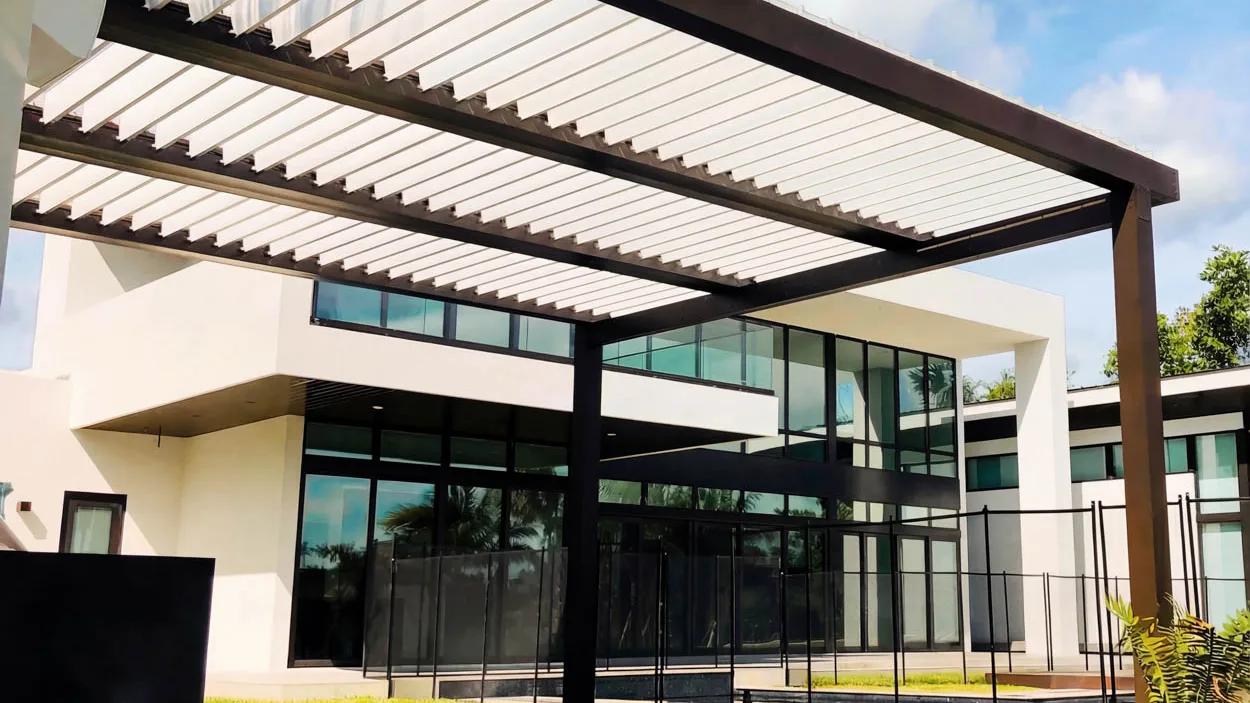
This is the detail that separates a louvered roof that earns its price from one that disappoints the owner on a schedule.
The blades rotate on one axis. Closing them toward the west blocks low western sun; closing them toward the east does not. If the blades run the wrong way for your yard, rotation gives you bars of light across the table at the exact hour you wanted shade, and no amount of remote-pressing fixes it. The motor is working perfectly. The geometry is wrong.
The problem is that the blade direction is not a free choice. It is traded against two other things at design time:
| What also depends on the blade direction | Why it pulls the other way |
|---|---|
| The span | Blades span between beams. Running them the way the sun needs can mean a longer span, a deeper beam, or an extra post in the middle of the space. |
| Where the water goes | A closed roof drains to the perimeter beam and down a post. Turn the structure and the low point moves, which can put the discharge somewhere that does not drain. |
None of that is a reason to accept the wrong orientation. It is a reason to raise it early, while it is still a line on a drawing. The question to ask whoever is quoting the job is not "which way do the louvers run" but "show me where the shade falls at five in the afternoon in July, and where the water comes out." A good answer arrives immediately and in plain terms. If the shade study is at noon, it is answering a question you did not ask.
A roof over four chairs and a roof over an outdoor kitchen are the same product in two different projects.
Our estimator prices a full outdoor kitchen at $25,000. Appliances, cabinetry and stone that are permanently outside age differently depending on whether they spend the wet season getting rained on, and the roof stops being a comfort item and starts being part of how that installation is specified. The same is true of a television, of upholstered furniture, and of anything with a power outlet in it.
The sequence matters here more than most people expect. Deciding to cover a kitchen after the kitchen is built usually means posts landing where the counter already is. Deciding both at once means the posts, the circuits, the lighting and the drainage are laid out together, and the wiring runs inside the hollow beams instead of on the surface of them. That is the whole argument for planning the structure and its contents in one pass, which is what designing the lights, fans and screens as one system is about, and what an outdoor kitchen actually costs covers the other half of that budget.
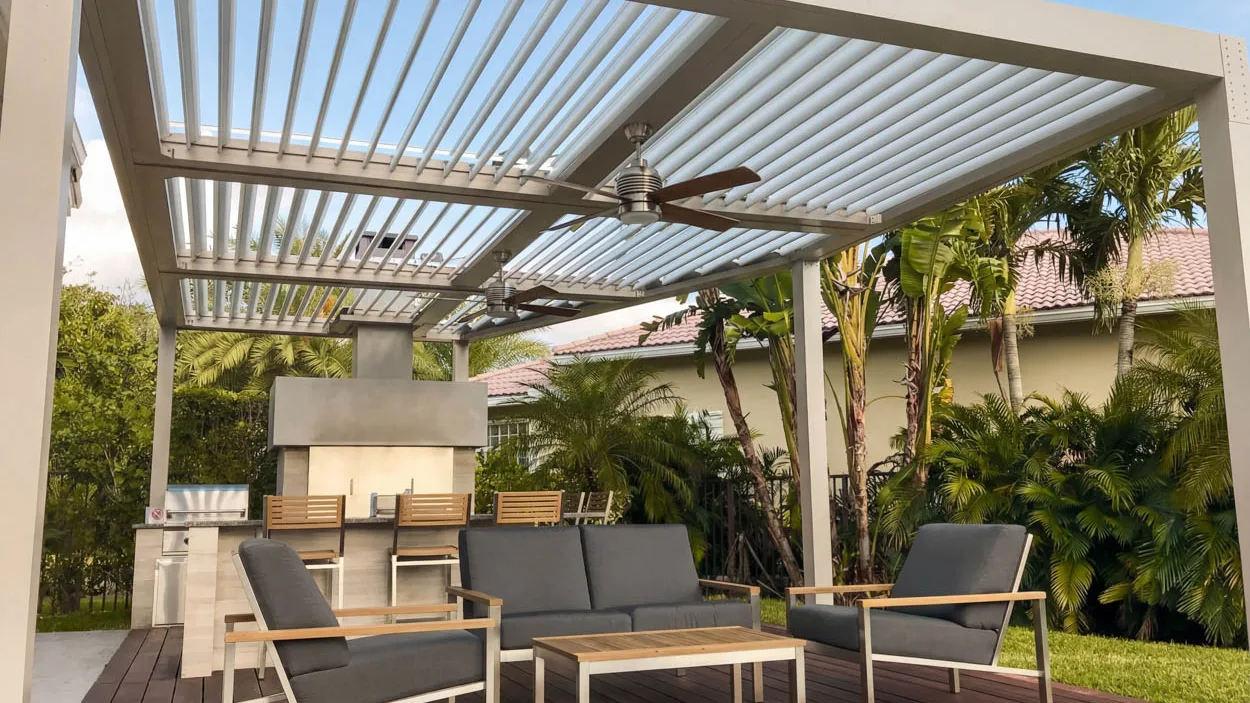
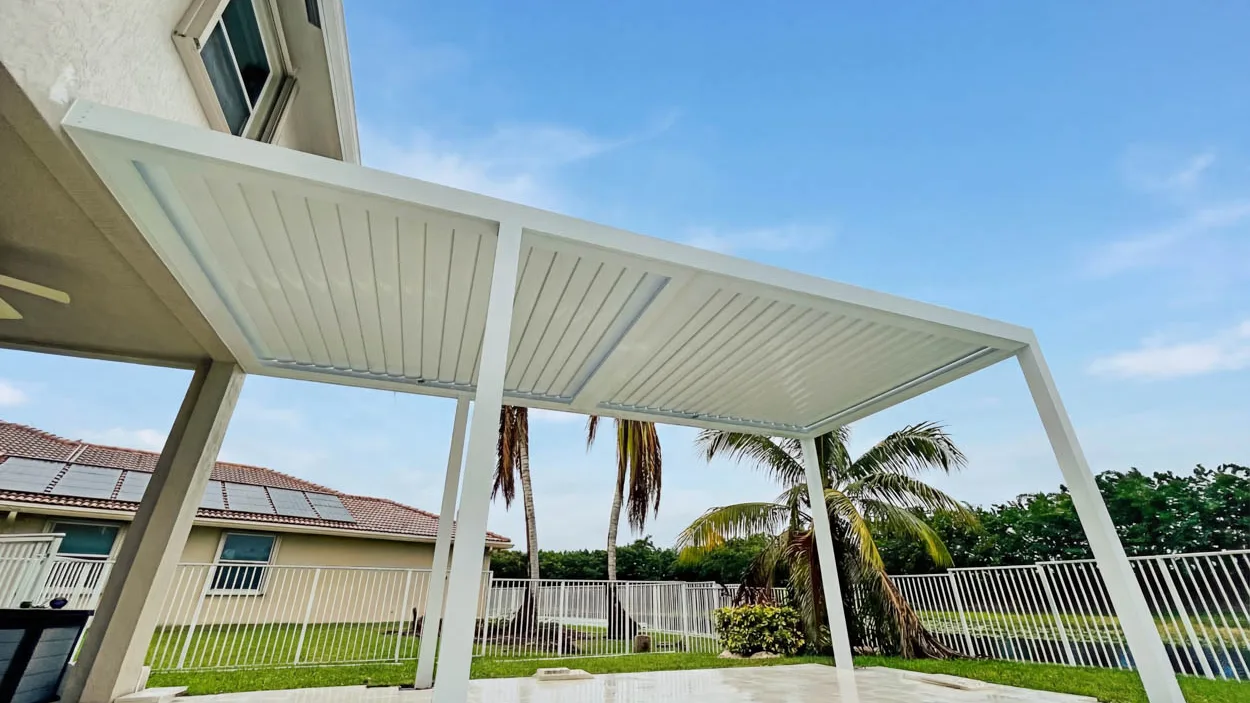
The aluminum and the powder coat will outlast the electronics. Motors, actuators, controllers, rain sensors and the seals between the blades are serviceable parts, and serviceable means that one day they need service.
That is not an argument against the system. It is an argument for asking three specific questions of whoever installs it, before rather than after:
The answer to the second question is what turns a failed actuator into a short inconvenience or a whole season without the roof you paid for, and it predicts your satisfaction in year six better than any feature on a brochure. The rest of the questions worth asking an installer go through the contract, the permit and the warranty in the same spirit.
One item specific to here: blade seals and the drainage channels in the beams have to be kept clear of leaf litter. Under live oaks that is not optional, and it is a short job a few times a year that somebody has to actually do.
If the list comes back mixed, the area beyond the line is real, and something with a plug is going under it, the motor earns its price and the remaining question is scope rather than principle — which is what the seven factors that move a louvered roof's price are about.
If the list comes back all rain, or the line sits past where you were planning to build, you have just saved yourself the most expensive kind of mistake in this category: the one that works exactly as advertised and still does not get used.
Our motorized louvered roof systems page shows how the structures are built and anchored, the gallery has finished ones in real North and South Florida backyards, and a project estimate starts with walking that shade line with you rather than with a number over the phone.
It is worth it when you need the same space to be different at different hours and different months: open in February, shaded in July, closed during a storm. If you only need the space to stay dry, a fixed solid or translucent cover does that for less and has nothing to service.
Treat it as something you buy to use, not as a return. Buyers price finished outdoor space differently depending on the house, the neighborhood and how the work was permitted, so nobody can promise you a number. If you are selling within a couple of years, that alone is a reason to think twice.
Over ground the house already covers. Many Florida homes have a lanai under the main roof, and a roof built tight against it often ends up shading a strip that was already shaded at five in the afternoon. The value is in the area beyond that line.
The aluminum structure and the finish outlast the moving parts. Motors, actuators, controllers and blade seals are serviceable items that eventually need service, so the question that predicts your experience is who services the system locally and how long replacement parts take to arrive.