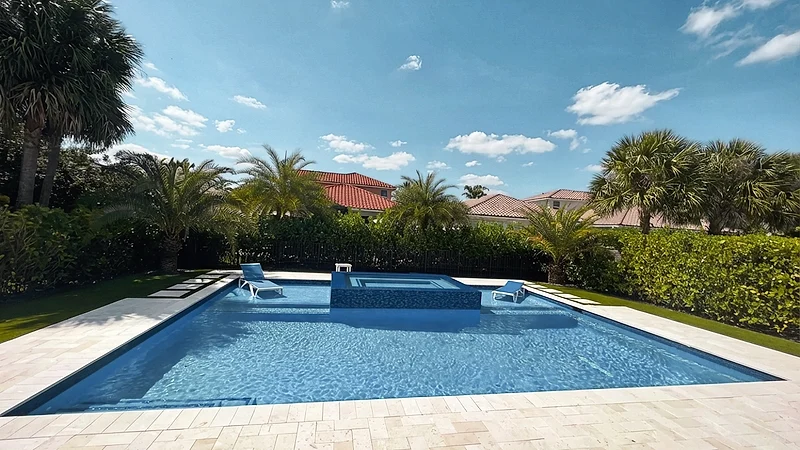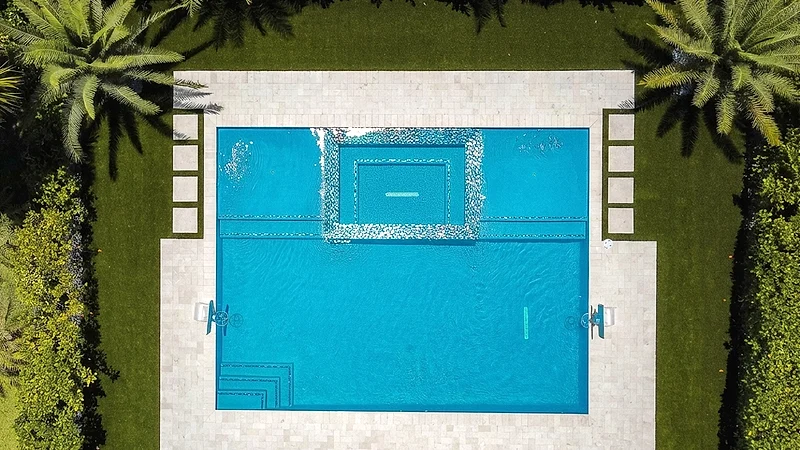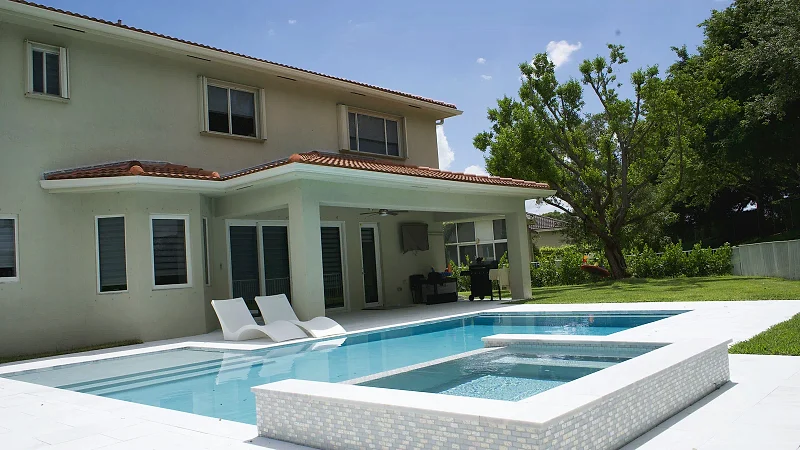
A spa adds $12,000 or $18,000 in our estimator. That is not the number the decision turns on — and unlike almost everything else in the yard, this one stops being available the day the shell is poured.
Build the spa with the pool or do not build it at all, and decide it on the bundle rather than the line item. Our estimator adds $12,000 for an integrated spa and $18,000 for a spillover spa. But a spa nobody heats is a bench with jets, and the same estimator prices a heater at $4,500. So the real fork is roughly $16,500 to $22,500 against nothing — and it closes the day the shell is poured.
Most people arrive at this deciding whether they like the look of a spa. That is a different question, and it is not the one that closes at the pour.
Build it now if someone in the house has a concrete reason to want hot water, if the pool is seen from the main living space and the yard has nothing else to look at, or if you are in North Florida, where the spa covers the months the pool does not.
Skip it if nobody in the house can name a reason to use it beyond "it would be nice", if the yard is tight enough that the spa takes footprint away from the pool, or if the same money does more for how often you actually go outside.
What does not exist is a cheap middle option. A pool-only build can leave the equipment pad and the electrical sized for a second body of water. It cannot leave the shell ready, and the shell is the expensive half.
The pool shell is formed and poured as one structure, and if there is a spa it is part of that structure. That single fact is what puts this decision before excavation instead of on a wish list.
Adding a spa to a finished pool means cutting into that shell, tying new steel into cured concrete, running new plumbing back to an equipment pad that was sized for one body of water, and lifting and relaying the deck around all of it. You are not buying a spa at that point. You are buying a demolition, a small construction project and a repair.
There is no line for it in our estimator, and that absence is honest rather than an oversight: it is not a catalog item. For a sense of scale, the estimator prices a complete pool remodel at 82% of what the same finished result costs as new construction. Having something there already saves less than most people assume.
So ask for two numbers, not one: what the spa costs now, and what it costs to size the equipment pad and the electrical service for a second body of water now. If the second number is small and the first is the problem, that is a real third option. A builder who tells you the shell itself cannot be left ready is being straight with you. Which rough-ins are worth buying up front and which can wait is a decision list of its own — see the upgrades worth planning before construction — and the stage each one lands in is in the pool construction timeline.
Both give you the same warm water. The difference is a wall.
| Integrated spa | Spillover spa | |
|---|---|---|
| Added in our estimator | $12,000 | $18,000 |
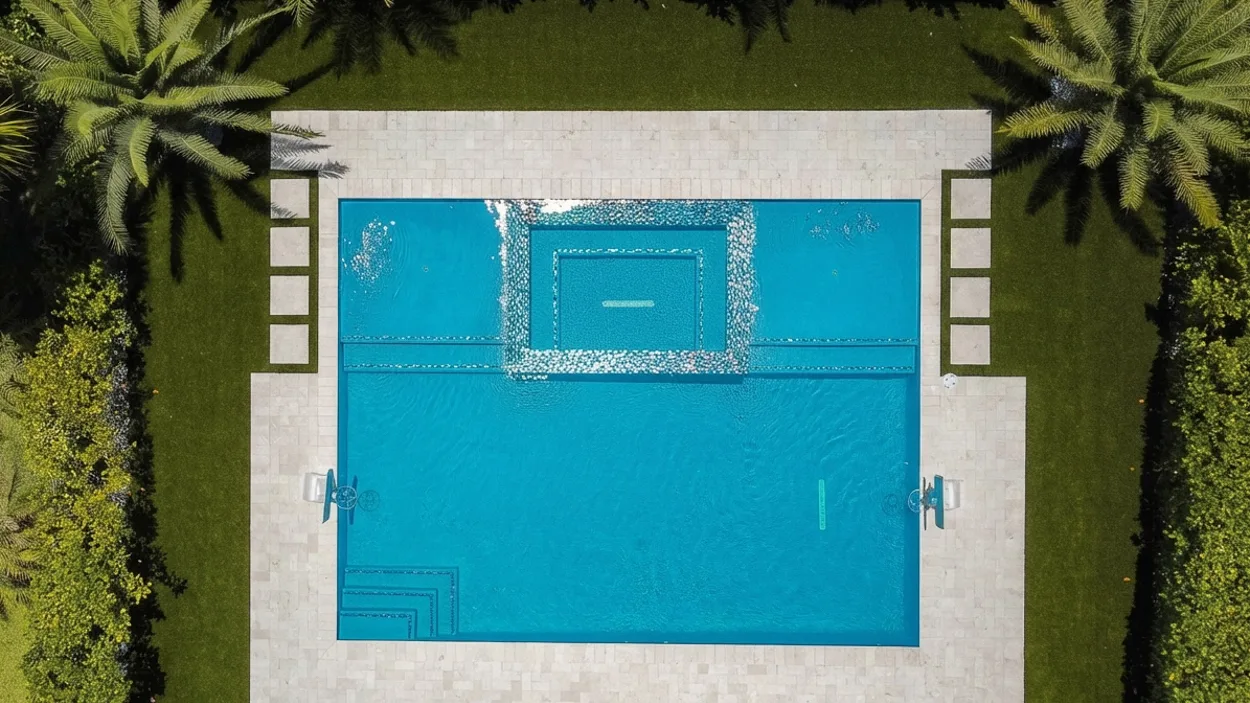
| Where it sits | flush with the pool, sharing a wall at deck level | raised above the waterline, water returning over a weir |
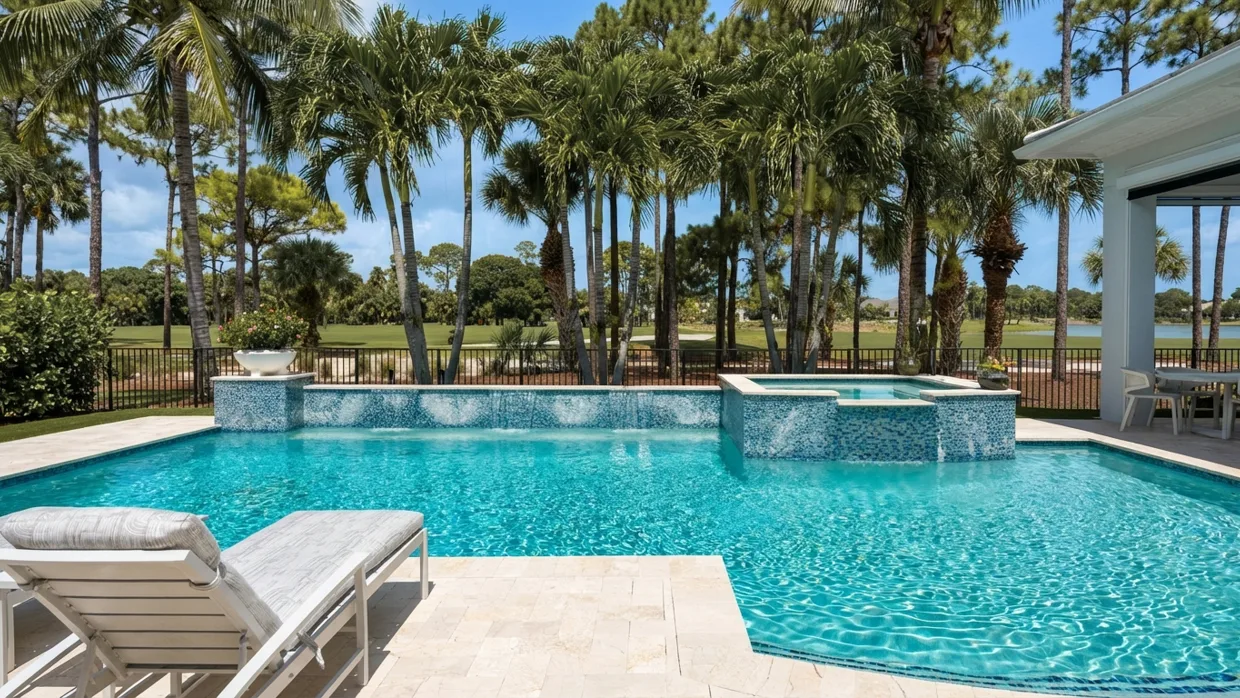
| What you see from the house | water, unbroken | a raised wall with a moving sheet of water on it |
| What you hear | no water sound of its own | falling water whenever the spillway runs |
| What it does to the deck | nothing beyond its own footprint | becomes an edge, a seat and a visual stop |
| The trade-off | nothing blocks the view of the pool | part of the view of the pool is now a wall |
That last row is the one people regret in both directions. Seated on the deck, your eye is close to the top of a raised spa wall, and what is behind it — the far end of the pool — stops being part of the view. Some homeowners find the backyard finally has something to look at; others find they paid to hide water.
So the useful way to spend the $6,000 question is this: if you want a spa because you want warm water, the integrated spa delivers exactly that for $6,000 less. If you want a spa because the view from the kitchen is currently a flat rectangle, you are buying a design element — and then the spillover should be judged against the other things that break up a flat pool, not against no spa at all. A raised bond beam with sheet falls or a planter wall gives the eye the same plane above the water; those are compared side by side in what makes a pool look custom.
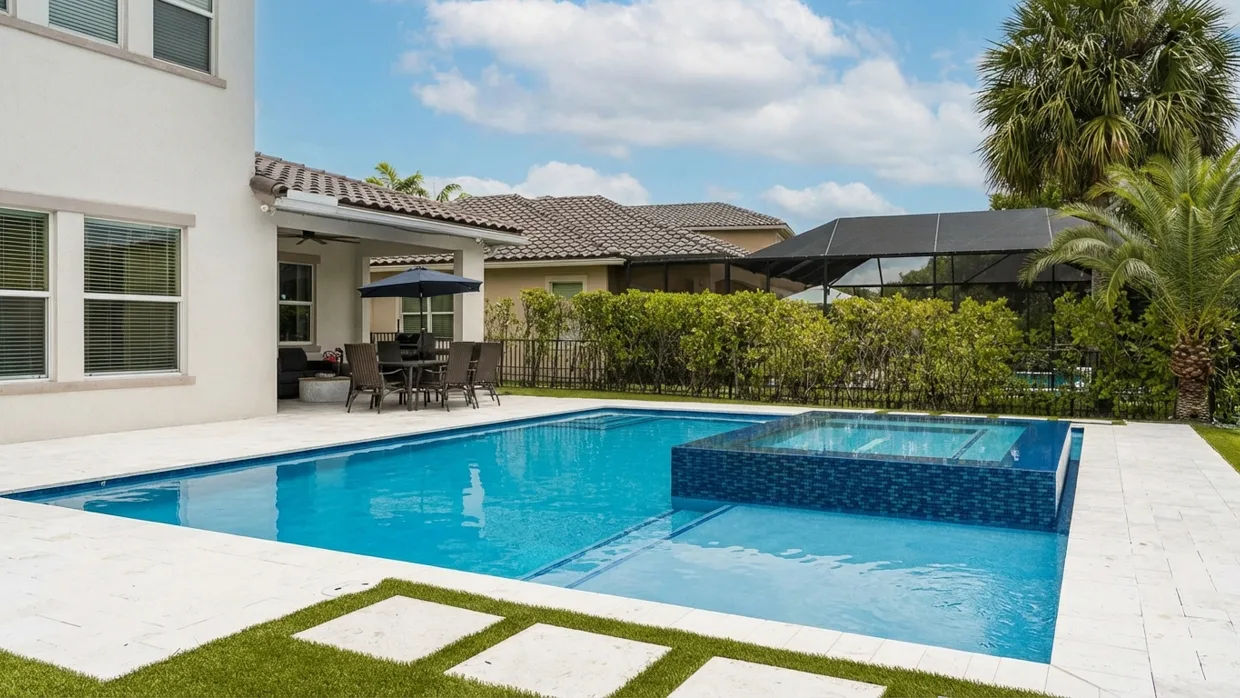
A spa is a small body of water and a pool is a large one. That asymmetry is the entire practical argument for a spa: it is the part of the backyard you can bring to temperature this evening. Moving a whole pool a few degrees is a different proposition in both time and fuel.
Which is why budgeting the spa without the heater produces a number that means nothing. Our estimator prices a heater at $4,500 as a single line. What that heater is sized to hold is worth asking about directly — a heater specified around a spa is not automatically one that will keep a whole pool comfortable on a January night in Gainesville or Ocala.
Two operating details that surprise people, and that are much easier to hear now than after the pour:
Automation belongs in the same decision. Our estimator prices it at $3,500, and a two-body system is where it earns that: switching to spa mode from a phone half an hour out is the difference between a spa that gets used and one that gets looked at.
This is the comparison that changes answers, and it is the one that rarely gets run. The spa is not competing with "no spa". It is competing with everything else the yard could have, out of the same budget. All of these are estimator figures:
| Instead of a spillover spa at $18,000 | Our estimator prices it at |
|---|---|
| A pool screen enclosure | $15,000 |
| An aluminum pergola plus landscaping | $8,500 + $8,000 |
| The full equipment package: heater, salt chlorination, automation and four LED lights | $4,500 + $2,200 + $3,500 + $1,800 |
| An outdoor kitchen | $25,000 |
Look at the third row. Heater, salt system, automation and four lights come to $12,000 — the whole equipment specification for a pool you will swim in year round, for a third less than the spillover spa alone.
None of this makes the spa the wrong answer. It makes the spa one of four or five things, rather than an upgrade you either take or leave. And it is the only one on that list whose window closes at the pour — although the screen enclosure has its own timing rule, because the deck has to be built to carry it whether or not it goes up on day one. That, and the eleven other decisions in the same bracket, are in the twelve decisions to make before excavation.
Not "do we want a spa". This one: how many evenings a year will someone in this house sit in hot water?
Ask it out loud, with the people who live there. The honest answer is usually smaller than the one in your head, and it is the number the rest of the decision runs on.
Geography moves that number more than anything else. North Florida gets a real winter, and in Gainesville and Ocala the weeks when the pool is too cold to enjoy are the weeks a spa gets used. That is a spa doing a job. Further south the job is different: jets, a smaller space for two people, a focal point from the house in the evening. All real, all worth paying for if that is what you want — but they are not the same argument, and a spa bought on the North Florida argument in a South Florida yard tends to become a heated planter.
If the honest count comes back at a handful of nights, the money usually belongs in whatever makes you use the pool more often: shade, screening, or somewhere to cook and sit.
Permitting. The spa is designed, reviewed and inspected as part of the pool rather than as its own project, which is why our estimator calculates permit cost as 9% of the pool and deck rather than adding a separate line for the spa. Whoever builds it should permit it under their own license and be present for the inspections.
The schedule, materially. A spa does not add a stage. It makes the existing ones slightly bigger, because it is excavated, formed, poured, tiled and finished along with the pool. The part that does affect your schedule is the equipment and automation, which arrive late and are a common place a project waits.
The rest of the design. Finish, deck material and deck size are priced independently, and all three are covered decision by decision in what a custom pool really costs.
Settle three things before your design is final: spa or no spa, integrated or spillover if yes, and how it is heated and jetted. That is the whole decision, and it wants to be made once, on paper, before anyone ties steel.
Then run it twice through our pool cost estimator — once with the spa, once without — and look at what the spa does to the total rather than at the line by itself. What comes out is a ±10% range, not a quote, and it is meant to tell you which decision is moving your number.
Bring both versions to the site visit. A project estimate starts by reviewing access, grade and utilities rather than by quoting a number, and seeing the two scopes side by side is the fastest way to find out which one you actually want. How the process runs from there is on the custom pool and spa construction page, and there are finished pools and spas in the gallery.
Physically yes, but it is not an upgrade, it is demolition plus new construction. The spa shares structure with the pool, so adding one means cutting into a finished shell, tying new steel into old, and running new plumbing back to an equipment pad that was sized for one body of water. There is no line for it in our estimator because it is priced per site, not from a catalog.
An integrated spa sits flush with the pool and shares a wall with it. A spillover spa is raised above the waterline and returns water over a weir. Our estimator adds $12,000 for the first and $18,000 for the second. The water is the same temperature either way; the extra buys a raised structure, the falling water and the sound.
If the reason you want a spa is warm water, then yes, and the two should be budgeted as one decision rather than two. Our estimator prices a heater at $4,500. What that heater is sized to hold is worth asking about directly, because a heater chosen around a spa is not automatically one that will keep a whole pool comfortable in January.
No. A spillover spa shares water with the pool and is isolated by valves only while it heats. When the system returns to pool mode that heated water goes into the pool, so the spa is not warm tomorrow because it was warm tonight. Nothing is wasted, but nothing is stored either.
It depends on why you would use it. North Florida has a real winter, and there the spa covers the months the pool does not. Further south the case is usually jets, a smaller space for two people, and something to look at from inside the house. Those are legitimate reasons — they are just different ones, and they are worth naming before you spend on them.