Eight decisions account for most of the difference between one Florida pool quote and another. Here is what each one adds or removes, and which ones are worth spending on.
Most pool pages answer this question with a range so wide it helps nobody. The honest answer is that size, style and finish are not the whole story, and the decisions people treat as details are often the ones that move the number most.
This guide walks the eight decisions that account for most of the gap between one Florida pool and another, with what each one adds or removes. The figures come from our own pool cost estimator, which prices a project the same way we do.
A custom pool of about 450 square feet with a paver deck, a pebble interior, a heater, a salt system and landscaping lands around $83,000 – $102,000 in Florida.
That is a starting point, not a quote. Change one decision and the number moves:
The rest of this guide is the eight decisions, in the order they usually get made.
Size is priced per square foot of water surface, so it compounds with every other choice you make. A larger pool needs a larger deck, more finish, more water to heat and more chemistry to balance.
From the same starting point, dropping to a 250-square-foot pool takes about $27,600 off. Going to 900 square feet adds about $62,000.
This is worth deciding early for a reason that has nothing to do with money: the pool has to leave room for everything else you want in the yard. A pool sized to the maximum the setbacks allow can leave no space for the covered seating or the kitchen you also wanted.
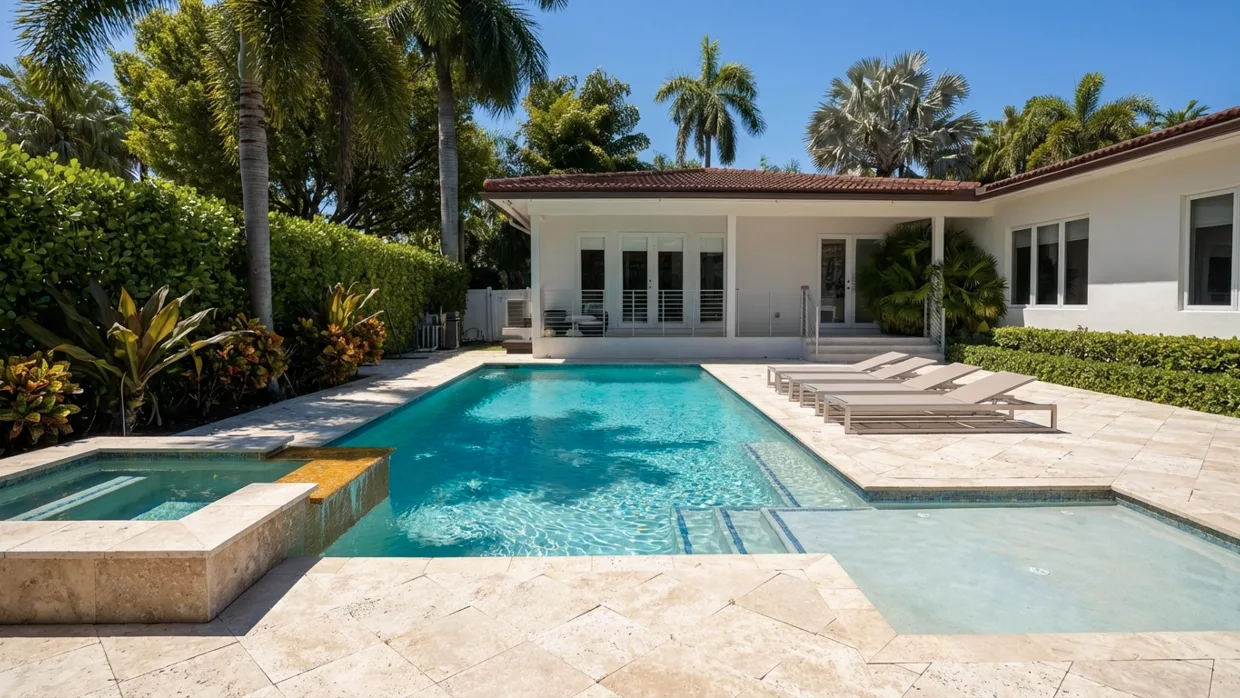
Style sounds cosmetic. It is not — it changes how the shell is built.
From the same starting point, standard geometry saves about $14,100 against freeform. Luxury adds about $19,700.
The interior finish is the surface you touch and the one that determines how the pool looks in year eight.
Against a pebble baseline, plaster saves about $8,100 and a premium finish adds about $10,800.
Of the eight decisions, this is the one most often downgraded to protect the budget and most often regretted, because it is also the one that is expensive to change later. Replacing an interior finish means draining the pool and removing the old surface.
The deck is usually larger than the pool, so its material is a bigger line than people expect.
| Material | Relative cost | What you notice |
|---|---|---|
| Concrete | Lowest | Cheapest to install, gets hottest, shows cracks |
| Pavers | Middle | Individually replaceable, wide range of looks |
| Travertine | Highest | Stays coolest underfoot, most expensive to repair |
From the same starting point, concrete saves about $6,500 and travertine adds about $8,500.
In Florida the surface temperature question is not a detail. A deck that is uncomfortable barefoot in August is a deck that gets used less.
Deck square footage is the decision most often left to the end, and it carries real money: going from a 200-square-foot deck to 1,500 is a swing of about $31,000.
It is also the decision that determines whether the yard works. A pool with a deck too narrow on the long side has nowhere to put a lounger without blocking the path around the water.
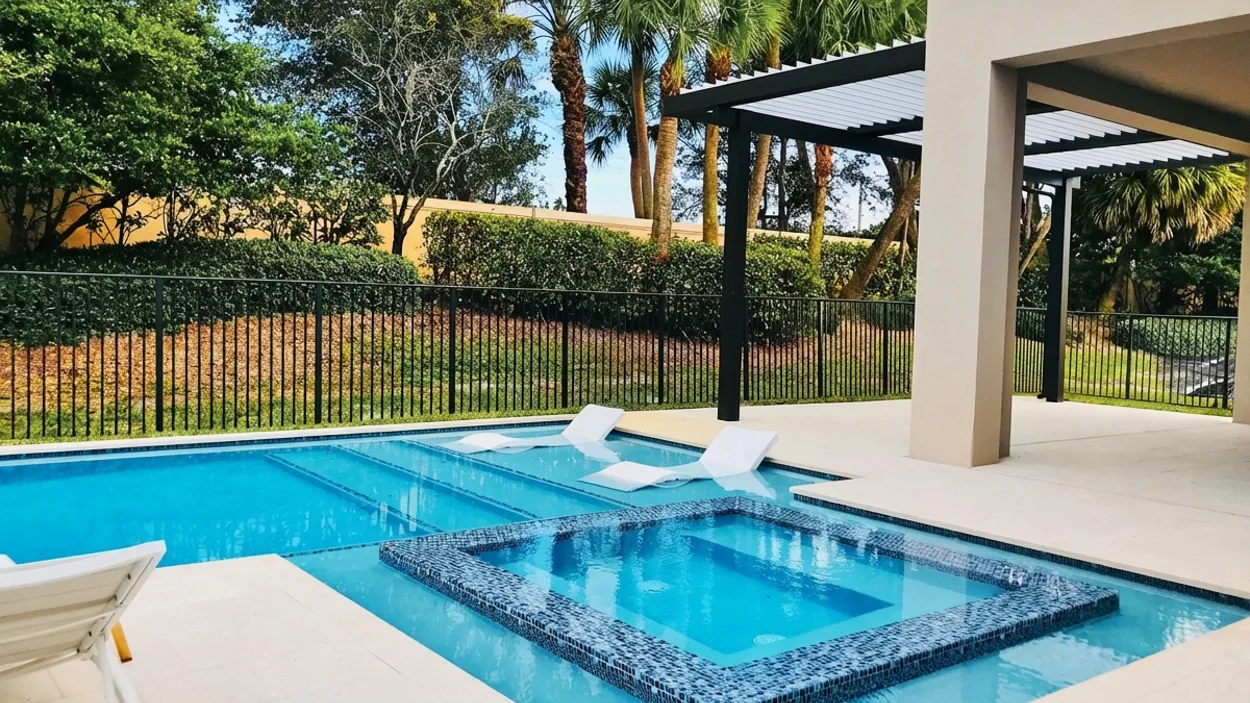
There are three answers, and the middle one is where most projects land.
A spa has to be decided before the shell is built. Adding one afterwards means cutting into a finished structure, which is why it is on this list rather than in the upgrades article.
The largest single additions to a pool project are usually not the pool.
| Addition | Adds |
|---|---|
| Aluminum pergola | about $8,500 |
| Screen enclosure | about $15,000 |
| Motorized louvered roof | about $18,000 |
| Outdoor kitchen | about $25,000 |
Every one of these is cheaper built alongside the pool than added later, because the crews, the access and the slab work are already on site. If an outdoor kitchen or a screen enclosure is on your list for "someday", the cheapest someday is now.
These are the decisions your property makes for you.
Together these can move a project by more than $18,000, and none of them are visible in a photograph of the backyard. They are the main reason an online number and a site visit disagree.
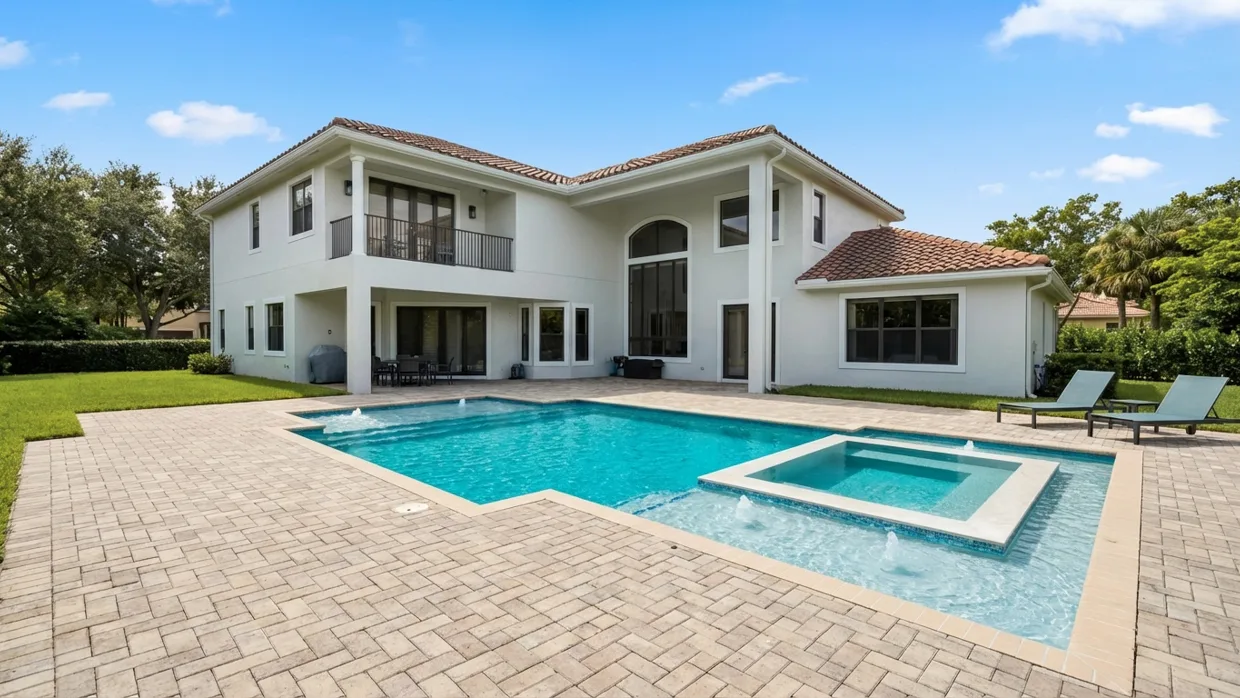
Permitting and engineering are already in the figures above, calculated against the pool and deck scope rather than as a flat fee — the drawings and reviews a project needs scale with what is being built.
What is not included: anything your county or HOA charges you directly, and anything nobody can see until the ground is open. Utility routing, an unexpected water table and a failed soil condition are all discovered, not estimated.
If you already have a pool, the same finished result costs meaningfully less — roughly $17,000 less on the project above — because the excavation, the shell and much of the plumbing already exist.
That saving is real, but it is conditional. It assumes the existing shell is sound. If it is not, the comparison changes, and that is a decision worth making before you commit: new pool construction vs pool remodeling covers how to tell.
Work through the eight decisions in order and write down what you actually want before anyone quotes you. Then run the same set through the pool cost estimator and see which decision is moving your number most.
If the answer surprises you, that is the useful part. Most people find one decision they were treating as fixed is worth more to them than two they were arguing about.
When you have a scope you believe in, a site visit is what turns it into a price. Ours reviews access, grade and utilities before anyone quotes a number — see custom pool and spa construction for how the process runs.
Yes. Permitting and engineering are calculated as a percentage of the pool and deck scope rather than a flat fee, because the drawings and reviews a project needs scale with what is being built. What it does not include is anything your county or HOA charges you directly, or work triggered by a condition nobody can see until excavation starts.
Because size is only one of eight decisions. Two 450-square-foot pools can differ by more than the price of a car once style, interior finish, deck material, deck size and spa are settled. The estimator exists to show which of those decisions is moving your number.
For the same finished result, yes, because the shell, the excavation and much of the plumbing already exist. The saving is proportional rather than fixed, and it disappears if the existing shell has structural problems that only surface once the old surface comes off.
When the site has not been looked at. Access, grade, water table, soil and utility routing are all things that change scope and none of them can be judged from a satellite image. An estimate is a planning tool for comparing decisions; a site visit is what turns it into a price.