The choices that make a pool look custom are mostly early, mostly cheap, and mostly decided on the layout drawing. The ones that cost the most show the least. Here are the nine, in the order they get locked.
A pool reads as custom when its geometry agrees with the house behind it. Not when it has more features. Four choices carry most of that read — where the pool sits relative to the house's lines, how much deck surrounds it and on which side, whether anything rises above the waterline, and whether coping, waterline tile and deck were chosen as one decision — and all four are settled on the layout drawing, before anybody prices a finish.
That is the useful part. The choices that do the most cost the least, and the ones that dominate a quote show the least when the geometry underneath them is ordinary. A long feature list on a badly placed pool still looks like a catalog pool.
Here are the nine, roughly in the order they get locked.
Everything after those is refinement.
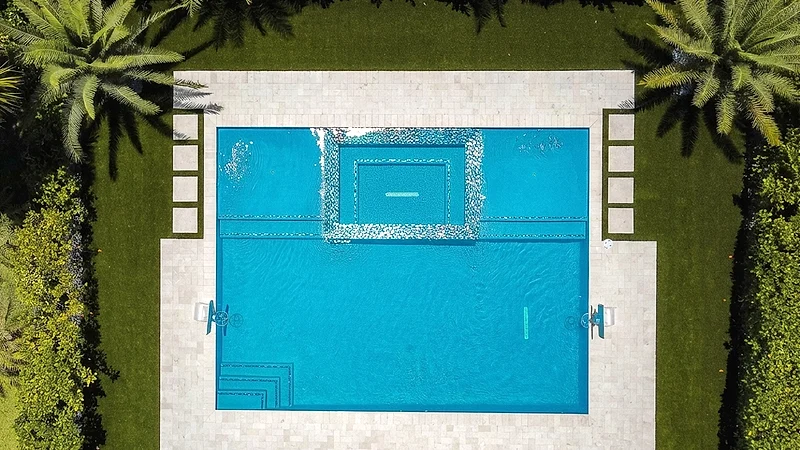
The common default is to center the pool on the yard. The better default is to align it to something the house already has: the opening of the main slider, a column line on the lanai, the outside face of the rear wall.
There is a quick test for this on the drawing. Lay a straightedge along each jamb of the main slider and run those two lines out into the yard. The pool's near edge should either land on one of them or clear them by a wide, obvious margin. What you do not want is a miss of a foot or two — that is the condition that reads as accidental from inside the house, and it is the one nobody notices on paper.
A pool centered on the lot but aligned to nothing on the house reads as dropped in, and the giveaway is usually a wedge of deck on one side that nobody uses and nobody can explain. A pool that shares a centerline or an edge with the architecture looks designed even when it is a plain rectangle.
This costs nothing to get right on paper, and it is the most expensive item on this list to change once the layout has gone to the county. The twelve decisions worth settling before excavation covers what else locks at that same moment.
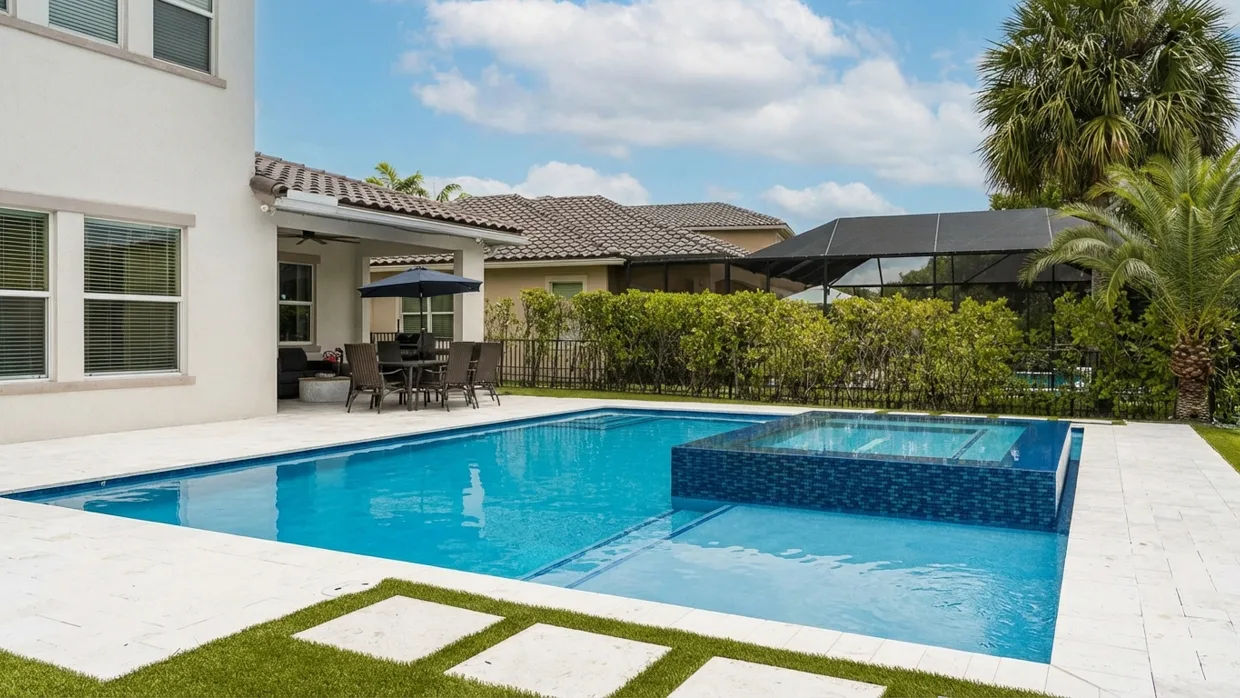
Deck is where budgets get trimmed first, and it is the main thing separating a custom-looking pool from a stock one.
The mistake is uniform width: the same three or four feet all the way around. Real use is never uniform. The house side carries furniture and traffic and wants depth. The far side often only needs walking room. One side frequently wants none at all — lawn or planting running straight to the coping is a deliberate move, not a saving.
It is worth pricing that extra depth against the feature it would be traded for, because the comparison usually surprises people. Our estimator prices paver decking at $22 per square foot and travertine at $35. Widening one 30-foot side by three feet is 90 square feet: roughly $2,000 in pavers, $3,150 in travertine. That is less than most water features, and it changes the proportion of the entire yard rather than one corner of it. What deck size and material do to the total is in the decisions that move a Florida pool's price.
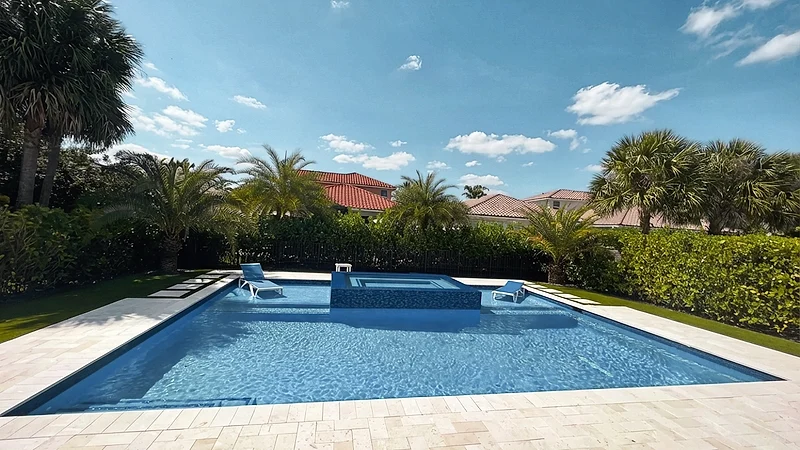
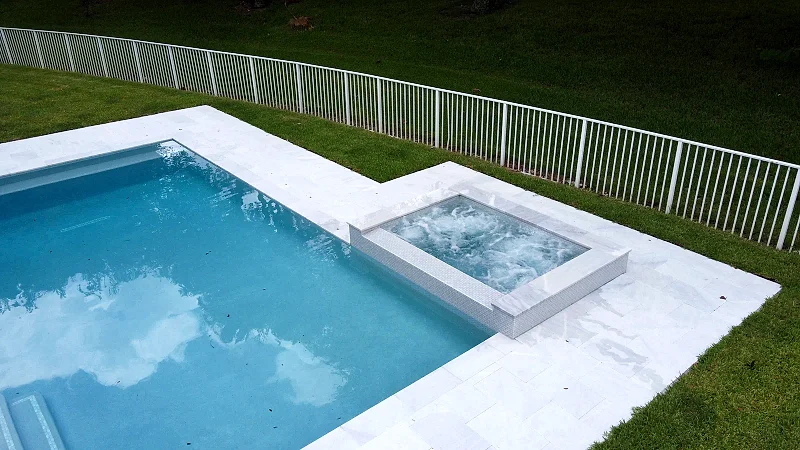
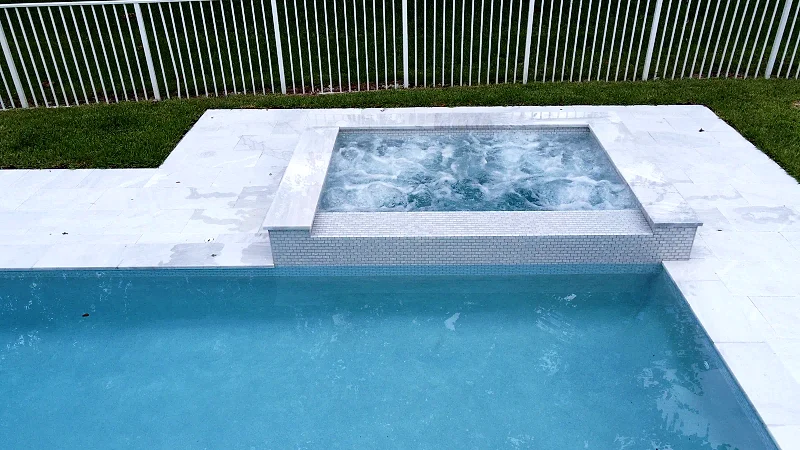
A pool that is entirely flat reads flat, however good the outline is. One vertical element — a raised spa, a raised bond beam with sheet falls, a planter wall at the far end — gives the eye a plane above the water. That plane is the only surface on the whole project that gets seen dry, at eye level and lit after dark, and it gives the pool a back, so the view from the house stops at something instead of running out.
Which element to build is a question about where people sit, not about the feature list. From a seat in the lanai a raised wall lands near eye level and closes off the far end of the water. That is a focal point if you wanted one and a wall if you did not. Walk to the chair you will actually use and look at that height before the wall is drawn.
One is usually enough. Two competing raised elements on a suburban lot start to read as a display rather than a yard.
Whatever you choose is structural: it is formed with the shell and poured once. The prices for each kind are in what a custom pool really costs.
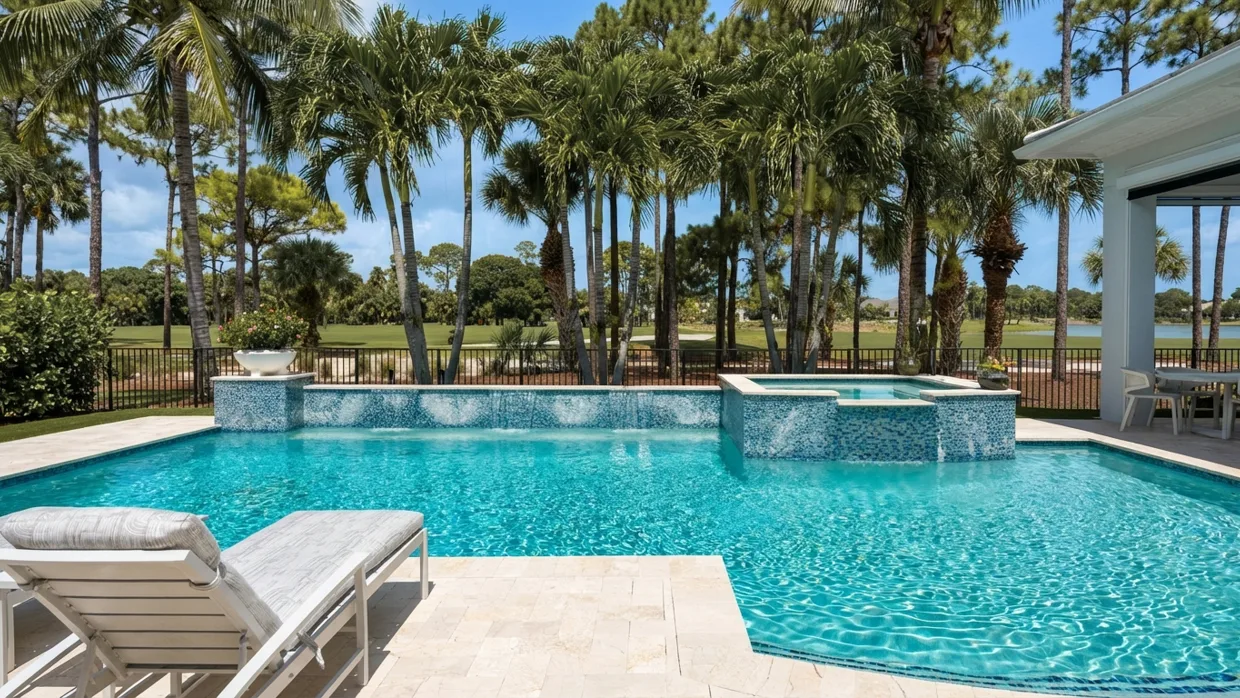
These three materials touch each other, and they are usually chosen at three different times, from three different sample sets, under showroom lighting.
Choose them together, outdoors, at something close to the real size. A warm travertine coping against a cool grey deck looks fine on a sample board and wrong in Florida sun, and it is a common miss on otherwise good pools.
Waterline tile deserves its own look. It is seen wet, dry, and almost always at a low angle rather than from above. A tile picked flat on a counter often turns out much darker or much glossier once it is a vertical band at the water.
Coping profile is a small decision with an outsized effect on the silhouette. A square-edged, narrow coping makes a pool look contemporary. A heavy rolled bullnose makes the same pool look dated, and it is the single detail most likely to give away a pool's decade.
What the deck meets matters as much as the coping itself. Concrete meeting turf in one clean straight line reads as intentional. Concrete dying into mulch reads as unfinished, and no amount of tile fixes it.
The finish is priced as a multiplier on the shell rather than as a flat line, so it scales with the size of the pool. The multipliers are in what a custom pool really costs.
What that money changes is the color of the water and the feel underfoot. It does not change the shape. On a well-proportioned pool it is one of the best upgrades available. On a generic one it is a more expensive generic, which is why it sits at number six on this list rather than near the top.
Where it always earns its cost is where the finish is seen dry and close: sun shelves, steps, benches, the top of a spa wall. Those surfaces get inspected at arm's length by everyone who uses the pool. The floor of the deep end does not.
A sun shelf is not an item to add to a list. It is a piece of the plan with a direction, and the direction is the part that gets skipped. It should face where people want to sit in late afternoon, which in most Florida yards is not where the first drawing puts it. A shelf on the wrong side is in full sun at four o'clock and empty by five.
Entry steps work the same way. Steps on the house side are convenient, and they also put the busiest, most visually cluttered part of the pool — handrail, step markers, the change in water color — right in the primary view from the slider. Moving them to a corner is free at layout and impossible afterward.
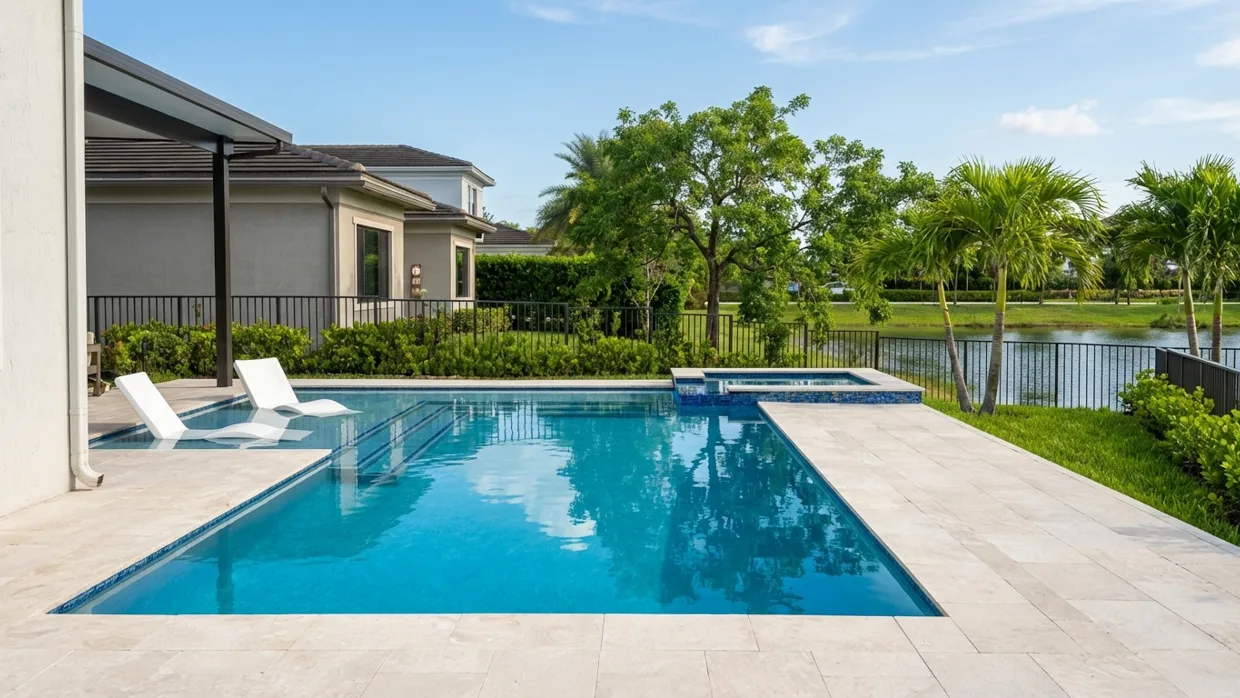
Two details give a pool away faster than anything on the finish schedule: where the equipment pad sits, and where the returns, skimmer and cleaner line come out.
Walk the sightline from the main slider before the plan is final. Unless someone decides otherwise at layout, the pad and the line routing get placed for plumbing convenience — which is a reasonable default and rarely the same as the view you will look at every day.
Skimmer placement is worth one more minute. Put skimmers where the prevailing wind pushes debris, not where the pipe run is shortest, or you will be netting the same corner for the life of the pool.
The pool is on view from the house every evening, and the night version is the one guests see.
Lighting the water gives you a glowing rectangle in a black yard. Lighting the vertical surfaces gives you depth. Two fixtures aimed to graze a tiled spa wall do more for the view from the slider than six spread evenly around the shell, because the eye reads the lit wall as a back plane and the darkness behind it as distance. The same applies outside the pool: the trunks of the palms behind it, a planting bed, the face of a garden wall.
That makes it a conduit decision more than a fixture decision, and conduit is only cheap while the ground is open and the shell has not been shot. It is on the pre-excavation list for that reason.
| Choice | Fixed at | What changing it costs later |
|---|---|---|
| Position and alignment | Layout and permit set | Resubmission; after excavation, effectively a rebuild |
| Deck width and shape | Layout | Re-pour or add-on, and the seam usually shows |
| Raised spa or raised wall | Structural plan | Structural work, not a change order |
| Equipment pad and line routing | Plumbing rough-in | Trenching through finished deck |
| Lighting positions | Before the shell is shot | Deck demolition, or a surface-mounted compromise |
| Coping and waterline tile | Before the finish stage | Material and labor only |
| Interior finish | Finish stage | Material and labor; later, drain and resurface |
Read that table top to bottom: the choices that move the custom read the most are the ones that lock the earliest and cost the most to undo, and they are the cheapest to get right while the drawing is still a drawing.
If you want the same budget working harder, the decisions that actually move a Florida pool's price lays out the trade-offs line by line, and ten luxury pool designs for Florida homes shows what these choices look like once they are finished.
If you are at the drawing stage rather than the shopping stage, the useful order is: place the pool against the house, then decide the deck, then decide what rises above the water. Everything else can be priced later without moving anything.
Our gallery of built pools is the fastest way to work out which of these choices you actually respond to. The pool cost estimator shows what each one does to the number, within about 10%. How we run the design stage — site review, layout against the house, then materials — is on the custom pool and spa construction page, and if you would rather start with the yard than with a number, a project estimate begins with a site visit.
No. A plain rectangle that lines up with the house, has deck where deck is actually used, and carries one element above the waterline will read as custom. A curved shape that follows nothing in the yard usually reads as dated instead, and it costs more per square foot to build.
Deck proportion, by a wide margin. Widening the side people actually use, and taking deck away from the side nobody walks on, changes how the whole yard reads and costs a fraction of a water feature. It is also decided on the drawing, where it is still free to move.
Not as a change order. Anything that rises above the waterline is structural and is designed into the shell, so adding one later means cutting and rebuilding rather than attaching. It is one of the few items on the list that genuinely has to be decided before the steel goes in.
It changes the color of the water and the feel underfoot, not the shape. On a well-proportioned pool it is one of the better upgrades available; on a generic one it buys a more expensive version of generic. Where it always earns its cost is on the surfaces seen dry and close up, like shelves, steps and the top of a spa wall.