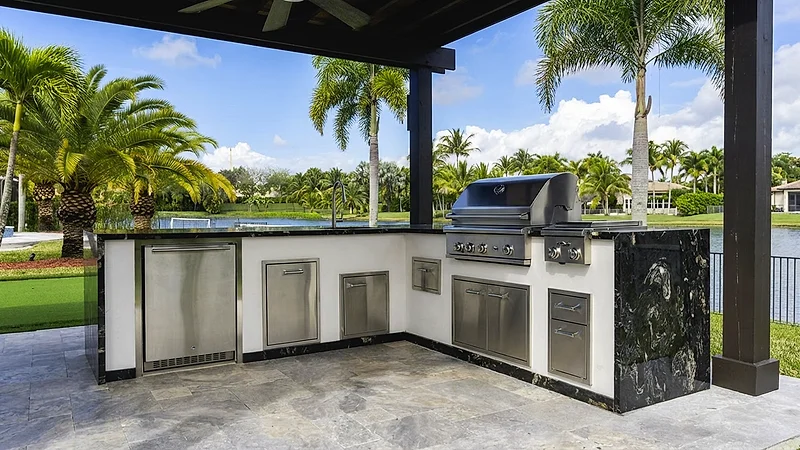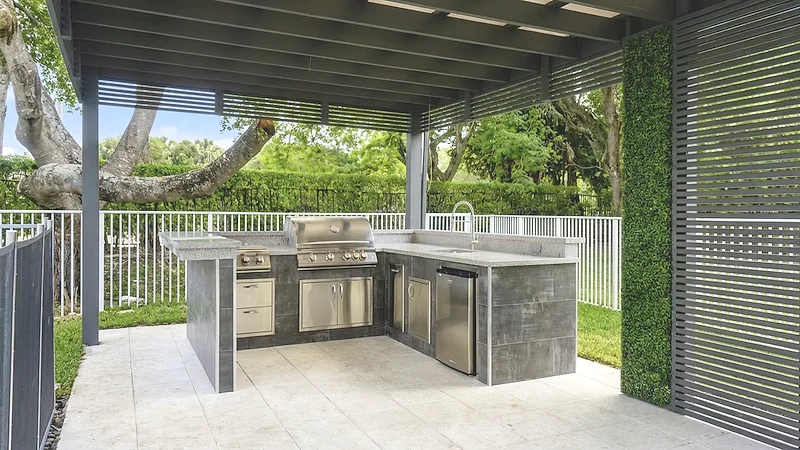
Appliances are not what you add at the end of an outdoor kitchen. They are the cutout dimensions, the gas line size and the number of circuits. These are the nine decisions that come before any model number, in the order they have to be made.
Choose the appliances before the island is designed, not after. In an outdoor kitchen the appliances are not something you drop in at the end — they are the dimensions of the block, the diameter of the gas line, the number of electrical circuits and whether the structure needs a vent hood. Decide them last and you are not choosing appliances; you are choosing whatever happens to fit the holes somebody already built.
That is the whole argument, and it reverses the order most people shop in. What follows are the nine decisions that come before any model number, in the sequence they have to be made. Each one eliminates options, which is the point: by the time you are comparing brands there should be three or four candidates left, not thirty.
| Decision | What it fixes in the construction | What reversing it costs later |
|---|---|---|
| Fuel | Trench route, meter tie-in or tank location | A new trench across a finished deck |
| Total burner demand | Gas line diameter | Re-running the line, not just the last few feet |
| Circuits | Conduit, GFCI protection, panel capacity | Opening the island face, or surface conduit you look at forever |
| Covered or open | Hood, clearances, roof framing | A structural change, not an appliance swap |
| Sink and ice maker | Water supply and drain route | Cutting the slab |
| Cutout sizes | Block openings and the countertop template | A new countertop |
Read that table as the reason for the order below. Every row is cheap while the kitchen is a drawing and expensive once it is masonry.
The first question is not which grill. It is which fuel, and the answer is usually decided by what already exists at the house rather than by preference.
Natural gas needs a line run from the meter to the island, which is a trench and a tie-in. Propane needs a tank, a location for it that is screened, accessible for exchange or fill, and far enough from the cooking appliances to satisfy the inspector. It also needs someone to notice when it runs out, which is always mid-cook.
Settle this first because it removes half the shortlist immediately. Many appliances are sold for one fuel with a conversion kit available for the other, some are sold for one fuel only, and "convertible" on a spec sheet sometimes means the factory sells a kit rather than that a technician can convert the unit in your backyard. Ask about the specific model, not the brand. The utilities that have to be run before construction covers what each choice means for the trench.
Homeowners size the gas line for the grill. It has to be sized for everything that can be on at the same time: grill, side burner, power burner, a griddle, a warming drawer, and anything you might add in two years.
The failure here is quiet and permanent. Nothing breaks. The grill simply takes longer to reach temperature, and longer still when somebody is boiling a pot on the side burner. Owners usually blame the grill, and the grill is fine.
Add up the demand for the full set, including the appliance you have not bought yet, and have the line sized for that total. Adding a second cooking appliance later is the moment people discover the line was sized for exactly what was there on day one.
An outdoor kitchen is rarely one circuit. Refrigeration wants its own, because a shared circuit means the fridge trips on a Friday when someone plugs in a pressure washer and you find out on Sunday. Countertop outlets are another. Lighting, a hood and a television, if there is one, are another again.
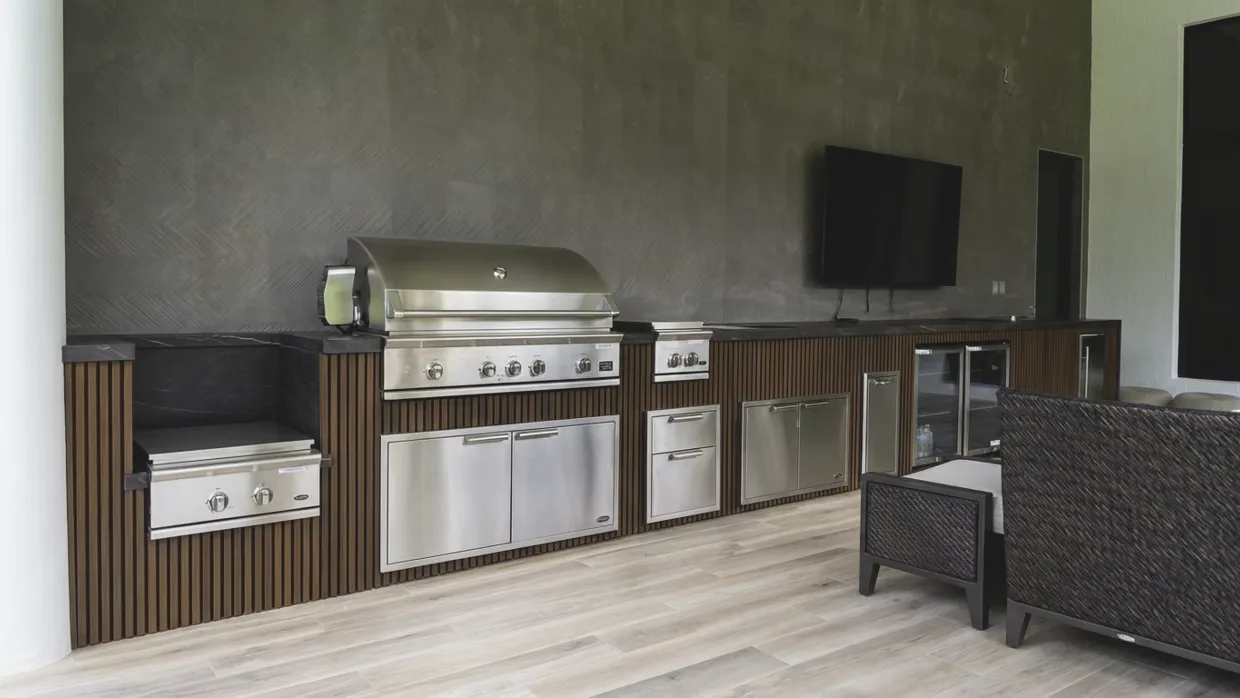
The constraint people hit is not the island — it is the house panel. If there is no spare capacity, the project includes a sub-panel, and a sub-panel is a cost and a lead time, not a detail to sort out later. Find out early enough that it is a line in the estimate instead of a change order.
Everything in this section has to be in conduit before anything is poured. Retrofitting a circuit into a finished island means either opening its face or running surface conduit down a wall you will be looking at for as long as you own the house.
Whether to roof the kitchen is a bigger decision than appliances, and it is its own trade-off in Florida. But it has to be answered before the appliances, because it decides whether there is a vent hood.
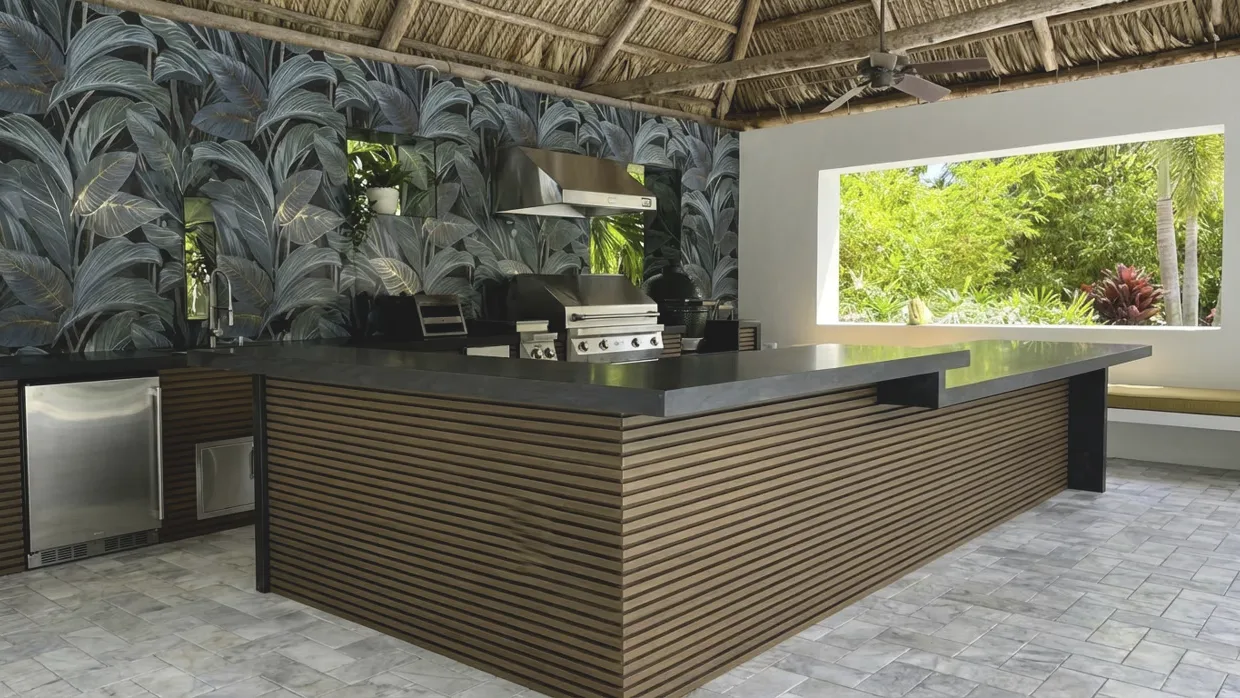
A grill under open sky does not need one. A grill under a solid roof or inside a lanai generally does, and the hood is sized to the grill's width and heat output. It needs clearance above it and a duct path to the outside, and both of those are framing decisions. A hood chosen after the roof is built is a hood that turns out to be too small, mounted too high, or ducted through the only beam that could not be cut.
If the ceiling above the grill is wood, the clearance is not a preference. It is a dimension the inspector measures.
Three usually go on the wish list. The number that matters is how many get used.
The honest version of this decision starts with a count: in the last twelve months, how many times did you cook outdoors, and what did you cook? A pizza oven is a Saturday appliance and a genuinely good one for people who entertain. A side burner is a Tuesday appliance. A kamado is a different cooking method, not a second grill, and it gets used by people who already own one.
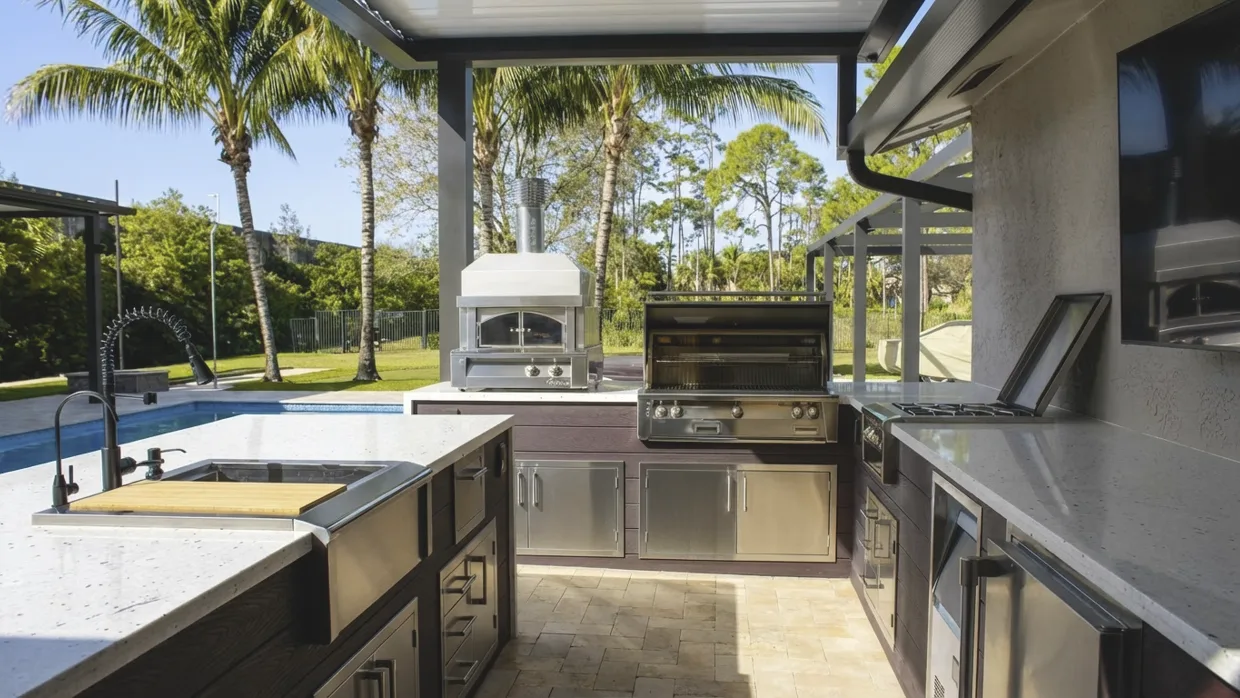
Each appliance you add takes counter length you will want for landing space — the flat run beside the grill where the tray goes down. Outdoor kitchens are far more often ruined by having nowhere to put a hot sheet pan than by lacking a burner. Laying the kitchen out around the way you actually cook is where that gets resolved; the decision to make here is simply which appliances get to compete for the space.
Refrigerator, beverage center, ice maker, kegerator. They are four different decisions that people make as one.
Two things separate them. First, an outdoor-rated refrigerator is a different appliance from an indoor one: sealed against humidity and specified to hold temperature in heat an indoor unit never sees. An indoor undercounter unit installed outside runs continuously, fails early, and the warranty will not cover it — that is not a technicality, it is the first thing the manufacturer asks about.
Second, the ice maker is the one that changes the plumbing. It needs a water supply and it needs a drain, and the drain has to go somewhere that was decided before the slab. Wanting ice after the concrete is poured is an expensive want.
A sink is the appliance decision that becomes a permit question.
The supply side is straightforward. The drain is the part that varies by county: whether a residential outdoor kitchen sink can discharge to a dry well or has to be tied into the sanitary line is a question your county's plumbing reviewer answers, and the answer is not the same everywhere in Florida. Ask your contractor what your county requires. If the answer is vague, the right time to find out is before the slab, not when an inspector is standing on it.
Worth saying plainly: a lot of outdoor kitchens are better without one. If the back door is fifteen feet away and nobody is washing dishes outside, a sink is a drain, a trench and a permit line in exchange for a place to rinse hands.
This is the decision that ruins islands, and it is the least glamorous one here.
A "30-inch grill" is a category. The cutout is a number on that specific model's spec sheet, and it is rarely exactly 30 inches. Different manufacturers in the same nominal size need different openings, different depths and different clearances to combustible material underneath. Masons build to the drawing they were given, so the appliances have to be selected, and their spec sheets in the builder's hands, before block goes up.
The same applies to everything with a door. Which way does it swing, does it clear the walkway when open, is the drawer stack on the side you actually stand on, and does the access door in front of the gas valve leave enough room to reach the valve. These are five-minute conversations at the drawing stage and demolition afterwards.
One more thing belongs here: lead time. An appliance on a long backorder stops being an appliance decision and becomes a schedule decision. Confirm availability at selection, order early, or choose from what can actually arrive before the countertop template is cut.
Stainless steel is not one material, and outdoor kitchens are where the difference shows.
The grades usually quoted for outdoor appliances and cabinetry are written as 304 and 430. The cheaper one gives up first at the welds and the fasteners, which is where salt collects and where the protective layer is thinnest, and it is what most bargain door-and-drawer sets are made from. Near salt water that is not a cosmetic issue: it decides how soon the hardware starts staining and how soon it stops closing properly.
Ask for the grade in writing, and ask for it twice: once for the appliances and once for the access doors, drawers and hardware, because they are frequently not the same and the doors are where the saving is made. A rough field check is that the cheaper grade is magnetic and the better one usually is not — useful for catching the obvious case, useless as a certificate.
Then read the warranty. Some manufacturers limit or shorten coverage for installations near salt water, and that is a thing to know before you buy rather than after something pits. Which materials hold up around the appliances — the counter, the facing, the cabinet boxes — is a separate question with its own answers.
Taken in this sequence, each decision narrows the next one. Fuel eliminates appliances. The appliance set sizes the gas line. The appliance set and the roof decide the hood. Cold and water decide the trenching. All of it decides the cutouts, and the cutouts decide the masonry.
Taken in the reverse order — which is how it usually happens, starting with a grill somebody liked at a showroom — each decision contradicts one already built, and the fix is always demolition of something that was finished correctly to the wrong information.
Our estimator prices a custom outdoor kitchen at $25,000, and what it shows is a range of plus or minus 10 percent. That number is the kitchen as a built project — structure, counter, utilities and a standard appliance set — not the appliance package priced on its own.
Appliances are the part of that figure that moves the most, because the spread between a competent grill and a top-tier one is wider than the spread in the masonry around it. Beyond the built project, there is no standard number for a particular appliance set, an ice maker's plumbing run or a sub-panel: those come from a site visit. What actually drives an outdoor kitchen's price goes through the rest of it, and the outdoor living cost estimator will put a range on your version.
If you are still deciding how much kitchen you need at all, a grill island and a full kitchen are different projects and the answer changes most of the nine decisions above.
Five things, and with them a design meeting produces a drawing instead of a wish list:
That is what we work from on a custom outdoor kitchen, and it is why the appliance conversation happens at the drawing stage rather than at the end. Finished kitchens in our project gallery show how the appliance set changes the shape of the island, and a project estimate starts with the site visit rather than a number.
Before. Cutout dimensions, gas demand, the number of electrical circuits and whether a vent hood is needed are all built into the island. Selecting appliances afterwards means choosing from whatever fits the openings that already exist.
Sometimes, and not always in the field. "Convertible" on a spec sheet often means the manufacturer sells a conversion kit for that model, which is not the same as a technician being able to convert the unit after installation. Confirm it for the specific model before you buy, not for the brand.
It depends on what is above it. A grill under open sky does not need one. A grill under a solid roof or a covered lanai generally does, and the hood has to be sized to the grill's width and heat output, with clearance above it and a duct path out. That is a structural decision, not an accessory.
No. An outdoor-rated unit is built differently: sealed against humidity and specified to hold temperature in high ambient heat. An indoor unit put outside runs constantly, fails early, and the manufacturer's warranty will not cover a failure caused by installing it outside its rated environment.
Ask for the grade in writing, separately for the appliances and for the access doors and drawers, because they are often not the same. As a rough field check the cheaper grade is magnetic and the better one usually is not. That catches the obvious case but it is not a substitute for the spec sheet.