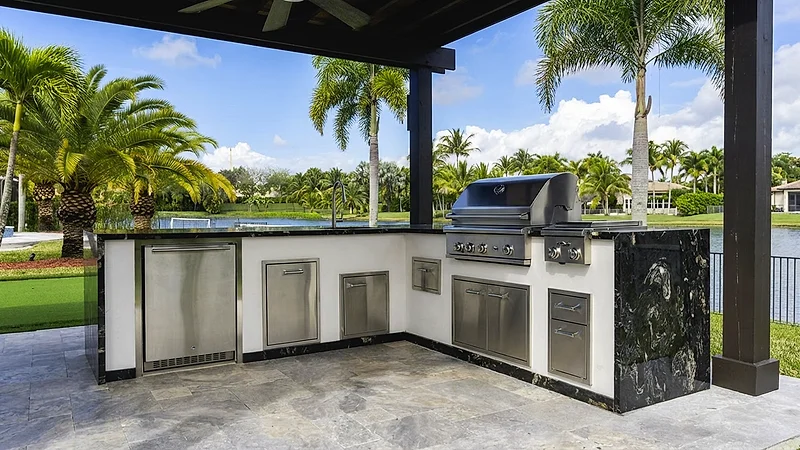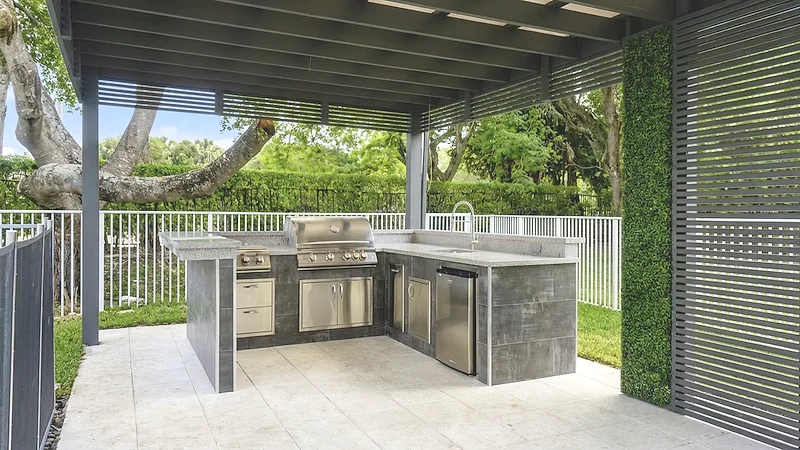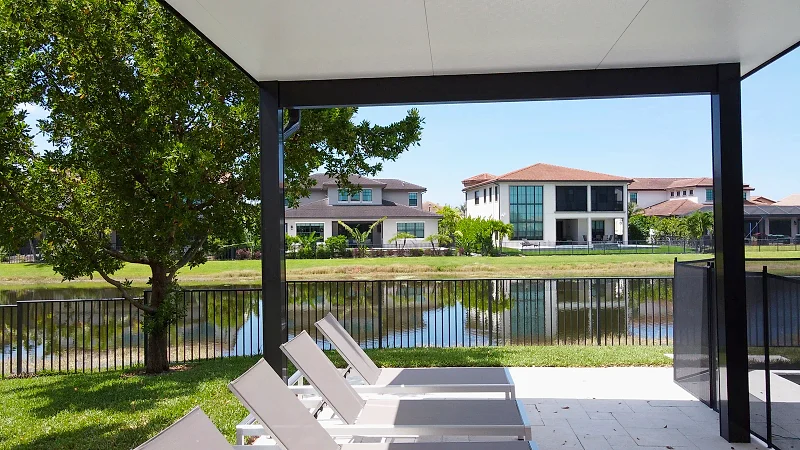
Everyone spends their design time on the countertop, which is the part least likely to fail. The frame and the fasteners are what decide whether the kitchen still looks right in year ten, and both are buried inside the island.
Three choices decide whether a Florida outdoor kitchen still looks right in year ten: a frame that cannot rot or corrode, which means concrete block, marine-grade polymer or welded aluminum; hardware and fasteners in 316 stainless anywhere near salt air or a saltwater pool; and a countertop in UV-stable natural stone or porcelain, which means granite, quartzite or a sintered slab, and not engineered quartz.
The order matters more than the list. Almost everyone spends their design time on the countertop, which is the part least likely to fail, and almost no time on the frame and the screws, which are the parts that do. Both are buried inside the island. Replacing either one means taking off the countertop that was chosen so carefully, which is why the cheapest line on the quote is usually the line that decides the expensive repair.
Outdoor kitchens here do not fail the way people picture. Nothing dramatic happens to the stone. What happens is a sequence, and it runs in roughly this order:
Budgets tend to run in the exact opposite direction. If you are deciding where an extra thousand dollars goes, it does more for you in hardware and framing than in a nicer slab.
A single kitchen run almost never lives in one climate. Under a solid roof, set back from the edge, the conditions are close to indoors. The end of the same island that pokes past the roof line gets direct rain. The end facing west gets afternoon sun on the stone and the door fronts every day of the year, and if there is a pool or the coast nearby, it gets the salt too.
Most kitchens are specified as though the whole run were the sheltered part. That is why you see an island where one end still looks new and the other has chalked door fronts and a faded countertop, on the same job, installed on the same day.
The rule is simple and it costs almost nothing to follow: spec the entire run for its worst zone. Mixing grades along one island saves a small amount of money and guarantees a visible line between the two halves within a few seasons. Where the island sits relative to the roof line, and therefore how many zones it has to survive, is settled in the outdoor kitchen layout guide — and it is worth settling before you choose a single material.
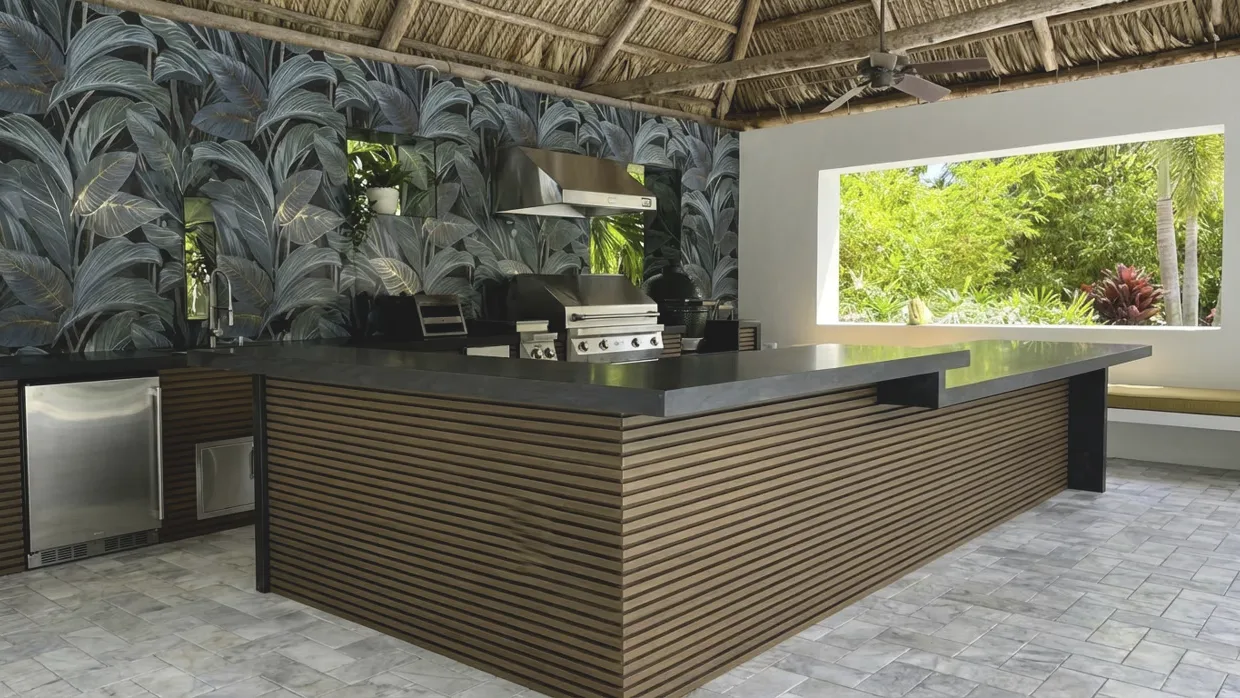
This is the structure inside the island: the thing the doors hang on and the countertop sits on. Once it is clad and topped, you are not looking at it again without demolition.
| Frame | Why it holds up | What to plan for |
|---|---|---|
| Concrete block | Nothing in it can rot or rust; the natural base for stone or stucco veneer | Heavy. Needs a proper slab or footing under it, and it is permanent — no moving it later |
| Marine-grade polymer | Will not rot, rust or absorb water; the cabinet is the finish, so there is nothing to refinish | Moves with heat, so the system has to be engineered for that; ask where the countertop load actually lands |
| Welded aluminum | Light, non-corroding, straightforward to clad in any finish | Every fastener into it must be compatible metal; cut ends and welds need coating |
| Galvanized steel studs | Fast and cheap to build | Every cut end is bare steel. In this climate that is where it starts |
| Wood framing | Fast, cheap, familiar to any carpenter | Humidity that never fully dries, termites, and a cement board skin that hides all of it until it is bad |
Concrete block is the default when the kitchen is staying put forever and the finish is stone, tile or stucco. It is the most forgiving structure we build here and the least forgiving to change your mind about.
Marine-grade polymer is the one homeowners are most skeptical of and most often end up happy with, because the cabinet material and the finish are the same thing: there is no coating to fail, no substrate to reach. The question to ask a builder is a structural one, not a cosmetic one — whether the stone is carried by the cabinets themselves or by a separate frame behind them.
Welded aluminum sits between the two, and it is the right answer when the kitchen has to be light, on a raised deck or a screened enclosure slab rather than on grade.
Wood framing with cement board over it is extremely common, and it is the construction we most often find quietly failing when we open up an island during a remodel. Cement board is not what rots. The frame behind it is.
Stainless steel is not one material. The grade that matters outdoors here is the difference between 304 and 316: 316 contains molybdenum, and that is what gives it its resistance to chlorides. Chloride is what salt air and salt water deliver.
Two things follow from that, and both get missed.
The upgrade belongs on the parts nobody looks at. It is common to see 316 door panels hung on 304 hinges, driven with whatever screws came in the box. The panel is the largest and cheapest part to protect; the hinge, the slide, the bracket and the screw are the ones whose failure takes the assembly with them.
Do not mix metals in a wet, salty joint. A plain steel screw into an aluminum frame, or a random fastener into a stainless door frame, sets up galvanic corrosion at exactly the point that stays wet longest. Fasteners should match what they are going into.
Even good stainless discolors near the coast. Surface staining on 304 in marine air is normal and it is cosmetic, not structural, as long as the steel underneath is sound. It responds to washing. Anything that will be near salt should be planned as something you rinse occasionally rather than something you never touch.
And a saltwater pool counts. A salt chlorination system puts chloride in the water, and splash carries it to whatever is within range. A kitchen within splash range of a salt pool is closer to a coastal environment than an owner inland in Ocala expects.
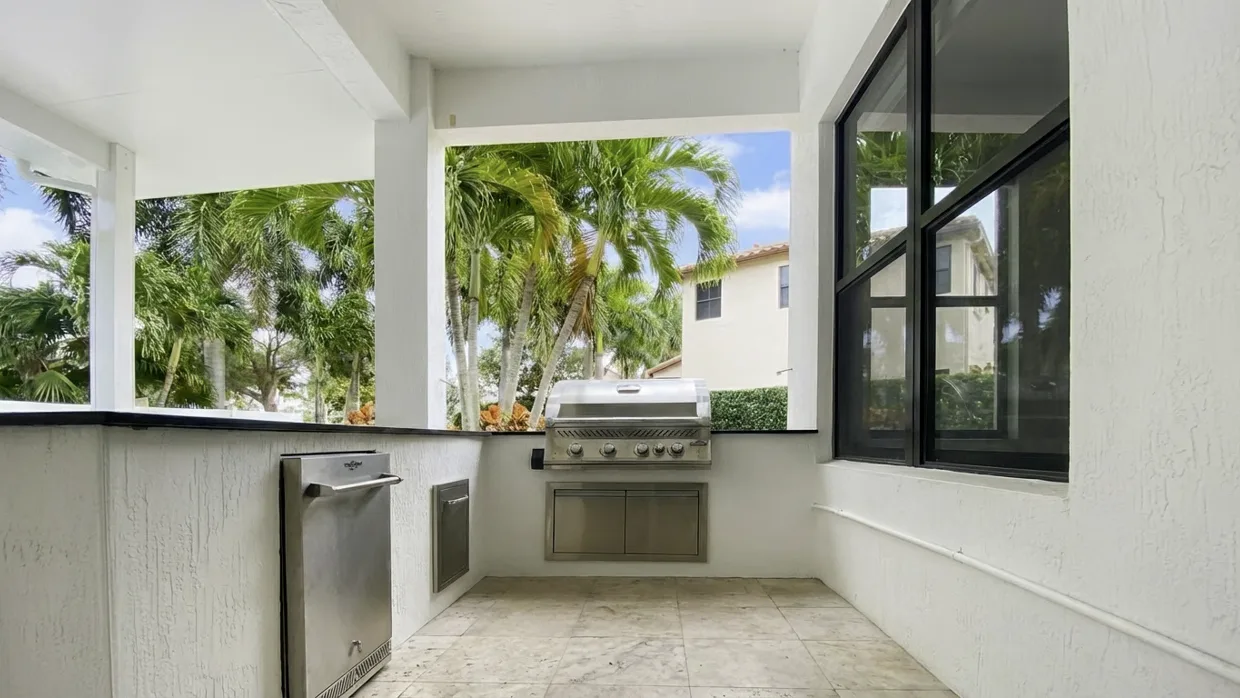
Two more hardware details worth naming in the spec: the cabinet interiors need to drain and breathe, because a sealed box under a countertop in this humidity is a condensation trap; and any enclosure around a gas appliance needs the ventilation the appliance requires, which is a safety requirement rather than a preference. What the appliances demand of the island is covered in what to run before construction, and it needs to be settled before the frame is built, not after.
| Surface | Why it works outdoors | What to plan for |
|---|---|---|
| Granite | Natural stone, stable under ultraviolet light, hard enough to take real use | Sealing on a schedule; dark colors get genuinely hot in direct sun |
| Quartzite | Natural stone, harder than granite, holds up to acid better than marble | Fewer slabs available; verify it is actually quartzite and not a soft stone sold as one |
| Porcelain or sintered slab | Non-porous, UV-stable, will not stain, consistent color across the run | Edges and overhangs need full support underneath; fabrication is specialized |
| Cast concrete | Any shape or edge you want, integral color, no seams where you do not want them | Hairline cracking is inherent; needs sealing and periodic re-sealing |
| Tile over a solid substrate | Inexpensive, repairable a piece at a time | The grout is the whole story; it is the maintenance and the failure point |
| Marble or travertine | Look right in a lot of Florida architecture | Soft and acid-sensitive: citrus, wine and cleaners etch it. Better on the floor than the counter |
This costs people real money, and the names are one letter apart.
Quartzite is natural stone, quarried and cut. Engineered quartz is quartz aggregate bound together in a polymer resin. The resin is the problem: it is not stable under ultraviolet light, and manufacturers know it, which is why outdoor installation is commonly excluded from the warranty.
That exclusion is the most reliable piece of information in the entire category. Read it before you fall in love with a slab, and read it even if the kitchen is going under a roof, because reflected light reaches further under a lanai than people assume and the wording rarely makes an exception for it.
Color choice is not only aesthetic here. A dark countertop on the sunny end of a run can be too hot to rest your hand on for most of the afternoon — not a durability failure, just a counter you stop using during the hours you built it for. If the island is exposed and facing west, that is an argument for a lighter surface on that section, or for getting a roof over it.
Stone veneer, stucco, tile, porcelain panel, composite boards: these are how the island looks, not how it stays dry. Water gets behind every one of them eventually. What keeps the kitchen sound is the frame behind and the drainage under.
Two failure modes recur. Efflorescence — white mineral bloom pushing through stucco or grout — means water is moving through the assembly and picking up salts on the way. And hairline cracks appear at outside corners first, because that is where movement concentrates.
Neither is fatal. Both are information, and both are much cheaper to act on early than to explain away.
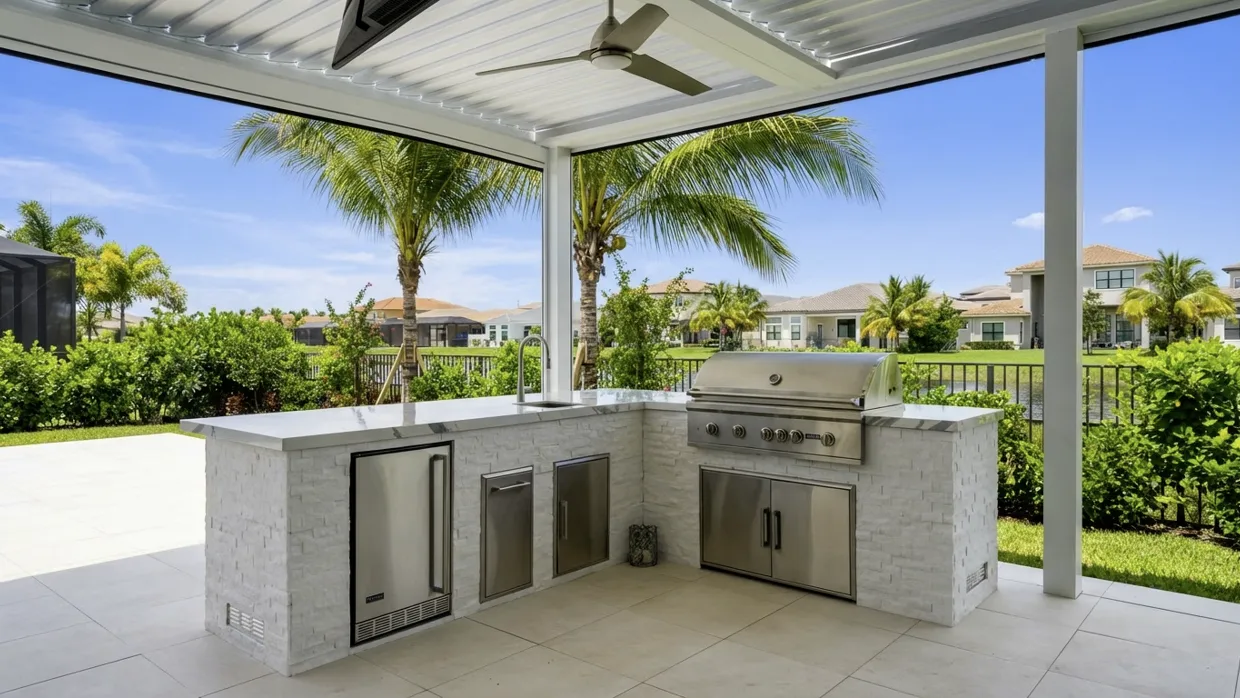
Almost every water problem we open up starts at a joint rather than in the middle of a material:
Sealant is a maintenance item, not a permanent product. Knowing that at handover — which joints, how often — is worth more than any single upgrade on this page.
The island sits on something, and that surface has to move water away from it. Travertine, paver and concrete decks all work; what matters is that the slope runs away from the kitchen and that there is no low spot where the base of the island sits in standing water after every storm.
If the kitchen is going on a deck rather than on grade, the structure below has to carry the load of masonry, stone and appliances, which is a different calculation than the one for furniture. That gets planned at the framing stage on the custom deck side, not after the island is drawn.
Our estimator carries a full outdoor kitchen at $25,000, and what it shows anyone is a range of roughly ten percent either side of that. It is a starting configuration, not a spec sheet, and the materials on this page are most of what moves a real project away from it.
The useful thing to understand is which direction each choice pushes. Moving from wood framing to block or polymer is a modest change in the total. Moving from 304 to 316 hardware is smaller still. Moving from granite to a large-format sintered slab, or adding a second run and a bar overhang, moves it much more. The corrosion decisions are cheap; the size and stone decisions are not. That is almost exactly the opposite of how people rank them going in.
What drives the rest of the number, line by line, is in what an outdoor kitchen actually costs in Florida.
Six lines, handed to whoever is quoting:
If a quote answers all six, you can compare it to another quote. If it says "stainless steel cabinets, granite top," you are comparing two numbers that describe different kitchens.
Finished examples of these assemblies, on real jobs, are in the project gallery, and the way we build them is on the custom outdoor kitchens page. If you want the material decisions made against your actual site — how far the roof reaches, where the salt comes from, what the deck can carry — that starts with a site visit and estimate rather than a slab sample.
Granite, quartzite and porcelain or sintered slab all hold up to sun and rain here. The choice between them is about edges, overhangs and heat rather than durability. Engineered quartz is the one to rule out, because the resin binding it is not stable under ultraviolet light.
Read the manufacturer's warranty before deciding. Most exclude outdoor installation, and a covered lanai does not always count as indoors in that wording. Reflected light and afternoon sun reach further under a roof than people expect, and the exclusion usually applies to the whole slab regardless.
Near the coast or beside a saltwater pool, yes, and it is worth it specifically on the parts nobody looks at: hinges, drawer slides, screws and brackets. On an inland site with a chlorine pool, 304 on doors with better hardware behind them is a reasonable place to spend less.
It does, and it surprises people who are nowhere near the ocean. A salt chlorination system puts chloride into the water, and splash and spray carry it onto anything close by. Treat a kitchen within splash range of a salt pool the way you would treat a coastal site.
Wood framing behind cement board is common and it is the construction we most often find failing during a remodel. The board is not what rots. If a wood frame is already there and sound, it can be clad and kept, but it is not what we would build new in this climate.