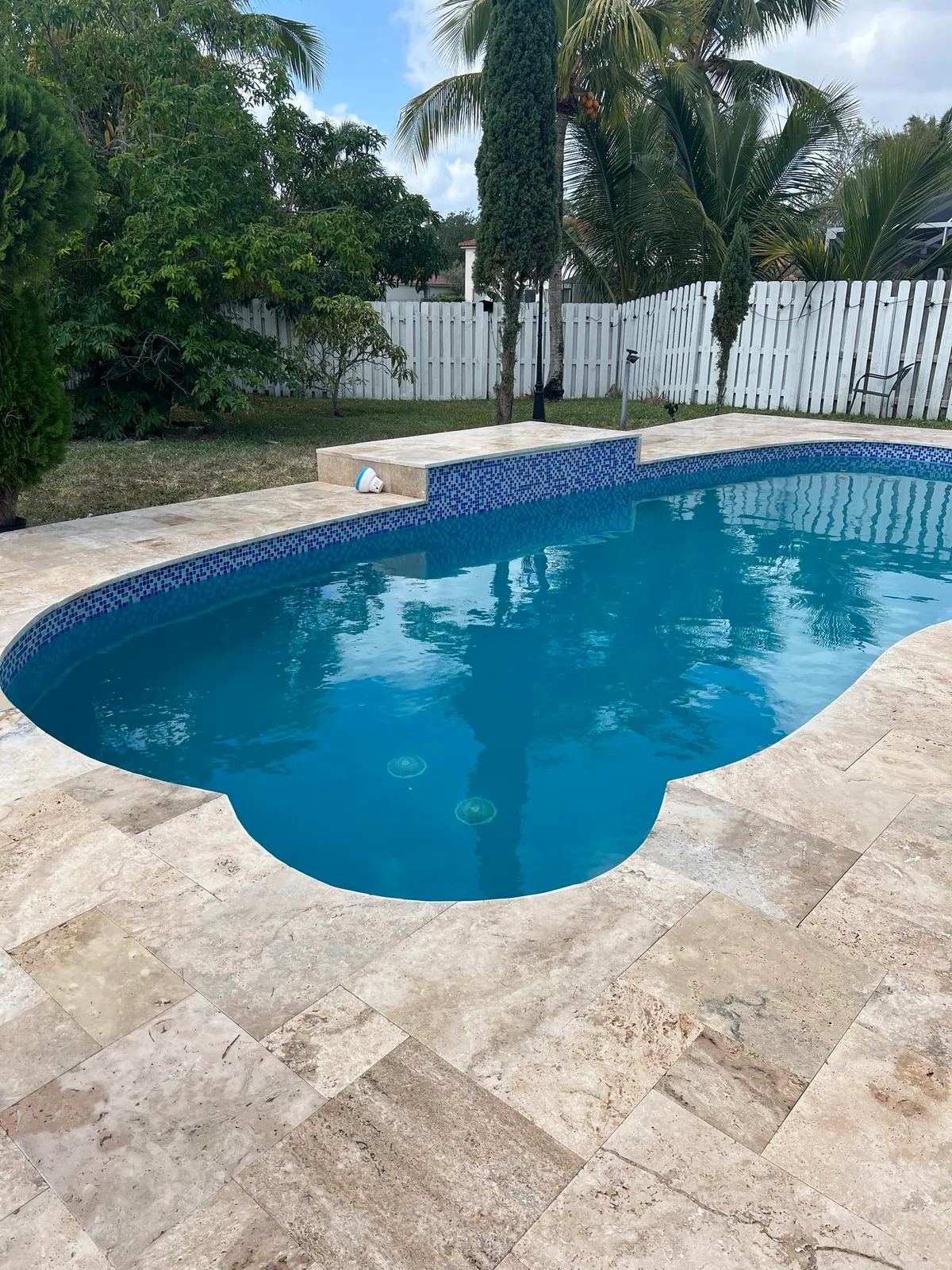
Pool Coping and Tile Replacement: When It's Needed and What It Involves
Coping and waterline tile are a small job when the concrete under them is sound, and the first sign of a bigger one when it is not. Here is how to tell which, and what the work involves.
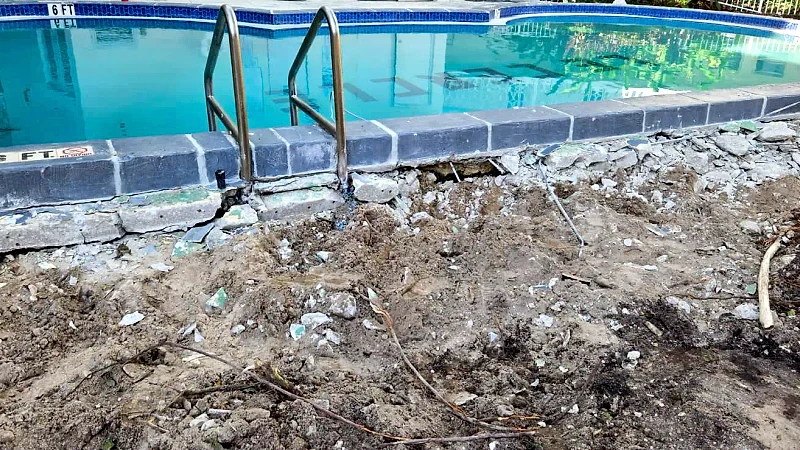
Pool coping and waterline tile need replacing when tile is loose, cracked or missing, when the coping rocks or lifts, or when the joint between the coping and the deck has broken open. The job means lowering the water, removing both, inspecting the concrete beam they sit on, resetting them, and repairing the first band of deck. If that beam is sound, it stays a contained job.
That last condition is the whole article. Coping and tile are the part of the pool you see failing, and they sit on the part you cannot see. Most of the time the edge has simply aged. Sometimes it has moved because something under it moved, and the only way to know is to lift a piece.
Key facts
- The Pool & Hot Tub Alliance lists "damaged tile & coping" among the surface issues that may need resurfacing or replacement.
- Coping and waterline tile both sit on the bond beam, the thickened top edge of the pool shell where it meets the deck.
- In a field report cited by the tile industry's trade magazine, the interface of coping and tile with the bond beam and the deck behind it accounts for a significant percentage of pool tile failures when installed improperly.
- The same report calls for a movement joint between the coping and the top of the tile on a cantilevered deck, and an expansion provision wherever a deck or slab butts up to the coping or the shell.
- The Florida Building Code requires residential inground pools to conform to ANSI/APSP/ICC-5 (R4501.6.1).
- Our estimator does not price coping and tile on their own. It prices complete remodels, where both are part of the pool and deck lines.
What are coping and waterline tile, and what holds them up?
The coping is the cap along the top edge of the pool: the stone, paver, brick or poured concrete you sit on and push off from. The waterline tile is the band just below it, where the water level sits and where the finish ends.
Both are set on the bond beam. Behind the coping is the deck, and the deck moves on its own schedule — with the soil under it, with heat, with water. Where the deck meets the coping there should be a joint that lets that movement happen without dragging the coping along with it.
That layout explains almost every failure at the edge:
- The tile is bonded to the beam and fails when that bond fails, usually along a line.
- The coping is set in a mortar bed on the beam and fails when the bed breaks up or the deck pushes against it.
- The joint between deck and coping is the safety valve, and when it is missing or has failed, the deck does its moving through the coping instead.
What are the signs coping or tile needs replacing?
| What you see | What it usually means | What to check before quoting |
|---|---|---|
| A tile or two loose, the rest tight | Local bond failure | Tap the tiles around it; replace locally if the rest sound solid |
| Tiles loose, cracked or missing along a line | The bond to the beam has failed along that stretch | Lift the coping above it and look at the beam |
| Coping that rocks, lifts or sounds hollow underfoot | The mortar bed under it has broken up | Whether the beam under the bed is sound |
| The joint between coping and deck cracked open or filled with debris | The deck is moving against the coping | Whether the deck has settled or pushed, and whether a joint was ever there |
| A crack that runs from the deck through the coping and down the tile | Movement that is not limited to the edge | The shell, before anything at the edge is priced |
| A white or gray band at the waterline that keeps coming back | Scale from the water, not a failure of the tile | Water chemistry first; it may clean off rather than need replacing |
The last row is worth separating from the rest. The National Plasterers Council notes that high calcium hardness, total alkalinity or pH lead to scaled surfaces and staining. A scaled band is a chemistry problem, and replacing the tile without fixing the water just gives the scale a clean surface to start on again.
When is replacing the coping and tile enough?
When three things are true together:
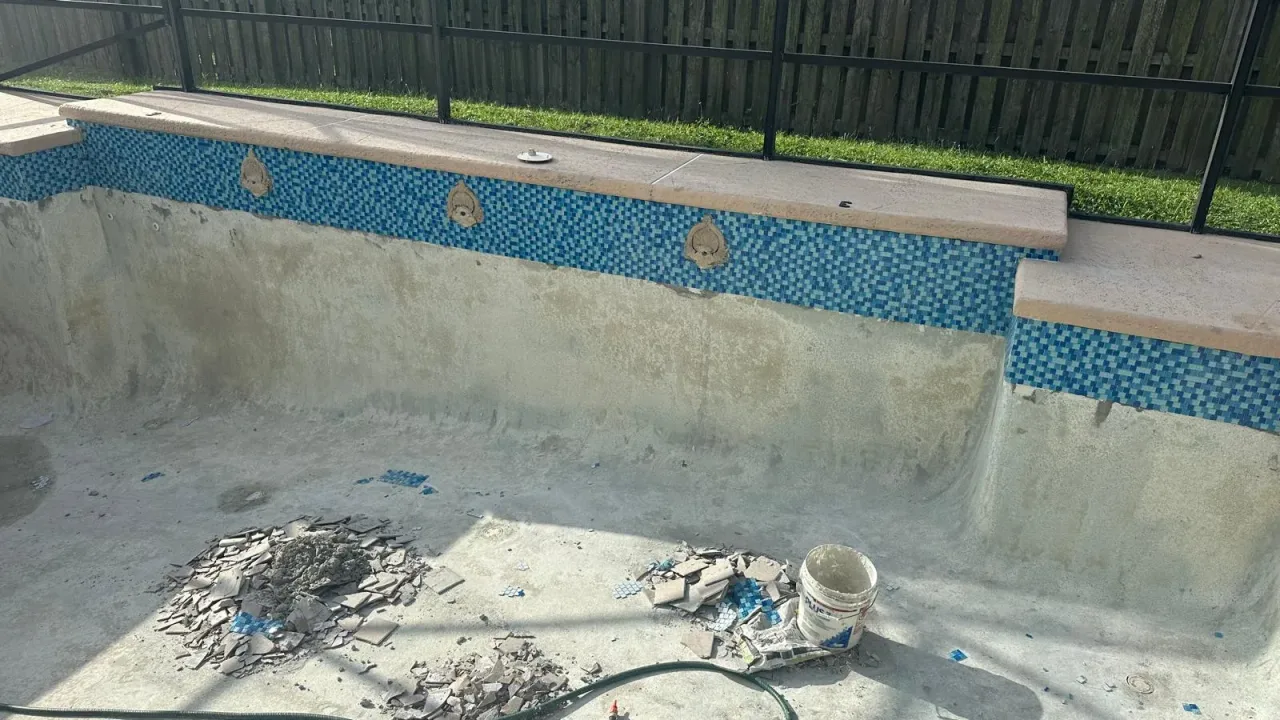
- The bond beam is sound once the coping and tile are off: no cracked or crumbling concrete, no rust coming through from the steel inside it.
- The deck is stable. It has not settled toward the pool or heaved against it, so a new joint between the two will stay a joint.
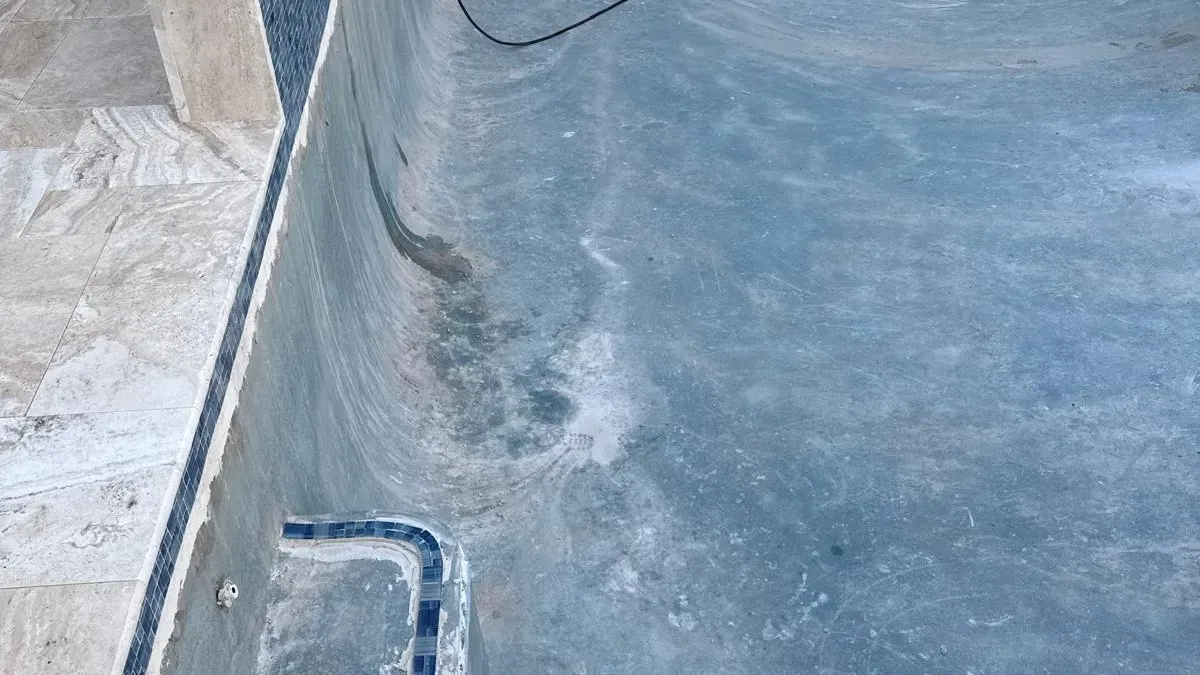
- The interior finish has life left. The finish meets the tile at the waterline. If the finish is close to the end, replacing the tile now means working against the top edge of new tile when it is resurfaced in a few years.
If all three hold, the job is what it looks like: a new edge on a sound pool. If the finish is close to done, the sensible scope grows by one layer — pool resurfacing vs a full renovation explains why tile, coping and finish are the three layers that share the same opening. How long a finish tends to last, and the signs it is near the end, are in how long pool resurfacing lasts in Florida.
When does it uncover something worse?
Lifting the edge is the first time anyone sees the top of the shell in years, and four findings change the job:
- Cracked or crumbling bond beam. The beam itself has to be repaired before anything new can be set on it.
- Rust staining or exposed steel in the beam, which means water has been reaching the reinforcement.
- A deck bonded solidly to the coping, with no joint between them. The coping cannot come off cleanly, and what was going to be a band of deck repair becomes a larger deck question.
- A crack that continues into the wall below the tile line. At that point the question is no longer the edge but the shell, and the place to start is new pool construction vs pool remodeling, which sets out what a shell has to show before rebuilding is on the table.
None of these can be priced honestly from the deck. A quote for coping and tile should say what happens if one of them is found: how it is priced, and who approves the extra work before it happens. What a quote should spell out for unknowns like these is in what a pool quote should include.
What does coping and tile replacement involve?
In order:
- Lower the water below the work. How far depends on the scope. A full drain in Florida is planned, not casual: groundwater can push an empty shell up, which is what the hydrostatic relief valve in the pool floor is there for.
- Remove the tile and coping, and the band of deck that is bonded to them.
- Inspect the bond beam. This is the step that decides whether the rest of the list is the whole job.
- Repair the beam where needed, and clean it back to sound concrete.
- Set the new coping on a fresh bed, with a movement joint between the coping and the deck.
- Set the new waterline tile and grout it.
- Repair the deck band that came out, to match the deck that stayed — or decide that the deck goes too.
- Refill and rebalance the water, so the new grout and any new finish start in balanced water.
Step 7 is where expectations most often go wrong. A strip of new concrete or new pavers next to twenty-year-old deck rarely disappears. If the deck is near the end of its life anyway, this is the moment to replace it, and the material choice is the same one you would make for a new pool. When a coating is enough for an old deck and when it is not is in pool deck resurfacing in Florida.
What does it cost?
Our estimator does not price coping and tile on their own, so we do not publish a figure for them. The number depends on how much edge there is, the coping material, the tile, how much deck comes out with them, and above all on what the beam looks like when it is uncovered.
What we can say is where it sits. Coping and tile are part of every complete remodel, and the ranges for a complete remodel — from a compact project to a large one — are in what a pool renovation costs in Florida. If the edge is only one of several things wearing out, that is the more useful number to look at, because doing the edge alone first is how a pool ends up opened twice.
In Gainesville and Ocala
The edge fails the same way everywhere. What changes locally is what has to be checked along with it.
- The office that reviews the work. Inside city limits that is the City of Gainesville or the City of Ocala; outside them, the county. Ask which one covers your address before the work is scheduled. Who reviews what is set out in pool permits in Gainesville and Alachua County and pool permits in Ocala and Marion County.
- Pools under a screen enclosure. Find out where the enclosure is anchored before any deck comes out, so that removing the deck band does not disturb it.
What else changes when the pool is older and in this part of the state is in remodeling an older pool in North Florida. How we scope and run this work is on our pages for remodeling an older pool in Gainesville and pool remodeling in Ocala. Our pool remodeling page covers the whole region.
Decide the edge with the rest of the pool
Coping and tile are rarely the only thing wearing out. Before deciding how far the job goes, look at the finish, the deck and the equipment at the same time and ask which of them are close to due. The ones that share the opening — finish, tile and coping — are cheaper together than apart; what to upgrade during a complete pool remodel sorts the rest.
Then put that scope through the pool cost estimator with the project type set to remodel, to see where it lands before anyone lifts a piece of coping.
Common questions
How do I know if my pool coping needs to be replaced?
Coping that rocks or sounds hollow when you step on it, stones that have lifted or cracked through, and a joint between the coping and the deck that has opened or broken out are the usual signs. Each one means the bond between the coping and the concrete under it, or the deck beside it, has moved. Lift a piece before deciding how far the job goes.
Can you replace pool tile without draining the pool?
The water has to be below the work, so waterline tile is never replaced with the pool full. How far the water comes down depends on what else is being done. In Florida a full drain is planned rather than casual, because groundwater can push an empty shell up out of the ground.
Should I replace the coping and the tile at the same time?
Usually, yes. They meet at the top edge of the pool, and taking one off almost always disturbs the other. Replacing them together also lets whoever does the work see and repair the concrete beam they both sit on.
Should I resurface the pool when I replace the tile?
If the interior finish is close to the end of its life, yes. New tile sits on top of the finish line, so resurfacing later means working against the edge of tile you just paid for. If the finish is sound, the tile can be done on its own.
Sources
- Pool & Hot Tub Alliance — Remodeling & Repairs (consumer guide)
- Florida Building Code, Residential, 8th Edition (2023) — R4501.6.1, conformity with ANSI/APSP/ICC-5
- Pool & Hot Tub Alliance — PHTA standards (ANSI/PHTA/ICC-5, residential inground pools)
- TileLetter (NTCA) — Tiling pools?, citing a CTIOA field report (April 2019)
- National Plasterers Council — Technical Bulletin #1, Testing Fill Water
About the author
Robert Wesley Brannen is the co-founder of Mr. & Mrs. Outdoor Living and a Florida-certified pool and spa contractor. Having started in his family's aluminum business at age 13 and previously led Happy House Outdoor Living, Robert brings extensive experience in custom pool construction, outdoor structures, and design-build project management.
Florida Licenses: CPC1460562 · CPC1461119 · SCC131153553.
Most Read Articles
How Much Does a Pool Renovation Cost in Florida? Price Ranges and What Sets the Scope
A typical complete pool remodel in Florida runs about $68,000 to $83,000 on our estimator, a compact one starts near $27,000, and a large luxury remodel reaches $218,000. Four decisions explain the gap.Read More: How Much Does a Pool Renovation Cost in Florida? Price Ranges and What Sets the Scope
Pool Resurfacing vs. Full Pool Renovation: What's the Difference?
Resurfacing and a full renovation are not two budgets for the same job. One changes the surface; the other changes the pool. Here is where the line falls and the question that decides which side of it you are on.Read More: Pool Resurfacing vs. Full Pool Renovation: What's the Difference?
What Should You Upgrade During a Complete Pool Remodel?
A remodel is not a shopping list. It is a window in which the shell, the deck and the ground between them are open. Here is what belongs in that window, and what you can buy any year without penalty.Read More: What Should You Upgrade During a Complete Pool Remodel?
Request a Design-Build Project Evaluation
Share your property details, project scope, and investment range. Our licensed design-build pool builders will review your request and confirm alignment before next steps.
Get a Free Estimate