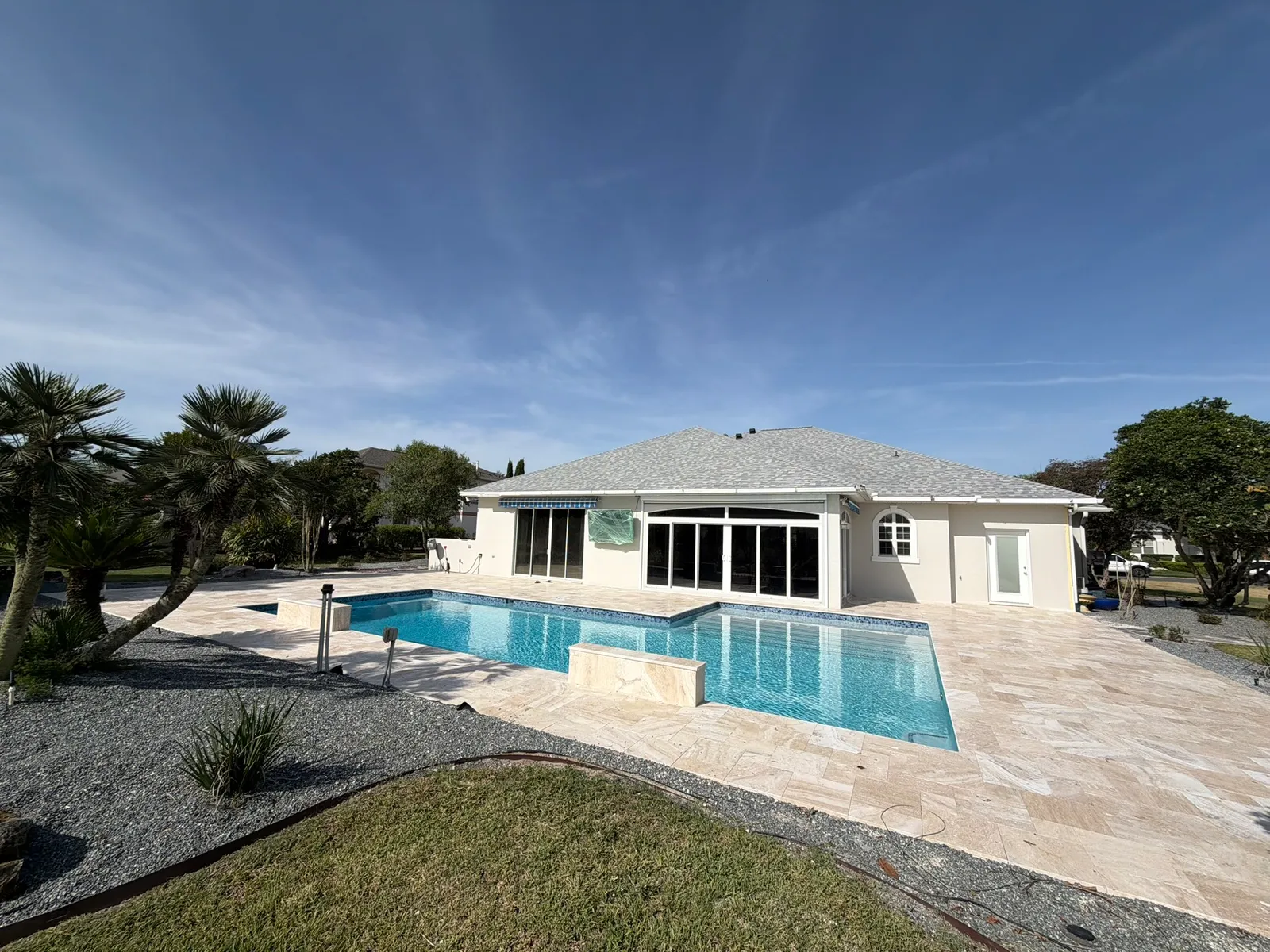
Pool Deck Resurfacing in Florida: When a Coating Is Enough, and When It Is Not
A deck coating changes the surface you walk on, not the slab under it. Five checks with a hose, a level and your eyes tell you whether a coating will last or whether the deck needs pavers over it or a full replacement.
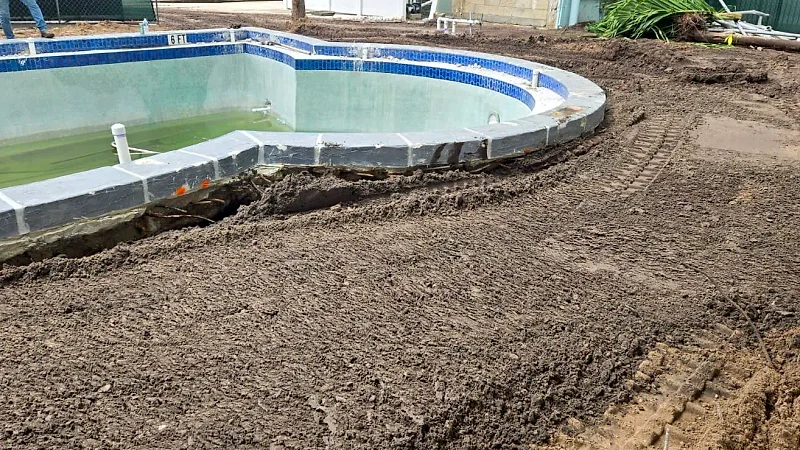
A coating is enough when the slab under it is sound: it sits flush, it drains away from the pool and the house, and its cracks are hairline and not moving. A coating renews the surface, which is the color, the texture, the heat underfoot and the grip. It does not change the slab. If the deck has settled, heaved, ponds or tips toward the house, a coating will copy every one of those faults into the new surface.
That is the whole decision. The rest of this article is how to tell which deck you have before you pay for either answer.
The short version
| What you see | Coating fixes it? | What does |
|---|---|---|
| Faded, stained or worn finish on a flat, draining slab | **Yes** | A cementitious topping or acrylic coating |
| Hairline cracks that are not growing, both sides level | **Usually**, after repair | Crack repair, then the coating |
| Cracks that open and close with the seasons | **No**: they can mirror through | Repair the cause, or replace the section |
| One side of a crack higher than the other (a trip edge) | **No** | Replace that section of slab |
| Water standing after a hose test | **No** | Correct the slope, which means new slab or a new surface set to new grades |
| Water running toward the house or the pool | **No** | Same as above |
| Coping loose or the deck edge broken at the pool | **No** | Coping and edge repair, usually inside a remodel |
The rows marked "no" have one thing in common: the problem is in the concrete, not on it. The U.S. Bureau of Reclamation's concrete repair guide says the same in general terms: most coatings should not be expected to repair cracks, and cracks from foundation settlement usually need repair of their own.
What a deck coating actually is
"Resurfacing" covers several products that behave differently, and quotes do not always say which one is being sold.
- Cementitious toppings. A thin layer of colored cement applied over a bonding agent and given a texture. Kool Deck is the best-known name in Florida. Mortex, which makes it, describes the result as a textured cement surface "as strong as the base concrete" it is bonded to.
- Polymer-modified overlays. Thin cement-based resurfacers made to bond to worn or spalled concrete. Duraamen's Uberdek data sheet describes its product as an alternative to "expensive and time consuming concrete replacement".
- Acrylic and elastomeric coatings. Paint-like systems, often with a texture and a sealer. They change color and grip but add almost no thickness.
All three have the same limit, and their own manufacturers state it: they are surfaces, so they depend on what is under them. Mortex's instructions put its topping at 1/8 inch thick. A layer that thin follows the slab; it does not reshape it. Sika's data sheet for its pool-deck acrylic coating says it "will not eliminate structural defects such as major cracks caused by an unsound substrate".
Five checks before anyone quotes a coating
You can do all five in an afternoon with a garden hose, a 4-foot level and a phone camera. They decide the answer more often than the age of the deck does.
- The hose test. Run water across the deck for a few minutes, then wait. Anything still standing after the rest has drained is a low spot. A coating will not fill it, and Sika's data sheet for its textured acrylic coating says it is not recommended on surfaces subject to ponding.
- The direction of the water. Watch where the hose water goes. It should leave the deck away from the pool and away from the house. Water running back to the house wall or toward the coping is a slope problem, not a finish problem.
- The crack edges. Run your hand across each crack. If both sides are at the same height, the crack is a candidate for repair and coating. If one side stands proud, the slab has moved and will keep moving.
- The crack history. Photograph the longest cracks with a coin for scale, and photograph them again in a few months. Cracks that open and close are active. The American Concrete Institute says active cracks need to be stabilized to avoid being reflected through a topping, and Duraamen warns that cracks which move, even when repaired, may mirror through its overlay.
- The edge at the pool. Look at the joint between the deck and the coping. If the coping is loose, the joint is open, or the deck has broken away at the edge, the job is no longer the deck alone. It reaches the coping and the waterline tile, which is remodel territory.
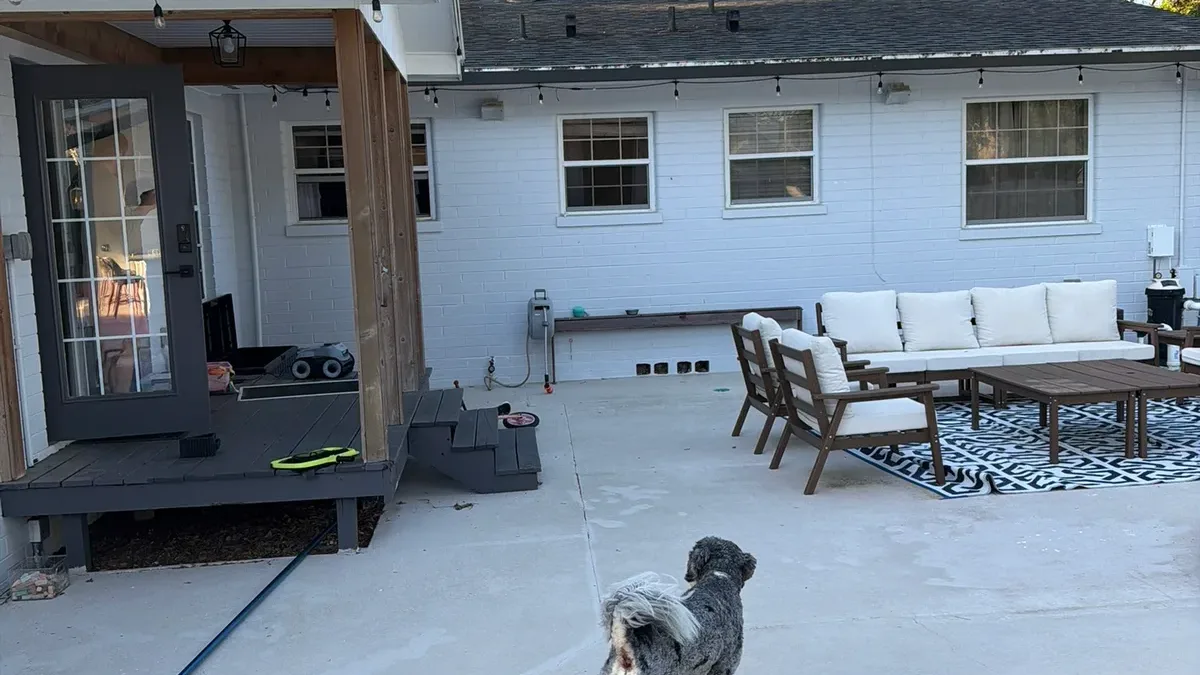
Those checks are the homeowner's version of what the American Concrete Institute calls a condition evaluation, which it says is required before choosing an overlay. If the deck passes all five, a coating is a sound use of money. If it fails one of the first four, the honest answer is a new surface set to new grades or a new slab, and the coating quote is quoting the wrong job.
What the manufacturers require before a coating goes on
This is the part of a coating quote worth reading closely, because it is where the cheap version and the lasting version separate.
| Requirement | What the manufacturer says |
|---|---|
| A sound base | Mortex: apply its bonding system "only to clean, sound concrete surfaces". Duraamen: weak concrete must be cleaned down to solid, sound concrete |
| Cracks and damage repaired first | Mortex: major cracks and structural damage repaired "well in advance" of the topping |
| Old coatings removed | Mortex: remove deteriorated concrete or old toppings with a scarifier and pressure washer, and remove paints, plastic coatings and adhesives |
| Joints kept as joints | Duraamen: moving joints such as expansion joints must be cleaned and carried through the new surface |
| Weather window | Mortex: 50°F and rising, and not over 90°F, for best results; Duraamen: between 50°F and 95°F, held for at least 8 hours after application |
| Cure before use | Mortex: limit contact for 48 hours, walking after two weeks, no furniture or hard-soled shoes for the four-week cure |
The line to look for in a proposal is the preparation. A quote that says "pressure wash and coat" on a deck with an old coating and repaired cracks is skipping the steps the product's own instructions call for. Ask what is being removed, how cracks are repaired, and whether expansion joints are kept open.
When pavers or travertine over the slab make sense
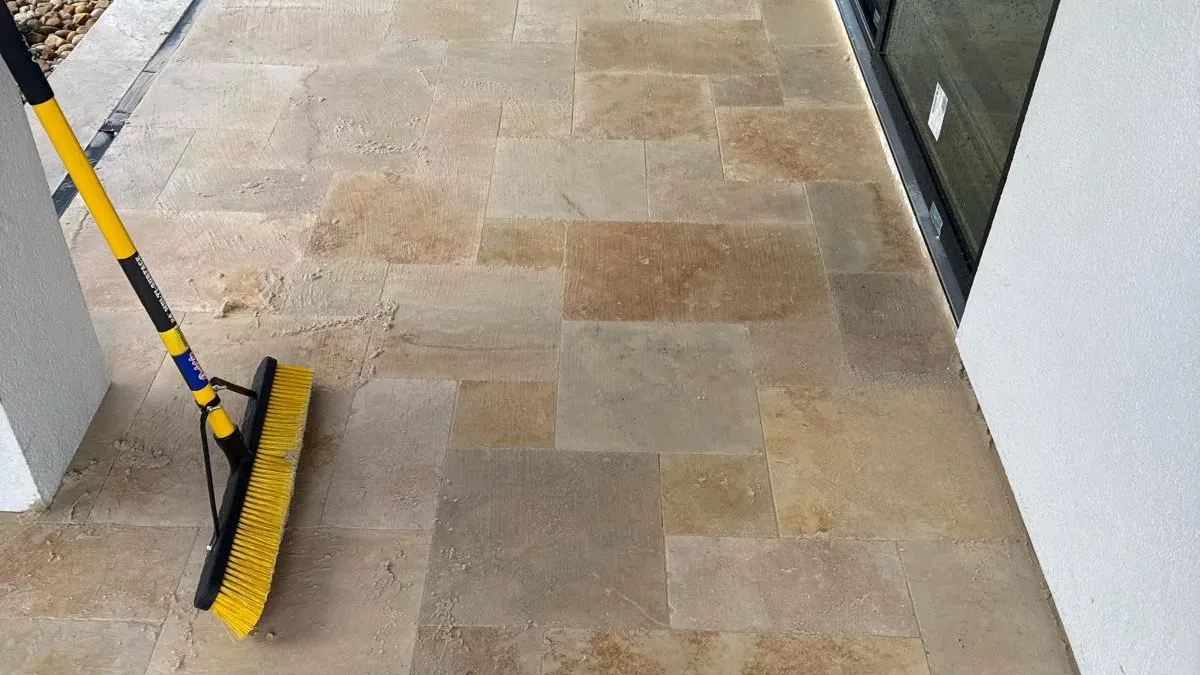
Setting pavers or travertine over an existing slab is a different answer from a coating. It hides the old surface completely and gives you a new material, but it adds height. That height has to fit at three places: the door thresholds into the house, the coping at the pool, and every drain in the deck.
On some decks it fits and the slab becomes a stable base. On others, the step down from the slider disappears, or the new surface meets the coping too high. And the slab still decides the result. The Concrete Masonry & Hardscapes Association's guide specification for pavers over a concrete base says the paver installer "cannot correct deficiencies in the base surface with additional bedding sand or by other means", and it calls for weep holes at the lowest points of the slab so water that gets under the pavers can leave. A slab that drains the wrong way gives you a paver deck that drains the wrong way.
Which material to choose, and how pavers, travertine and cool-deck finishes compare in Florida heat, is in choosing a pool deck material in Florida. This article only covers the question before that one: whether the slab can stay.
When the deck should come out
Replacement is the answer when the slab is the problem: it has settled or lifted unevenly, it drains toward the house, or its edge at the pool has broken away. It is also the right moment when the deck is coming out anyway.
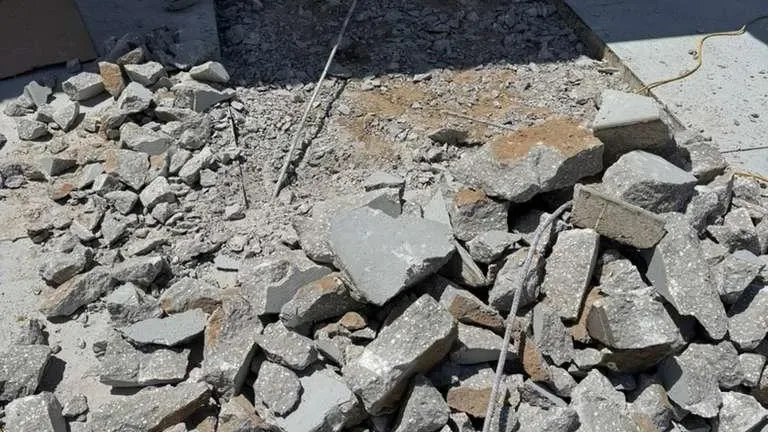
That second case is the one people miss. A complete remodel is the only time the ground between the pool and the equipment is open. New plumbing, larger return lines, conduit for lights and future structures, and deck drainage all go in while the slab is out. Our guide to what to upgrade during a complete pool remodel lists what closes when the deck goes back down. It makes the same point from the other side: if the deck drains and sits flush, patching and resealing is a legitimate answer, and the money is better spent in the shell.
If a screen enclosure stands on the deck, its posts are anchored to that slab. Replacing the deck under a cage is a cage question as well as a concrete one, and it belongs in the same plan.
What it costs
Our pool cost estimator does not price a coating or a deck-only resurfacing. It prices a new deck as part of a pool or a complete remodel, by material:
| Deck material | Estimator price per sq ft | On a 600 sq ft deck |
|---|---|---|
| Concrete | $12 | $7,200 |
| Pavers | $22 | $13,200 |
| Travertine | $35 | $21,000 |
On the estimator's default complete remodel (a 450 sq ft freeform pool with a pebble interior and a 600 sq ft deck), changing the deck from concrete to pavers moves the total by about $5,400, and from concrete to travertine by about $12,300. That includes the permit line, which the estimator calculates at 9 percent of the pool and the deck, and the remodel adjustment it applies to the total. The full picture, with three project sizes, is in how much a pool remodel costs in Florida.
For a coating alone we do not publish a figure, because we do not have one we can stand behind. The factors that move it are the area, how much old coating has to be removed, how many cracks need repair, and how many joints and drains have to be detailed.
In Gainesville and Ocala
Two things make the deck decision different in North Central Florida.
The first is the canopy. Decks under live oaks collect leaves, and the coating manufacturers' care sheets are direct about it: Mortex says not to let dirt and leaves stay on the surface for long, and to rinse the deck frequently if the pool has a salt chlorinator. On a deck under trees, plan for cleaning as part of the finish, whichever finish it is.
The second is the size of the job. Lots outside both cities tend to be larger, and a larger deck makes the price per square foot matter more. It also makes a partial answer tempting. If the slab is sound in one area and broken in another, a coating on the good section and replacement on the bad one can be the honest scope, as long as the two meet at a joint rather than in the middle of a slab.
We remodel pools and decks across the region. Our pages on pool remodeling in Gainesville and complete pool remodels in Ocala and Marion County explain how a deck fits into the rest of a remodel, and what a site visit checks first. Our pool remodeling page covers the whole region.
Price the deck in context
The deck is usually the largest surface in a pool remodel and the line that moves the total most. Run your pool and deck through the pool cost estimator with each material to see where the deck sits in the whole budget before you choose between coating, overlay and replacement.
Common questions
Can you resurface a cracked pool deck?
Yes, if the cracks are not moving and the two sides of each crack sit at the same height. Coating manufacturers require major cracks and structural damage to be repaired before the topping goes on, and they warn that cracks which keep moving can mirror through a thin overlay. A crack with one side higher than the other is a slab problem, not a surface problem.
How long does a new deck coating take before you can use it?
For a cementitious topping like Kool Deck, the manufacturer's care sheet says to limit contact for 48 hours, allow walking after two weeks, and keep patio furniture and hard-soled shoes off for the full four-week cure. Plan a remodel so the deck is finished before the pool season, not during it.
Is it better to coat the deck or put pavers over it?
It depends on the height you have to spare and on the slab. A coating adds almost no height and keeps the existing slope. Pavers over the slab raise the surface and need room at the door thresholds, the coping and the drains. If the slab drains the wrong way, neither fixes it: the slope has to be corrected first.
Does a deck coating make the deck cooler?
Some do, by color and texture. Mortex says its Kool Deck topping stays cooler than plain concrete and publishes a comparison chart rather than temperatures. Treat cooler-than-concrete as a comparison between surfaces in the same sun, not as a promise of a comfortable deck at noon in July.
When should a pool deck be replaced instead of resurfaced?
When the slab has settled or lifted unevenly, when water runs toward the house or sits in puddles, when the edge at the coping has broken away, or when a remodel already has the deck coming out for new plumbing, conduit or coping. In those cases a coating would only repaint the problem.
Sources
- Mortex — Keystone Kool Deck on Existing Concrete, application instructions
- Mortex — Kool Deck care and cleaning instructions
- Mortex — Kool Deck consumer brochure
- Duraamen — Uberdek technical data sheet
- Sika — Sikalastic-658 product data sheet
- American Concrete Institute — Technical FAQ 853, overlays on slabs on ground
- U.S. Bureau of Reclamation — Guide to Concrete Repair, 2nd ed. (2015)
- Concrete Masonry & Hardscapes Association — PAV-GSP-006-25, pavers over a concrete base
About the author
Robert Wesley Brannen is the co-founder of Mr. & Mrs. Outdoor Living and a Florida-certified pool and spa contractor. Having started in his family's aluminum business at age 13 and previously led Happy House Outdoor Living, Robert brings extensive experience in custom pool construction, outdoor structures, and design-build project management.
Florida Licenses: CPC1460562 · CPC1461119 · SCC131153553.
Most Read Articles
How Much Does a Pool Renovation Cost in Florida? Price Ranges and What Sets the Scope
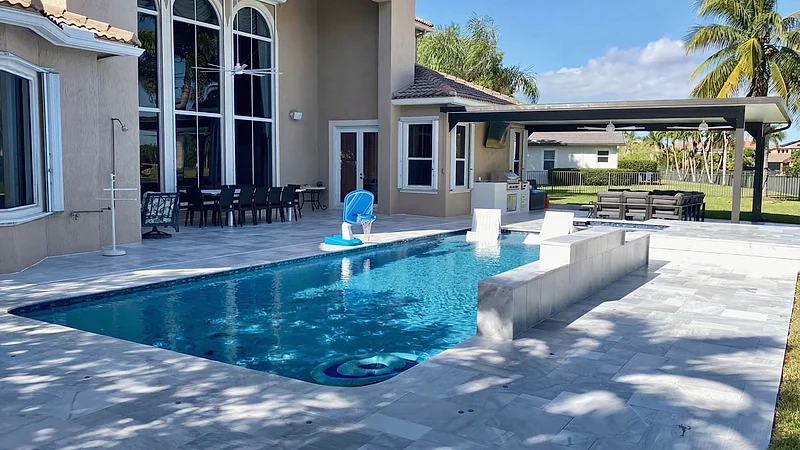
A typical complete pool remodel in Florida runs about $68,000 to $83,000 on our estimator, a compact one starts near $27,000, and a large luxury remodel reaches $218,000. Four decisions explain the gap.Read More: How Much Does a Pool Renovation Cost in Florida? Price Ranges and What Sets the Scope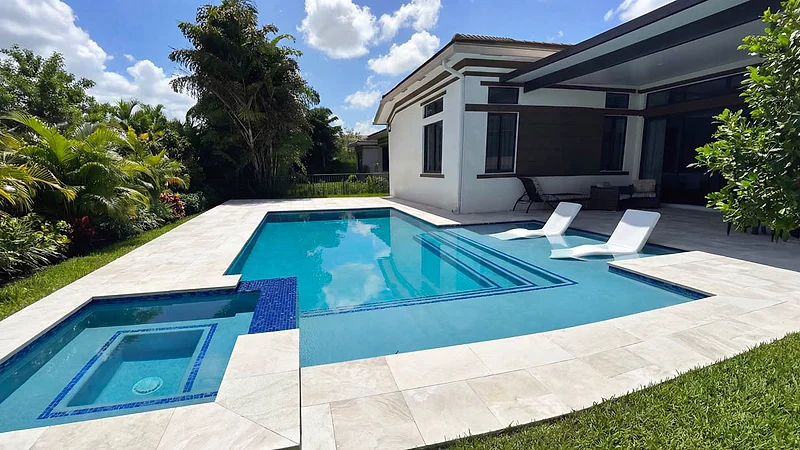
What Should You Upgrade During a Complete Pool Remodel?
A remodel is not a shopping list. It is a window in which the shell, the deck and the ground between them are open. Here is what belongs in that window, and what you can buy any year without penalty.Read More: What Should You Upgrade During a Complete Pool Remodel?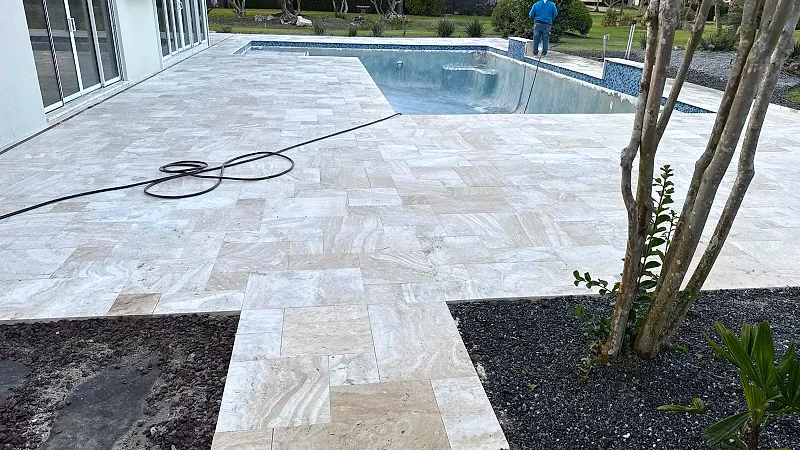
Pool Deck Materials for Florida: Pavers, Travertine and Cool Deck
In Florida a pool deck is chosen for heat underfoot first, grip when wet second and price third. Light, reflective surfaces run cooler, joints decide how easy a deck is to repair, and the spread between concrete and travertine on a typical deck is about $15,000.Read More: Pool Deck Materials for Florida: Pavers, Travertine and Cool Deck
Request a Design-Build Project Evaluation
Share your property details, project scope, and investment range. Our licensed design-build pool builders will review your request and confirm alignment before next steps.
Get a Free Estimate