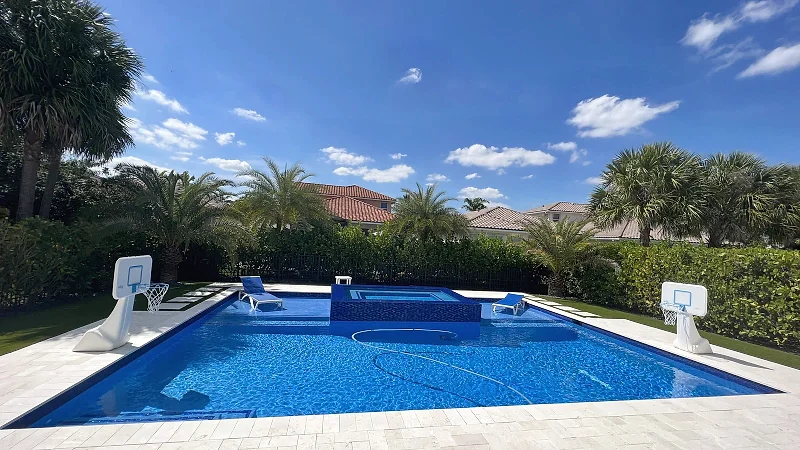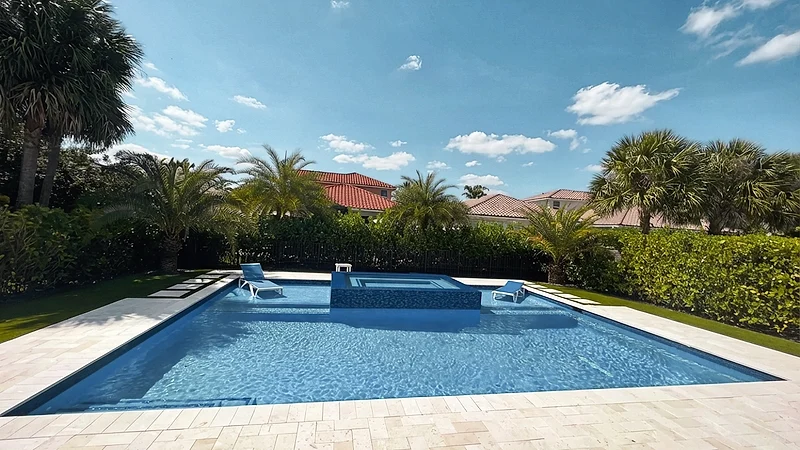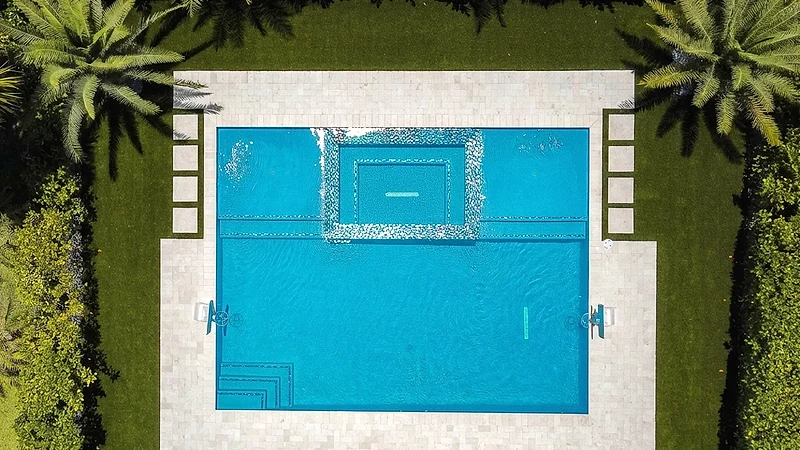
A remodel is not priced from what is wrong with your pool. It is priced from the finished result you are buying. Here is what that costs, and the four things that decide how far the scope goes.
A complete pool remodel in Florida — new interior finish, new waterline tile and coping, a rebuilt equipment pad and a replaced deck — runs about $68,000 – $83,000 on our estimator's default project: a 450-square-foot freeform pool with a pebble interior, a 600-square-foot paver deck, a heater, salt chlorination, three lights and landscaping. That figure comes from our own pool cost estimator, which prices a remodel at 82% of what the same finished result would cost as new construction and publishes every total as a ±10% band.
The second half of that sentence is the part worth understanding. A remodel is not priced from what is wrong with your pool. It is priced from the finished result you are buying, minus the work you already paid for once. The hole, the shell and most of the plumbing are already there. Everything else is quoted the same way it would be on a new build.
That has a consequence most homeowners do not expect: the age and condition of your pool barely appear in the arithmetic. Condition decides whether a remodel makes sense. Scope decides what it costs.
The same estimator, run on the same project both ways:
| Project | Remodel | New construction | Difference |
|---|---|---|---|
| 250 sq ft pool, 200 sq ft deck (the smallest the sliders go) | about $45,000 | about $55,000 | about $10,000 |
| 450 sq ft pool, 600 sq ft deck | about $76,000 | about $92,000 | about $16,600 |
| 900 sq ft pool, 600 sq ft deck | about $127,000 | about $155,000 | about $27,800 |
All three are the same specification — freeform shape, pebble interior, paver deck, permitting and engineering, a heater, a salt system, three LED lights and landscaping — with only the two sizes changed. The range we publish is the middle figure ±10%. Unless a number below is called out as a line in the breakdown, every remodel-path figure in this guide is what the estimator's total moves by when you change one input and leave the rest alone.
Two things fall out of this table.
The saving is a percentage, not a coupon. It grows with the project. On the smallest project the estimator models it is worth about $10,000; on the largest, nearly $28,000. Anyone quoting you a flat "remodels save about $15,000" is quoting the middle of a curve.
Everything you choose during a remodel is also discounted. A spillover spa that adds $18,000 to a new build adds about $14,760 on the remodel path. A screen enclosure that lists at $15,000 adds about $12,300. The crews, the access and the site setup are being paid for once either way.
That 18% — the gap between the remodel price and the new-build price — assumes the shell is sound. It is the entire load-bearing assumption in the number, and the one thing an estimator cannot check.
If the structure has moved, if the steel has corroded through, or if the shape itself is the problem, the credit you are being given for "the shell already exists" shrinks toward nothing — and at some point rebuilding is the cheaper honest answer. That comparison is a diagnosis rather than a budget exercise, and remodel or rebuild is where to make it before you start pricing scope. If you are still deciding between renovating what you have and starting over on a new pool entirely, new pool construction vs pool remodeling covers that fork.
Assume for the rest of this guide that the shell is fine. Four things then decide what the remodel costs.
This is the biggest fork in the road, and it is not really about the pool. It is about the edge.
| What comes off | What it touches | Relative cost |
|---|---|---|
| Interior finish only | The surface and nothing else | Lowest |
| Finish, waterline tile and coping | The first band of deck, necessarily | Middle |
| Finish, tile, coping and deck | The whole deck footprint | Highest |
Where the line falls between the first row and the other two is the subject of resurfacing versus a full renovation; what follows here is what each one does to the number.
Waterline tile and coping sit exactly where the deck meets the water. Removing them means cutting into the deck edge, and a repaired band of twenty-year-old concrete next to new coping rarely looks like anything other than a repaired band. That is why the middle option tends to slide into the third one on site: once you have opened the edge, replacing the deck is the difference between a remodel that looks new and one that looks patched.
The deck is also where the money is. On the remodel path, running the deck slider from 200 square feet to 1,500 is a swing of about $25,600, and choosing travertine over concrete on a 600-square-foot deck is another $12,300. The deck is usually larger than the pool, so it behaves like the larger line item it is. (The material trade-offs — heat underfoot, repairability — are covered in what a custom pool really costs; they are identical on a remodel.)
Inside the water, the interior finish carries the other swing: plaster to a premium aggregate is about $15,500 on this project. It is the decision most often trimmed to protect a budget, and the one that is most expensive to revisit, because changing it later means draining the pool and removing a surface you just paid for.
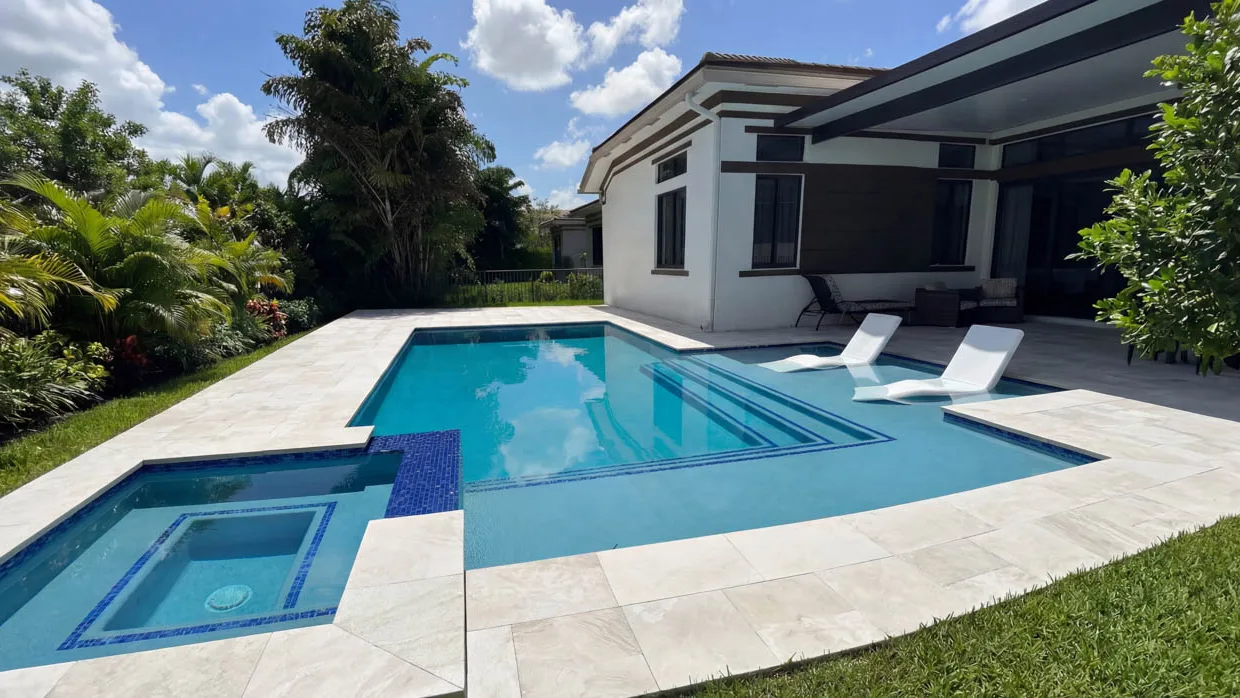
A remodel that resurfaces the existing shape is one kind of project. A remodel that changes the shape — squaring off a kidney, raising a wall, adding a sun shelf or a vanishing edge — is new construction performed inside an existing hole.
Our estimator carries three shape tiers — standard, freeform and luxury — at $85, $110 and $145 per square foot before the finish multiplier. On the remodel path, a 450-square-foot pool moving from the standard tier to the luxury one is about $27,800; from the freeform default to luxury, about $16,200. That gap is real work: new steel, new forming, new plumbing runs, and a structural tie between old shell and new.
It is also the point where the 18% credit starts to erode, because you are demolishing the part of the pool you were being credited for. If more than a wall or two is changing, price it both ways before committing.
A pool built twenty years ago was plumbed for the pad of its day: a single-speed pump, no automation, and lights that were not LEDs. The pad is usually the cheapest meaningful upgrade in the project, and the easiest one to leave out of a budget.
On the remodel path our estimator adds roughly:
The reason to decide this now rather than later is procedural, not financial. Touching the equipment pad generally pulls electrical work — and the bonding of everything metallic around the pool — into the same permit and the same inspection as the rest of the remodel. Done during the project, it is one review. Done in two years, it is its own permit, its own inspection, and a second trip for a crew. What permits are required for pool construction in Florida covers how the reviews stack, and it works the same way on a renovation.
This is the factor that separates remodel pricing from new-build pricing, and it is the one that rarely appears in a budget.
The builder who dug your pool had an open lot. Today that same yard may have a screen enclosure over it, a side gate too narrow for a mini excavator, an A/C pad, a paver walkway, an irrigation system and twenty years of root growth. Every cubic yard of demolition debris has to leave through that, and every pallet of coping has to come in the same way.
Our estimator prices restricted access at 8% of the entire project — about $6,100 on the 450-square-foot remodel above. Rock excavation, where it applies, is 12%, roughly $9,100. Together they move this project by more than $15,000, and neither is visible in a photo of the backyard.
On new construction, tight access is the exception. On remodels it is closer to the default, and it is a common reason an online number and a site visit disagree.
Four things are discovered rather than estimated:
None of these are unusual. What matters is how the contract handles them: whether there is an allowance, who approves the extra work, and whether you see a priced change order before it happens rather than on the final invoice. That question, and the others worth asking before signing anything, are in how to choose a pool builder in Florida.
A remodel quote with no language about what happens below the surface is not a lower quote. It is an incomplete one.
Anything that needs the deck opened, the pad rebuilt or a crew in the backyard is cheaper now than it will ever be again. On the remodel path our estimator prices these additions at:
| Addition | Adds |
|---|---|
| Aluminum pergola | about $6,970 |
| Screen enclosure | about $12,300 |
| Motorized louvered roof | about $14,760 |
| Outdoor kitchen | about $20,500 |
The same structures added two years after the remodel cost their full new-build price, plus the cost of cutting into a deck you just paid to install. If a screen enclosure or an outdoor kitchen is on a someday list, the remodel is the someday.
Which upgrades genuinely have to happen now and which are fine to defer is a separate sorting exercise, and what to upgrade during a complete pool remodel works through it item by item.
Permitting and engineering are already inside every figure above. Our estimator charges them at 9% of the pool plus the deck rather than as a flat fee, so it moves with the scope: on the 450-square-foot project the estimator's Permits & Engineering line reads about $6,300, and it reaches the remodel total at the same 82% as everything else. A project that leaves the deck alone carries a visibly smaller permitting line than one that replaces it.
What sits outside those figures: whatever your county or HOA charges you directly. The review process is set by the county, not by the state, so the sequence and the fees in Alachua are not the sequence and the fees in Broward. What is constant is that the work should be permitted and inspected under the license of the company you contracted with, and that you can verify that license yourself in the state's public register.
Decide the finished result first — deck size, deck material, interior finish, whether the shape changes, what the equipment pad becomes — and price that. Do not start from what is broken; that tells you why you are remodeling, not what it costs.
Then run the same set of decisions through the pool cost estimator with the project type set to remodel, and watch which one moves your number most. For most people it is the deck, and most people expect it to be the finish.
When you have a scope you believe in, a site visit is what turns it into a price. Access, the condition of the shell and what the deck is actually bonded to all need to be looked at — see complete pool remodeling and renovation for how we run one, or request an estimate to start with the walkthrough rather than a number.
Because the excavation, the shell and most of the plumbing already exist and are not being paid for a second time. Our estimator prices a remodel at 82% of the same finished result built new, so the saving is a proportion of the scope rather than a fixed amount. On a larger project it is worth more; on a small one, less.
Far less than most people expect. Condition decides whether a remodel is the right move at all, and scope decides what it costs. A twenty-year-old pool and a ten-year-old pool finished to the same specification price almost identically, as long as both shells are sound.
Sometimes, and it is the cheapest version of the job. The constraint is the edge: waterline tile and coping sit where the deck meets the pool, so replacing them usually means cutting and repairing the first band of deck. If the coping stays, the deck can stay too.
Because the shell is only visible once the old surface comes off. Hollow spots, corroded steel and plumbing buried in the shell wall are discovered rather than estimated. Ask before signing how the contract handles what is found, and what the approval step is before that work proceeds.