Two findings make a rebuild the honest answer. Everything else is remodel work, and the gap is about $16,600 on a typical project. Here is the order to check in, and what each finding actually means.
Rebuild your pool for one of two reasons: the shell has stopped doing its structural job, or the pool is in the wrong place. Nothing else on the usual complaint list — dated finish, cracked deck, obsolete equipment, a shape you stopped liking years ago — requires demolishing anything. That is all remodel work, and our estimator prices a remodel at 18% below the same finished project built new: about $16,600 less on a project that comes out at roughly $92,000 new.
So this is a diagnosis, not a budget exercise. Price the two paths after you know what you have, not before. Below is the order to check in, and the first check that fails is the one that decides.
Checks 1 and 2 are pass or fail. A shell that has failed, or a pool sitting in the wrong part of the yard, sends you to a rebuild regardless of what the rest says.
Checks 3, 4 and 5 decide nothing by themselves. They tell you how much of the remodel saving is actually there, which is a different question and the one most quotes get wrong.
The 18% is a discount on a project the estimator assumes can reuse the shell, the hole and the plumbing already in the ground. That assumption is exactly what check 1 tests. Run the remodel number before anyone has looked at the shell and you have priced a scope you have not confirmed you can buy.
So price is the second question here, not the first. How that discount behaves as the scope grows — what it covers, what it does not, and why it is worth more on a big project than a small one — is worked through in what actually changes a remodel's scope. For the broader comparison of the two routes, budget and disruption included, read new pool construction vs pool remodeling. This article is only about which of the two your pool needs.
This is the only check that can end the conversation on its own, and the only one you cannot do from a deck chair.
What matters is not whether there are cracks — nearly every older concrete pool has some — but which kind. Fine, shallow crazing across the plaster is a surface condition. A crack that runs in a line through the finish and into the shell, that has a lip you can feel with a fingernail, that reappears in the same place after being patched, or that is echoed by a matching crack in the deck above it, is movement. Movement means the shell is working against the ground instead of with it.
Four other findings point the same way:
One or two of these usually means a repair. Several together, or a single structural crack that has moved twice, usually means the shell has reached the end.
Two practical notes. First, none of this can be judged through water and twenty-year-old plaster, so a real answer requires the pool drained. Second, draining a Florida pool is not a homeowner job. Groundwater can float an empty shell out of the ground, which is exactly what the hydrostatic relief valve in the floor is there to prevent, and in wet ground that valve is not always enough. The inspection and the draining get planned together, by whoever is going to be standing in the pool.
Nothing in a remodel moves the pool. Not one foot. If the pool is in the wrong place, a remodel spends real money making a badly located pool nicer to look at.
Stand in the yard and answer honestly:
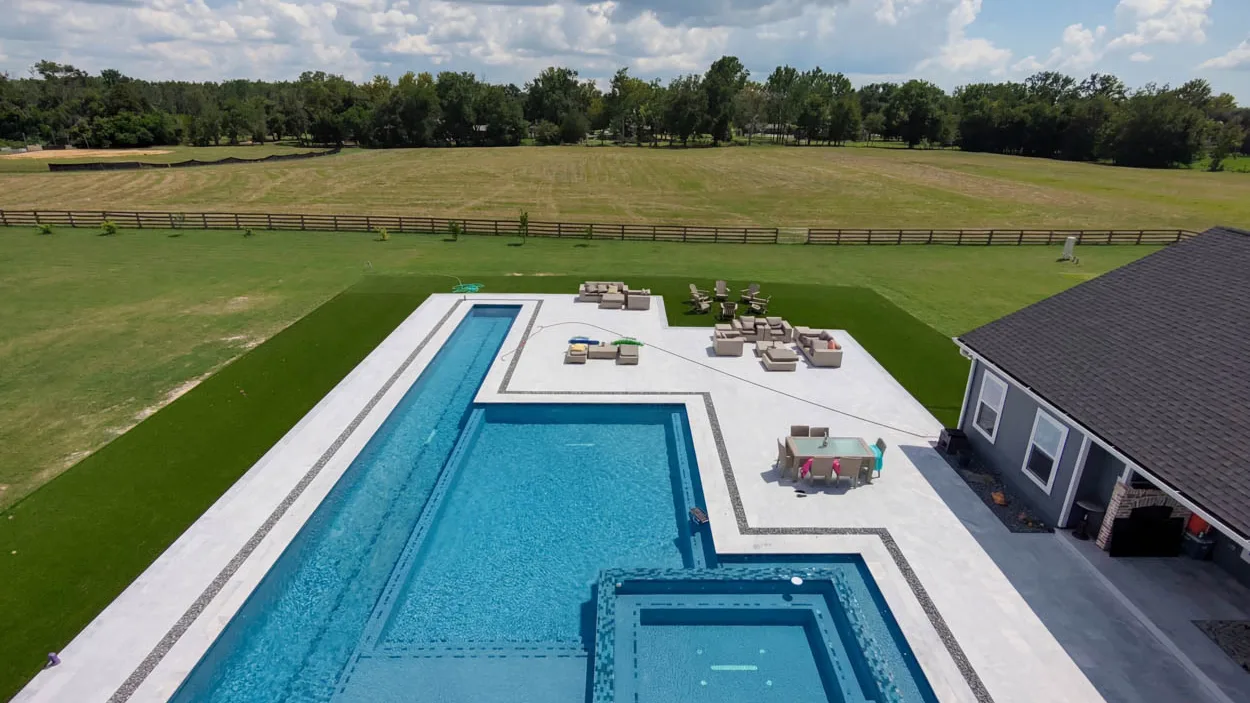
A pool that has to move at all is a rebuild. A pool that is in the right place with the wrong deck around it is a remodel and a deck job — which is usually the cheaper problem, even when the deck is the larger number.
More can be done inside an existing shell than most people expect, and the dividing line is simple: do the existing walls stay where they are?
Work that keeps the walls in place is structural remodeling. Filling in a deep diving well to get a usable depth, cutting in a sun shelf, raising a wall to carry a spillway, squaring off a kidney shape at one end, adding an integrated spa against an existing wall — our estimator prices that spa at $12,000, or $18,000 with a spillover, whether it goes on a new pool or an old one.
Work that moves the walls outward is a new shell. It can be sold as a remodel, and the deposit will be smaller, but you are paying for excavation, steel, concrete and a full inspection sequence. That is a rebuild of part of the pool, and it should be priced and permitted like one.
There is a middle path worth asking about: rebuilding a section while keeping the rest. It is common where one end of a pool is failing or where a diving well has to go, and it prices between the two. What it is not is a way to avoid the structural question in check 1 — a partial rebuild attached to a failing shell is money spent on both.
This is where remodel savings quietly evaporate, because the reuse everyone is counting on is buried.
Ask for the suction and return lines to be pressure tested before anyone commits to a scope. Ask how the lines are routed and whether they run under the deck or under the shell. Ask whether the equipment pad can stay where it is, and what the electrical service at the pad will support — a heater at $4,500, a salt system at $2,200 and an automation panel at $3,500 are all standard remodel line items, and all of them assume power that is already adequate.
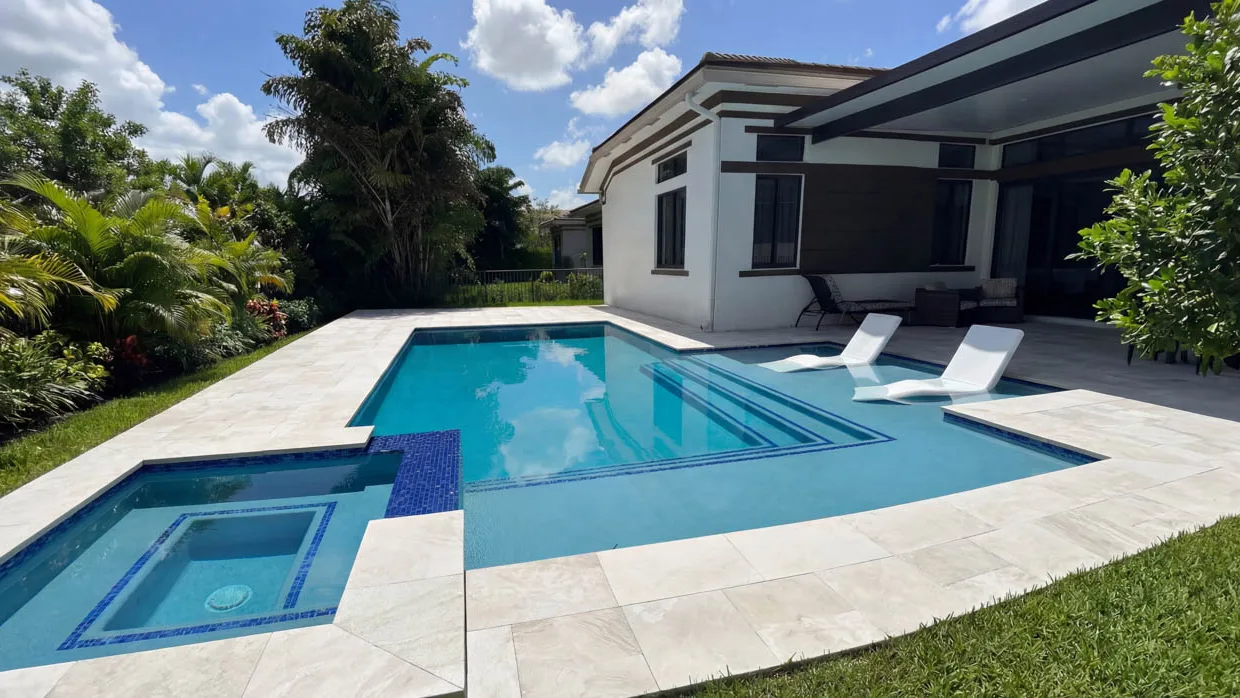
If the answer is that the lines have to be re-run, a good share of the reuse saving goes with them, and the honest comparison changes. That is not a reason to rebuild by itself. It is a reason to know before you sign, rather than at week three.
On most remodels the deck is the biggest single number after the pool itself, and people are consistently surprised by it.
Our estimator prices decking at $12 per square foot in concrete, $22 in pavers and $35 in travertine. On a 600-square-foot deck that is $7,200 to $21,000 — a spread as wide as the entire interior finish decision. If the existing deck is cracked, sloped toward the house or the wrong height against a new coping line, it is coming out, and it belongs in the comparison from the start.
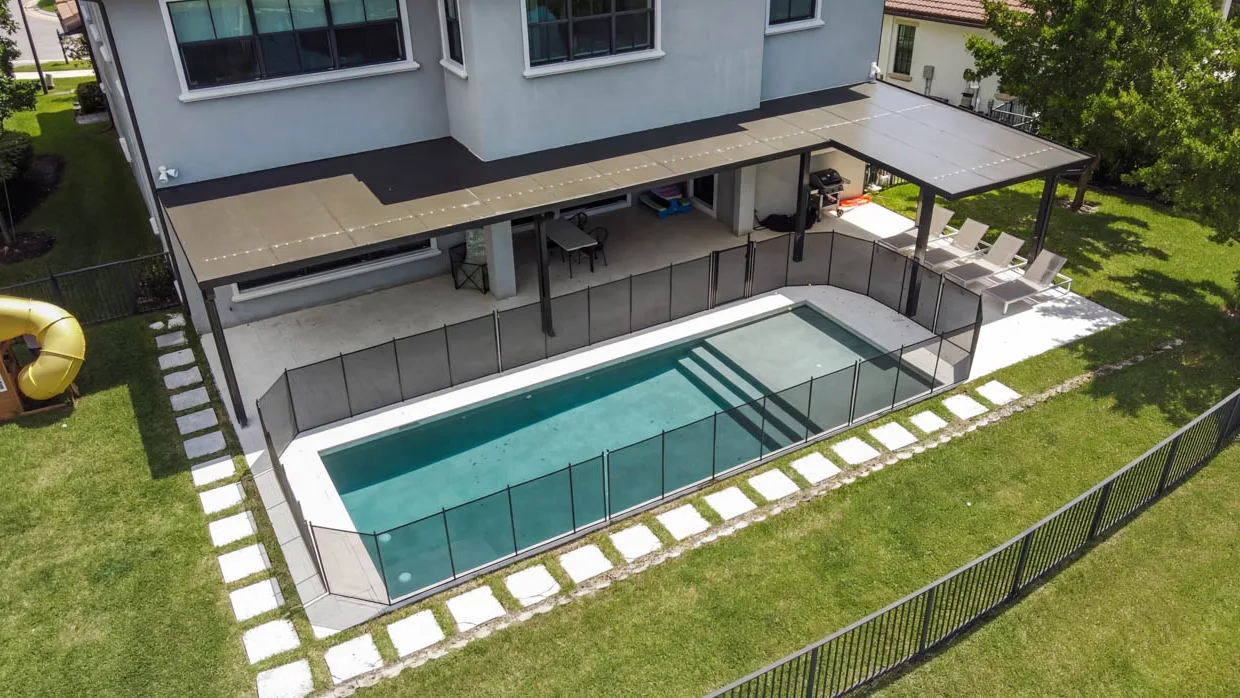
Two more items around the water change the arithmetic:
New construction figures — ours included — assume an empty yard. A rebuild starts with an excavator removing a pool that is already there, and then builds the new one.
There is no demolition line in the estimator, because demolition is not estimated from a table. It is driven by three things: how an excavator reaches the back yard, how large and how deeply reinforced the old shell is, and how much deck comes out with it. A pool behind a house with a wide side gate and one behind a house with a narrow gate and a screen cage are not the same job.
So the comparison is not remodel versus new. It is:
| Path | What you pay for |
|---|---|
| Remodel | New finish, new equipment, deck work, some structural work — at 18% below the new-build figure |
| Partial rebuild | The above, plus excavation, steel and concrete for the section being replaced |
| Full rebuild | Demolition and disposal of the old pool, plus the full new-construction price |
Permits scale with scope on all three paths. The estimator carries permitting and engineering at 9% of the pool and deck, which means the same review cost that a new build carries arrives with a remodel the moment the structure, the depth or the electrical changes. A finish-only project usually does not trigger that; a structural one usually does. What each county reviews, and in what order, varies — the part that does not vary is that the contractor pulls the permit under their own license and the work gets inspected.
If the yard would genuinely be better without the pool, removing it is a real answer. It is not the right answer often — but it is worth five minutes before committing a remodel budget to a pool nobody in the household has swum in for three years.
Worked in that order, the decision is usually already settled by check 1 or check 2, and what was left to argue about turns out to be scope. That is the useful outcome: it moves the conversation from what the pool costs to what it needs.
If you want to see how we run that inspection and what a scope looks like when it comes back, that is on the pool remodeling and renovation page. If the shell turns out to be finished, custom pool and spa construction is the other path, and a project estimate starts with the site visit rather than a number.
Age on its own decides nothing. A concrete shell that was built well and has not moved can be resurfaced and re-plumbed repeatedly. What forces a rebuild is a shell that has lost its structure or a pool sitting somewhere you would not put one today.
Our estimator prices a remodel at 18% below the same finished project built new — around $16,600 on a project that prices at about $92,000 new. Because it is a percentage it grows with the size of the project, and it assumes the existing shell can be reused. If the shell cannot be reused, the saving that number is built on is not there.
Sometimes. Filling in a deep diving well, adding a sun shelf or raising a wall for a spillway is structural work done inside a shell that stays where it is. Moving the walls outward is a new shell, which is a rebuild whatever it gets called in the quote.
It is higher. New construction figures assume an empty yard, and a rebuild starts by demolishing and hauling away a pool that is already there. How much higher depends on access to the back yard, the size of the old shell and how much deck comes out with it.
Not safely in most of Florida. Groundwater can lift an empty shell out of the ground, which is what the hydrostatic relief valve in the floor exists to prevent. Draining should be planned by the contractor who is going to do the inspection, and usually only when the water table allows it.