How Long Does Pool Resurfacing Last in Florida, and What Are the Signs It's Time?
Neither the pool industry's standards body nor the plasterers' council publishes a lifespan in years for a pool finish. What they do publish is what shortens it, and the signs that it is done. Judge your pool by those, not by its age.
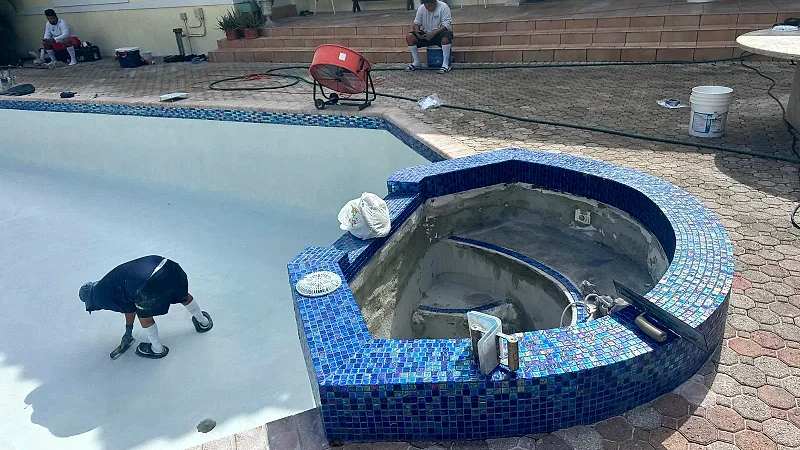
There is no standard number of years. Neither the Pool & Hot Tub Alliance nor the National Plasterers Council publishes a lifespan for plaster, quartz or pebble finishes. What decides it, according to the plasterers' council, is the finish chosen, how it was installed, how it was started up, and how the water has been kept since. A pool commonly needs resurfacing when the surface has become pitted and rough.
So the honest answer to "how long does it last" is a question back: what does your surface look like? The rest of this article is how to read the surface you have.
Key facts
- The National Plasterers Council (NPC) says a pool commonly needs resurfacing "when the surface has become pitted and rough."
- NPC calls unbalanced water chemistry the leading cause of deterioration of the finish coating.
- Color loss caused by bad water chemistry is, in NPC's words, irreversible once the pigment has leached.
- The Pool & Hot Tub Alliance (PHTA) says a freshly plastered pool needs frequent brushing, testing and chemical adjustment for the first 28 days, and that there is no one-day start-up that safely balances the water.
- PHTA puts proper water balance between −0.3 and +0.5 on the Langelier Saturation Index. Below zero, PHTA says, the water tends to etch cement-based surfaces.
- One pebble-finish manufacturer warrants its materials, and its installers their workmanship, for a minimum of five years, and asks for water chemistry records with any claim. That is a warranty, not a lifespan.
Why is there no honest number in years?
Because the finish does not wear out on its own. It wears out at the rate the water and the use allow.
You will find figures in years quoted for every finish type. We have not found one published by the industry's standards body or by the plasterers' council, and we do not have measured lifespans from our own work to publish in their place. What the published sources agree on is the list of things that shorten a finish, and that list is more useful than an average, because most of it is in the owner's hands.
| What decides it | What it does to the surface | Source |
|---|---|---|
| The finish chosen | Plaster, quartz and pebble differ in how they wear and how they show wear | NPC finishes guide |
| Installation | A finish applied badly fails early whatever is done afterwards | NPC finishes guide |
| Start-up | The first 28 days set the surface; skipping them shortens its life | PHTA start-up fact sheet |
| Water balance, every week after | Aggressive water etches and leaches color; over-saturated water scales and stains | NPC white papers, PHTA water balance bulletin |
| Fill water | Low calcium, alkalinity or pH in the source water etches; high levels scale | NPC Technical Bulletin #1 |
How plaster, quartz and pebble compare as materials — the look, the feel underfoot and what each costs — is in pool finishes compared: plaster, quartz and pebble. This article is about when the one you have is done.
What are the signs a pool needs resurfacing?
| Sign | What it means | Resurface? |
|---|---|---|
| Rough, pitted surface that snags swimsuits and scrapes feet | The finish has worn or etched away at the surface | Yes — NPC's own description of when resurfacing is commonly needed |
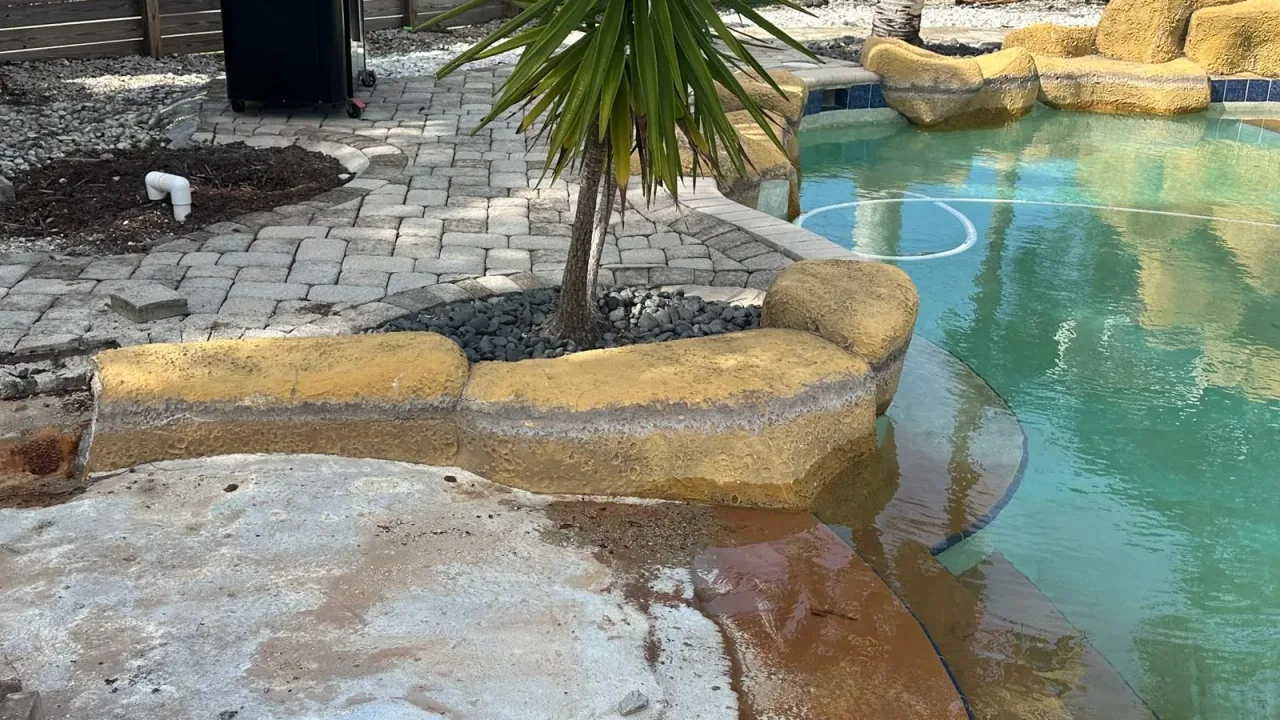
| Etching: a dull, sandy texture, sometimes in patches | Aggressive water has dissolved part of the surface | Often, once it is rough; fix the water first either way |
| Color that has faded or gone blotchy and does not come back | Pigment leached by bad chemistry | If the look matters to you; NPC says this color loss is irreversible |
| Areas that sound hollow when tapped, or flake at the edges | The finish has separated from the shell beneath it | Yes, and the separated areas have to come off first |
| White or gray crust, especially at the waterline | Scale from over-saturated water | Not necessarily — scale is a chemistry problem first |
| Stains, rust-colored or dark | Metals in the water, debris, or steel corroding behind the finish | Depends on the cause; rust from behind the finish is a structural question |
| Fine surface cracks like a crazed glaze | A surface condition of the finish | Not on their own |
The last two rows are the ones to slow down on. A rust stain bleeding through from behind the finish, or a crack that runs in a line and has a lip you can feel, is not a resurfacing sign. It points at the shell, and resurfacing over it hides the problem for a season. That diagnosis is covered in new pool construction vs pool remodeling.
Which signs are not about the finish at all?
Several common complaints get answered with a resurface and should not be:
- Scale and stains that clean off. If a brush, an acid wash or a chemistry correction brings the surface back, the finish was not the problem.
- Loose or missing waterline tile. That is the edge, not the finish, and it has its own causes — see pool coping and tile replacement.
- A pool that loses water. A new finish is not a leak repair. Find the leak first.
- A pool you no longer like the shape of. Resurfacing returns the same shape, depth and steps. If the shape is the problem, read pool resurfacing vs a full renovation before pricing a finish.
Why the first 28 days matter more than the label
A new finish is at its most vulnerable right after it goes on. PHTA's start-up guidance for plastered pools is blunt: there is no one-day start-up that safely balances the water, and the first 28 days need frequent brushing, testing and adjustment.
That is one reason two pools with the same finish can age very differently: one was started up over four weeks and kept in balance, the other was filled, dosed once and left. If you are resurfacing, ask who is responsible for the start-up, what it involves, and for how long — and if the finish carries a manufacturer's warranty, keep the water records it may ask for.
Does the finish you choose change how long it lasts?
It changes how the surface ages and how it shows wear, and it changes the price. Our estimator multiplies the pool line by 1.15 for pebble and 1.35 for a premium aggregate, against plaster. What it does not do is exempt any finish from the water: NPC's guidance on chemistry applies to every cement-based finish, and one pebble manufacturer's warranty asks for chemistry records before it pays a claim.
Color is the other half of the choice. Dark finishes show chemistry and scale sooner, which is worth knowing before you pick one; dark pool finishes in Florida covers what that means here.
In Gainesville and Ocala
The signs are the same anywhere. One local factor deserves a test before the new finish starts up.
- Well water. Outside city water service, a pool may be filled from a private well. NPC's bulletin on fill water says low calcium hardness, alkalinity or pH in the source water can etch a new surface, and high levels can scale and stain it. If the pool is filled from a well, test the fill water before start-up rather than after the first stain.
- The rest of an older pool. A pool old enough to need its finish replaced usually has other layers close to due. What changes on an older pool in this part of the state is in remodeling an older pool in North Florida.
How we assess and resurface a pool in each area is on our pages for pool remodeling in Gainesville and complete pool remodels in Marion County. Our pool remodeling page covers the whole region.
What to do with this
Look at the surface, not the age. Run a hand along the floor and the steps, tap the areas that look different, and note whether the stains brush off. If the surface is rough and pitted, the finish is done. If it is stained but smooth, start with the water.
When it is time, decide the scope before the finish: whether the tile, the coping or the deck are close to due as well changes what the job should be, and what a pool renovation costs in Florida shows how each choice moves the number. To have someone who will be standing in the pool look at yours, request a design-build evaluation.
Common questions
How long does pool resurfacing last?
There is no published standard in years. The National Plasterers Council says a finish reaches its expected life through the finish chosen, proper installation, a proper start-up, and ongoing water chemistry and care. Manufacturers state their own warranties. In practice, the condition of the surface tells you more than its age.
How often should you resurface a pool?
When the surface tells you to, not on a calendar. The National Plasterers Council says a pool commonly needs resurfacing when the surface has become pitted and rough. Rough patches, etching, color loss that will not come back, and areas that sound hollow when tapped are the signs to look for.
What shortens the life of a pool finish?
Unbalanced water chemistry, above all. The National Plasterers Council calls it the leading cause of deterioration of the finish. Water that is too aggressive etches the surface; water that is over-saturated leaves scale and stains. A careless start-up in the first weeks after the finish goes on also shortens it.
Is a stained pool a pool that needs resurfacing?
Not necessarily. Stains and scale can come from the water and may be treatable without replacing the finish. Color loss caused by bad chemistry is different: the plasterers' council describes it as irreversible. A rough, pitted surface is the clearer sign that the finish itself is done.
Sources
- National Plasterers Council — A Guide to Swimming Pool Finishes (brochure, 2016)
- National Plasterers Council — Why Is White Cement Used in Swimming Pool Plastering? (white paper)
- National Plasterers Council — What happened to my pool's interior finish color? (white paper)
- National Plasterers Council — Technical Bulletin #1, Testing Fill Water
- Pool & Hot Tub Alliance — Technical Bulletin, Water Balance Indexes (2017)
- Pool & Hot Tub Alliance — Fact Sheet, Fresh Fill Water Start-Up for Plastered Pools (2021)
- Pool & Hot Tub Alliance — PHTA standards (ANSI/PHTA/ICC/NPC-12, plastering of pools and spas)
- Pebble Technology International — Warranties (manufacturer's statement)
About the author
Robert Wesley Brannen is the co-founder of Mr. & Mrs. Outdoor Living and a Florida-certified pool and spa contractor. Having started in his family's aluminum business at age 13 and previously led Happy House Outdoor Living, Robert brings extensive experience in custom pool construction, outdoor structures, and design-build project management.
Florida Licenses: CPC1460562 · CPC1461119 · SCC131153553.
Most Read Articles
Pool Resurfacing vs. Full Pool Renovation: What's the Difference?
Resurfacing and a full renovation are not two budgets for the same job. One changes the surface; the other changes the pool. Here is where the line falls and the question that decides which side of it you are on.Read More: Pool Resurfacing vs. Full Pool Renovation: What's the Difference?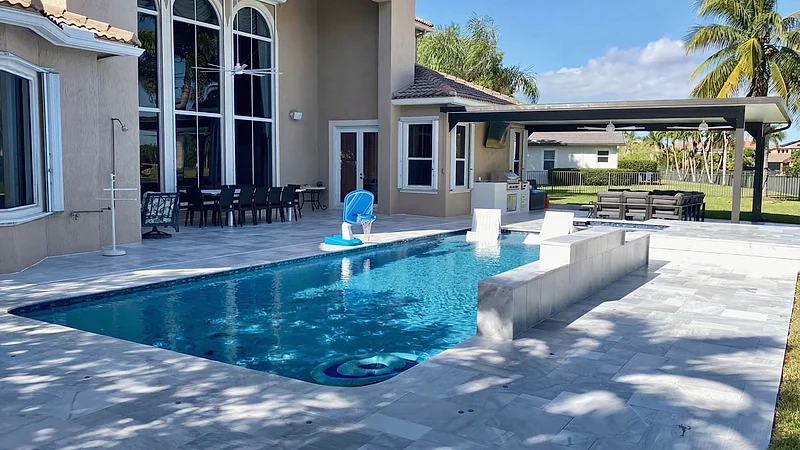
How Much Does a Pool Renovation Cost in Florida? Price Ranges and What Sets the Scope
A typical complete pool remodel in Florida runs about $68,000 to $83,000 on our estimator, a compact one starts near $27,000, and a large luxury remodel reaches $218,000. Four decisions explain the gap.Read More: How Much Does a Pool Renovation Cost in Florida? Price Ranges and What Sets the Scope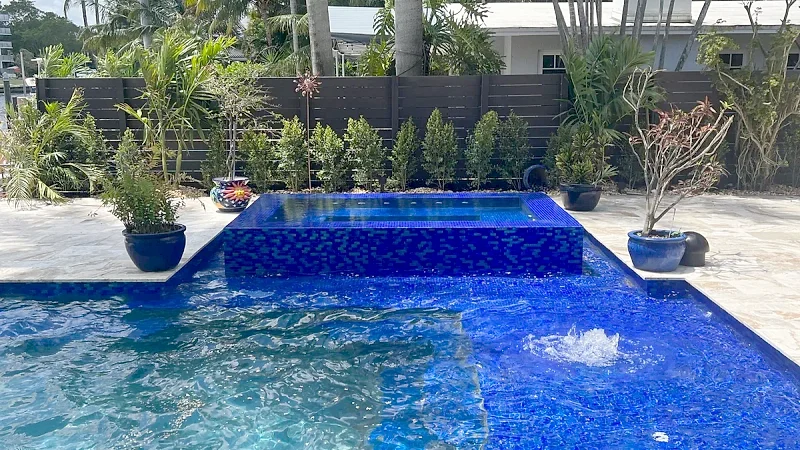
Dark Pool Finishes in Florida: What Changes With the Water, the Heat and the Chemistry
A dark finish turns a Florida pool into a deep blue or green mirror, warms the water faster, hides debris and shows chemistry mistakes. It is the single choice that changes a pool's character most, and it rewards owners who understand the trade-offs before they pick a sample.Read More: Dark Pool Finishes in Florida: What Changes With the Water, the Heat and the Chemistry
Request a Design-Build Project Evaluation
Share your property details, project scope, and investment range. Our licensed design-build pool builders will review your request and confirm alignment before next steps.
Get a Free Estimate