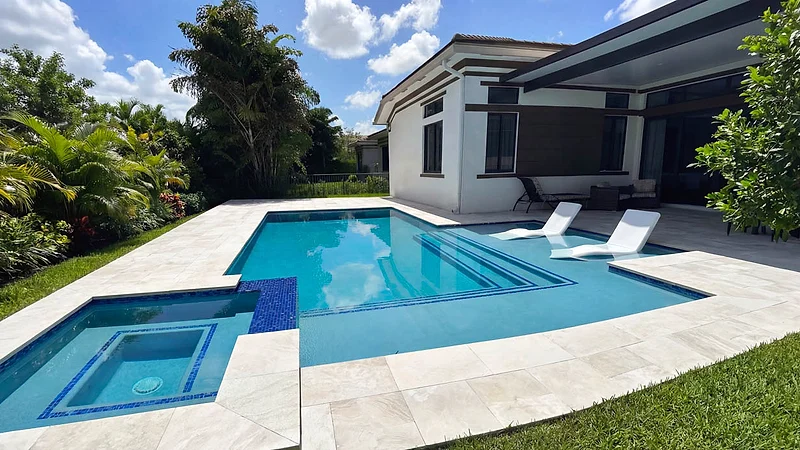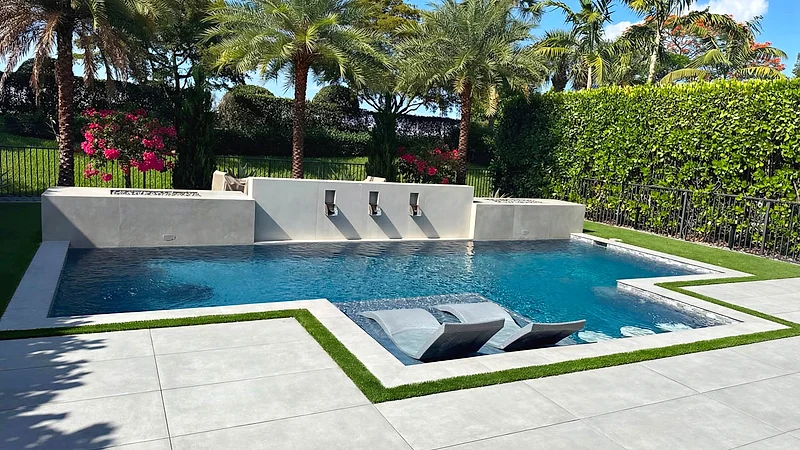
Most remodel lists rank by cost or by what shows up in a photo. These nine are ranked by what is different about a Saturday once the crew has gone, which is why the interior finish comes ninth.
The decisions that make an old pool feel new are the ones that change what you do in the yard, not the ones that change what you look at. Ranked that way, the list opens with how many months the water is warm enough to get into, what shades the deck between noon and five, and whether there is anywhere to sit other than a lounger. The interior finish, which is where nearly every remodel conversation starts, comes ninth.
That is one ranking of the same work, and it is worth saying which one it is. Which changes you actually see from the deck ranks this list by what reads in the view. What belongs in the scope while the pool is open sorts it by what closes when the crew leaves. This article asks a third question, and it is the one people are actually paying to answer: after everybody has gone home, what is different about a Saturday?
The remodel worth avoiding is the one that changes everything you look at and nothing you do. New tile, new coping, new plaster — and the water is still too cold in March, the deck is still unusable at two in the afternoon, and the same two people get in.
| # | Decision | What it changes | When it shows up |
|---|---|---|---|
| 1 | Heat, and how much water you heat | Months of the year the pool gets used | Every cool week |
| 2 | What shades the deck | Hours of the day the deck gets used | Every summer afternoon |
| 3 | Where people can sit | Who uses the pool, not just how often | Whenever there are more than two of you |
| 4 | How the water moves | What upkeep costs and feels like | Weekly |
| 5 | Where the equipment lives | Whether you sit outside at night, and how it gets serviced | Nightly, and at every service call |
| 6 | Sanitizing and controls | What the weekly routine is | Weekly |
| 7 | The edge: coping and tile | How the pool reads, and what you grab and sit on | Every time you look at it or get out |
| 8 | Light | Whether the pool has an evening at all | After dark, half the year |
| 9 | The interior finish | Texture underfoot, and when you do this again | Daily, and again at the next refinish |
A heater is a purchase. Our estimator prices one at $4,500, and it can be bought in any year without a remodel. What cannot be bought later is a pool that is cheap to heat, and three remodel decisions set that permanently.
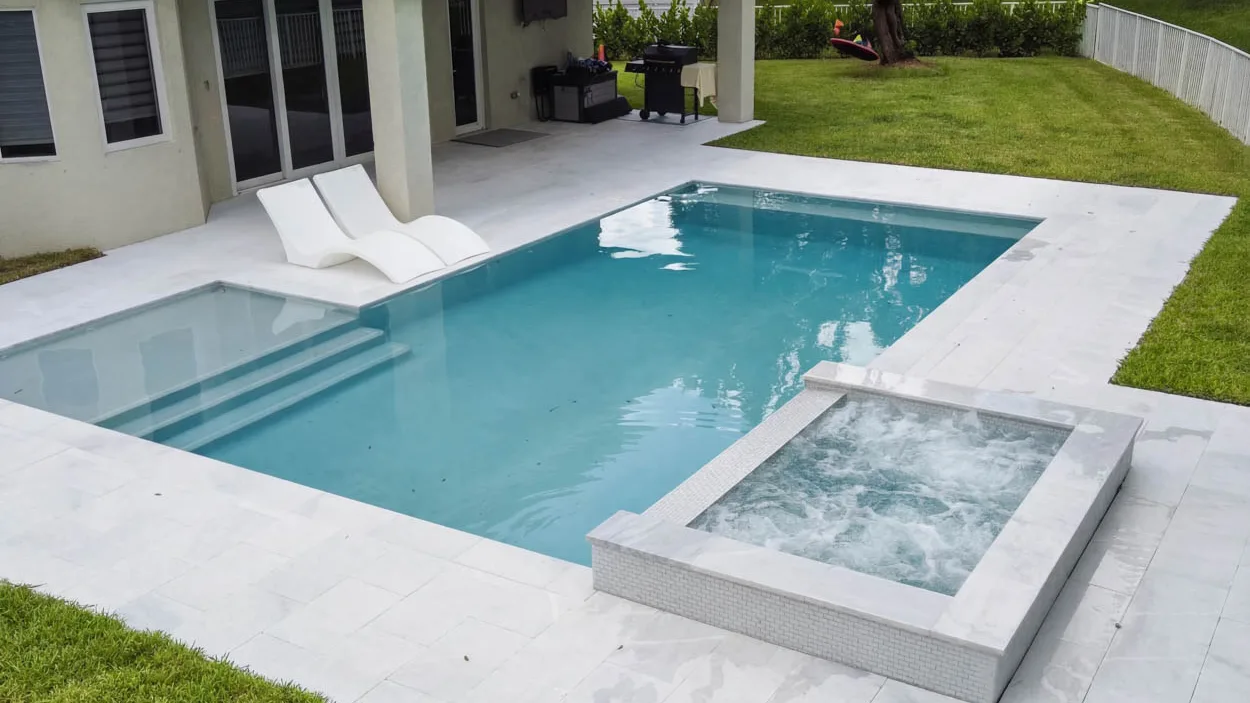
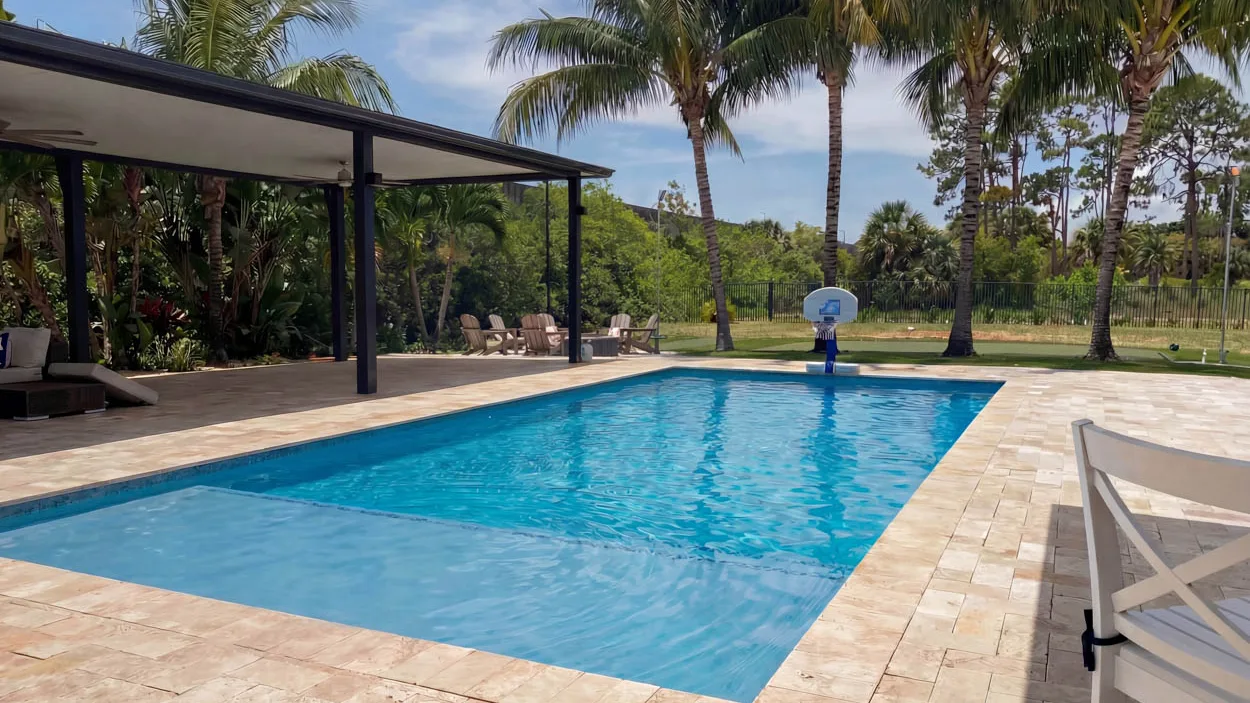
A deck too hot to cross barefoot is not a deck, and a pool nobody walks to is not used. Deck material is priced per square foot in our pool cost estimator and surface temperature varies with it, but the larger lever is what stands over the deck rather than what it is made of.
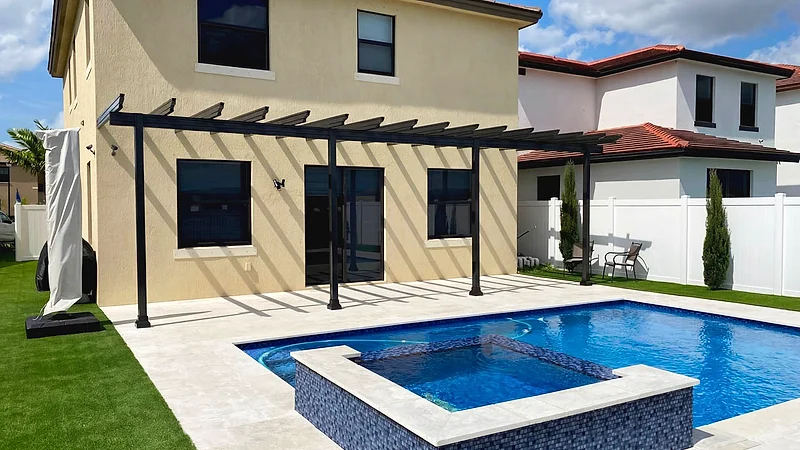
Three scopes, all priced in the estimator: a pergola at $8,500, a screen enclosure at $15,000, a motorized louvered roof at $18,000. They do different jobs. A pergola shades at a fixed angle, so where it sits decides which hours it is worth having. A louvered roof lets you change that angle and close it in rain. A screen enclosure changes insects and leaf load far more than it changes heat, which is a different problem that often gets solved with the wrong product.
The part worth doing before anyone draws anything: stand in the yard at four in the afternoon, in the month you use the pool most, and mark where the shadow of the house actually falls. Shade gets designed on plan at noon, because noon is the easiest geometry and the sun is overhead — and noon is not when anybody is out there. Anything standing over the deck also needs footings through the slab, which is why the timing belongs with the rest of the scope.
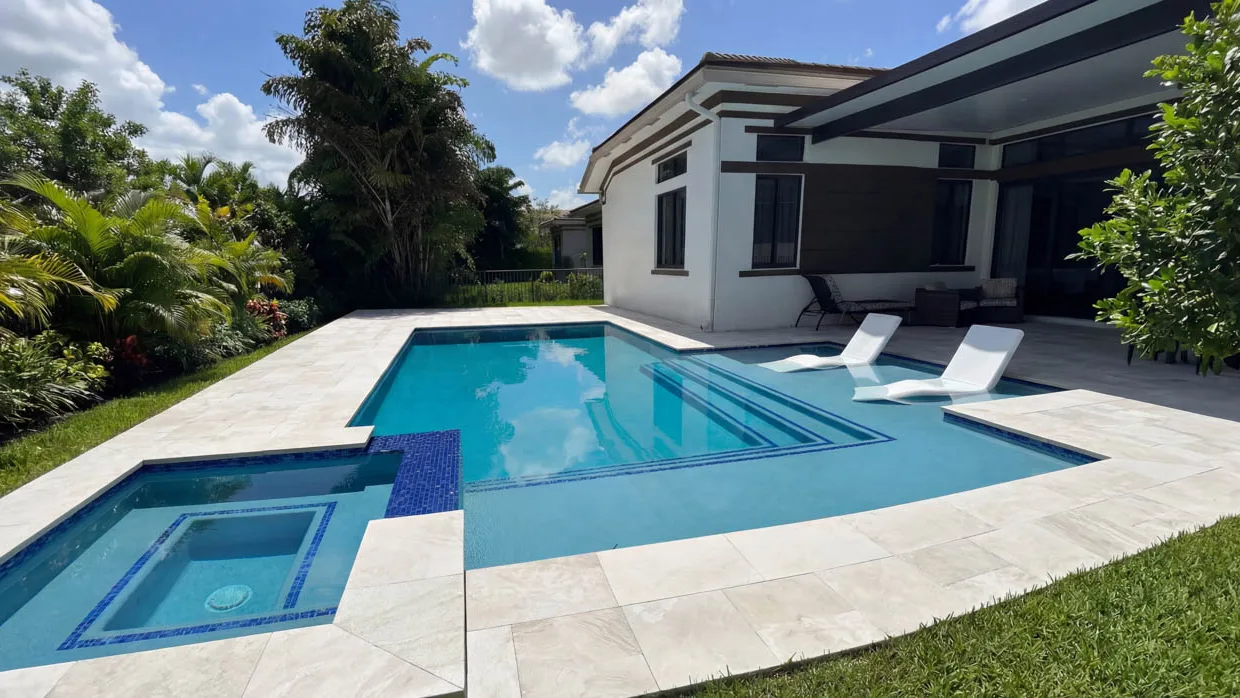
Most old pools offer exactly two positions: swimming, or sitting on a lounger looking at the water. The edits that change that are cuts into the shell, so they are decided before demolition:
The deck half of the same question is width, not material. A uniform walkway around a pool has nowhere to put a table, because a table needs the depth of a chair pulled out plus a path to walk behind it. Measure the furniture you already own before anyone quotes a surface: pull a chair out from your indoor table, measure what it occupies, and mark that on the ground. Widening one side and narrowing another can cost the same square footage. What that does to the view is covered in the changes you actually see; what it does to the slab and its drainage is custom deck construction.
Nothing in this group shows up in a photograph. Together they are most of what people mean when they say a pool is easy, or that it is a pain.
You can diagnose an old pool's circulation without touching the equipment. The same corner is always the last to clear after a storm. One end is noticeably warmer than the other on a heated day. The water behind the steps never seems to move at all.
That is geometry, not chemistry — how many returns there are and where they point — and it gets blamed on the sanitizer for years. It costs a homeowner in brushing time, in chemical, and in the one corner that always goes green first. Ask where the returns are and where they aim before the finish is specified, because both are cut into the shell.
Pipe diameter belongs in the same conversation. How quietly and how cheaply a variable-speed pump can turn the pool over depends on the diameter it is pushing water through, and that diameter was decided the day the pool was plumbed. The pump is a purchase you can make in any year. What it pushes against is not.
The pad went where the plumbing run was shortest on the day the pool was built. Two decades later it is under a bedroom window, or on the side of the house you now want to use for something else.
Noise is the consequence people notice: a pad you can hear from the deck is a pad you turn off in the evening, which is the half of the day you were hoping to get back. Service access is the consequence they notice later. A pad you cannot reach with a filter cartridge in both hands is a pad that gets serviced badly, and that shows up as equipment life rather than as an inconvenience.
Decide it against three things: what it is audible from, what will screen it, and whether there is room to stand in front of it. The screening is the part that gets forgotten, because it belongs to a different trade — landscaping has to know where the pad ended up before anything gets planted in front of it.
Our estimator prices salt chlorination at $2,200 and automation at $3,500. Neither changes a single thing about how the pool looks, and between them they change the weekly routine more than anything else on this list.
On a scope list they belong near the bottom, because neither needs the shell, the deck or the trench open — that is the argument in what belongs in the scope while the pool is open, and it is correct. On this list they are sixth, because the bottom of a scope list is not the bottom of a difference. They are cheap to defer and worth having.
One thing in this group is trapped by the remodel: the electrical capacity and the conduit at the pad. Confirm that both can carry whatever you might add while there is an electrician on site, or the inexpensive upgrade turns into a trench.
This is the one item where the visual ranking and this one agree, and the changes you actually see covers what the tile band and the coping profile do to the view. The part that belongs here is narrower and gets left out of both conversations: the coping is the edge you grab when you get out, sit on with your feet in the water, and walk on wet.
Profile is therefore a comfort decision as much as a visual one. A square or cantilevered edge is a better handhold and a harder thing to sit on for twenty minutes. A rolled bullnose is the opposite. Whichever you choose, choose it with a hand and a wet foot rather than from a sample board, because you will use it that way every time.
Our estimator prices LED pool lights at $450 each. That number is not the interesting part. The interesting part is that in Florida the comfortable hours in summer are after dark, so a pool without usable light is a daytime object in the season when daytime is the worst time to be outside. Lighting is an hours-of-use decision, and it belongs in the same argument as heating rather than in the argument about photographs.
An older pool typically has one large fixture in the deep end aimed back at the house. It lights the water from one side, leaves the shallow end dark, and shines directly at whoever is sitting on the far deck. More fixtures and better aim fix all three. A pool fixture is not a lamp you screw in: the wall is formed around its housing and a conduit run back to power, which makes the count and the aiming a shell decision rather than an equipment one.
The exception worth knowing is lighting mounted on the house itself, like permanent soffit LED lighting, which is not trapped by the deck at all. That is a reason to decide it separately and later, not a reason to leave the yard dark.
Our estimator multiplies the pool line by 1 for plaster, 1.15 for pebble and 1.35 for a premium finish. The color conversation dominates this decision and two things it leaves out matter more day to day.
Texture. An exposed-aggregate finish has more grip than plaster and more bite — better on a step you walk down wet, more abrasive under a foot resting on a ledge for an hour. If decision 3 gave you a ledge people will stand on daily, feel the sample with a bare foot, not with a hand.
Service life. The finish is the item that decides when the pool next comes offline, which is to say when you do some version of this again. It also cannot be deferred at all: once the pool is drained it is being refinished, whatever else is or is not in the scope.
Color still matters, and how it reads against the coping and the deck is in the changes you actually see. Ask to see any candidate in finished water, outdoors, at a depth close to yours. Samples are dry, small and lit by a showroom.
Most of the regret in a remodel is not a bad decision. It is two good decisions taken separately.
| If you decide this | You have also decided this |
|---|---|
| To fill the unused diving well | What the pool costs to heat from then on |
| To shade the west side of the deck | That the water gets less of the afternoon sun that heats it |
| To add a tanning ledge | Where a bubbler could ever go, and where sun has to reach for the ledge to be worth having |
| To move the equipment pad | What has to screen it, and which side of the house stays quiet |
| To widen one side of the deck | The permit line, which our estimator calculates at 9% of the pool and deck work |
That last row surprises people. Permitting scales with scope rather than arriving as a flat fee, and what gets reviewed is a county question rather than a Florida one — a cosmetic resurface, a structural change to the shell and new electrical are three different submissions. What permits are required for pool work in Florida walks through a full set. Whatever your scope turns out to be, the work should be permitted and inspected under a licensed contractor, and you can check that license yourself in the state's public registry.
Two things sit outside this list. What actually changes a remodel's scope is where the arithmetic lives, and whether the existing shell is worth keeping at all is a decision taken before any of these nine, in remodel or rebuild. If you want to see how the nine land in finished work rather than in renderings, our project gallery is built jobs.
The way we scope a complete pool remodel follows the order above, starting from what the existing shell, deck and plumbing can carry. To turn a scope into a price, request an estimate — and ask for the visit at the hour you would actually be out there.
A change in what you do in the yard, not only in what you look at. The pool gets used more months of the year, the deck is usable in the afternoon, and there is somewhere to sit other than a lounger. A pool can be entirely refinished and still be used exactly as little as before.
It makes it look clean, which is not the same thing. Resurfacing changes nothing about when the pool is warm enough to use, whether the deck is usable at two in the afternoon, or where a person can sit in the water. Those are separate decisions with separate scopes.
Partly. A concrete shell can be cut and added to, so edits at the edges are practical — a tanning ledge, a bench, a wider entry step, a raised wall, filling an unused diving well. Changing the overall outline is a different project, and at that point the honest comparison is against building new.
Our estimator prices a full remodel at about 82% of what the same finished result costs as new construction, because the excavation and the shell already exist. That assumes the existing shell is sound; if it is not, the comparison changes.
It depends on the scope and on the county, which is why the answer varies across Florida. A cosmetic resurface, a structural change to the shell and new electrical or plumbing are different reviews. Whatever the scope, the work should be permitted and inspected under a licensed contractor, and you can confirm that license in the state's public registry.