A remodel photographs well from angles you will never stand in. These are the ten changes that read from the patio door, ranked by how much of them you see rather than by what they cost.
The changes you actually see are the vertical ones: the waterline tile, the coping edge, and whatever stands up behind the water. The interior finish is usually the largest single line in a pool remodel and the one you notice least from the deck, because at standing height you are looking at reflected sky rather than at plaster.
That is not an argument for skipping the finish. It cannot be deferred once the pool is drained, and it sets the color of the water in every wide shot of the yard. It is an argument for sorting your list by what changes the view from the kitchen window and what only changes the drone photo. The ten below are sorted that way.
Most before-and-after sets are partly a remodel and partly a photography difference. Three patterns account for nearly all of it:
None of that is dishonest, but none of it is the remodel either. Ask for one pair taken from the same spot, at the same height, at the same time of day. Whatever difference survives is what you are buying. Apply the same test to our own project gallery: the photos worth learning from are the ones shot from where somebody would actually be standing.
Standing on a deck, you see the water at a grazing angle, so most of what reaches you is reflection. Vertical surfaces reach you at full value: the tile band, the face of the coping, a raised wall, the screen frame, the house behind. Horizontal surfaces close to your feet — the deck — reach you at something in between, but they cover more area than anything else in the view.
So the honest ranking is not by cost. It is by how much of a change is standing up in front of you.
| Change | What you see standing on the deck | Where it lands in the budget |
|---|---|---|
| Waterline tile band | High. It frames the water at the line the eye tracks | Small |
| Coping edge and profile | High. It draws the whole outline of the pool | Small to medium |
| Deck surface and tone | High. Largest area in the view | Large. The material sets the rate |
| A raised wall or spillway | High. Often the only thing standing up | Medium to large |
| A raised spa | High. Elevation is the thing you see | Large |
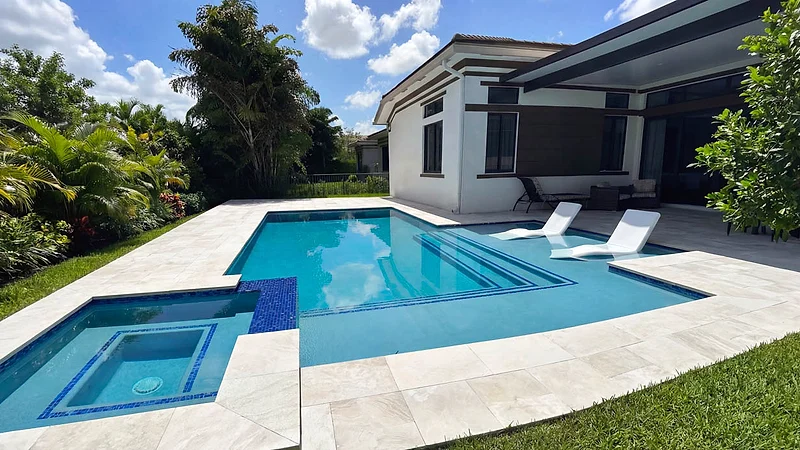
| Tanning ledge or wider entry | Medium. Changes the shape of the water | Medium |
| Deck footprint and proportion | High. It decides whether there is room to sit | Large. The area sets the total |
| Interior finish | Low at eye level, high from above or at distance | Large |
| Lighting | Nothing by day, everything after dark | Small per fixture |
| What you take away or screen | High, and the cheapest item on the list | Smallest, unless it needs planting |
The tile band is the single most reliable tell of a pool's age. Two things date it: the pattern, and the chalky calcium line sitting on top of it that no amount of brushing takes off.
It is also a small area. A band of tile is a narrow strip around a perimeter, which is why it delivers more visible change per dollar than anything else in a remodel. The decision worth making deliberately is height: a deeper band reads as a border and makes the pool look intentional, a thin one reads as trim. Whichever you choose, it is the element people photograph without meaning to, because it is exactly where the eye lands.
Coping is the edge you walk on and the line that draws the pool's shape. A worn bullnose concrete edge with chipped corners is what makes an otherwise sound pool look tired.
Two properties do the work, and only one of them usually gets discussed. The profile sets how sharp the outline reads. The overhang sets the shadow line under it, and that shadow is what separates the deck from the water in any photo taken in sunlight — a pool with a crisp line under the coping looks newer than the same pool without one. Neither the tile nor the finish compensates for an edge that is wrong.
The deck is the largest surface in almost every view of the pool, which makes it the biggest single lever on the after photo — and the biggest budget line that scales with area rather than with taste. Our estimator prices decking at $12 per square foot for concrete, $22 for pavers and $35 for travertine.
One note is worth more than the material choice: resist matching the house. A deck close in tone to the wall behind it gives the eye nothing to separate, and the result photographs as one flat field. Deliberate contrast is what gives a finished yard its depth — and unlike area, tone costs nothing to get right.
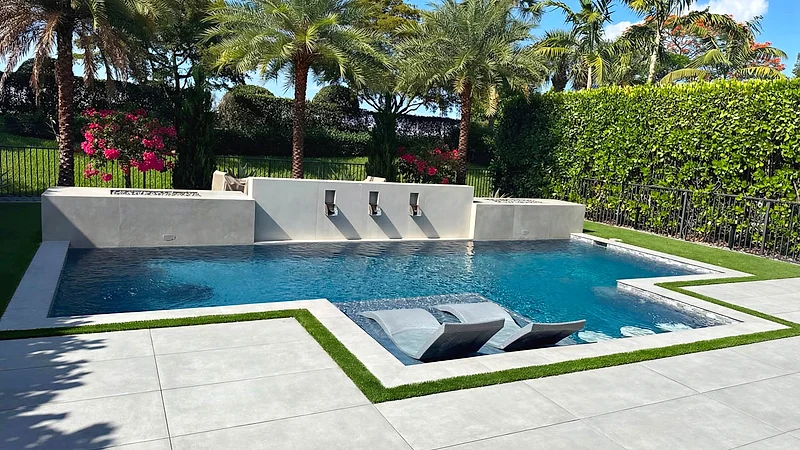
Most old pools have nothing vertical in the frame except the house and a fence. Adding one element that stands up — a rendered wall with scuppers, a raised planter, a fire feature, a pergola — changes the photo more than any surface swap, because it gives the eye something at full height to read.
It also adds movement and sound, which is the part that does not show up in any photograph and is the reason people keep sitting outside. The scope jump depends entirely on which one you pick: our estimator prices a pergola at $8,500, and a raised spa has its own line below. A rendered wall is priced by what it is built from and what it is founded on, which is why it belongs in the site conversation rather than in a table.
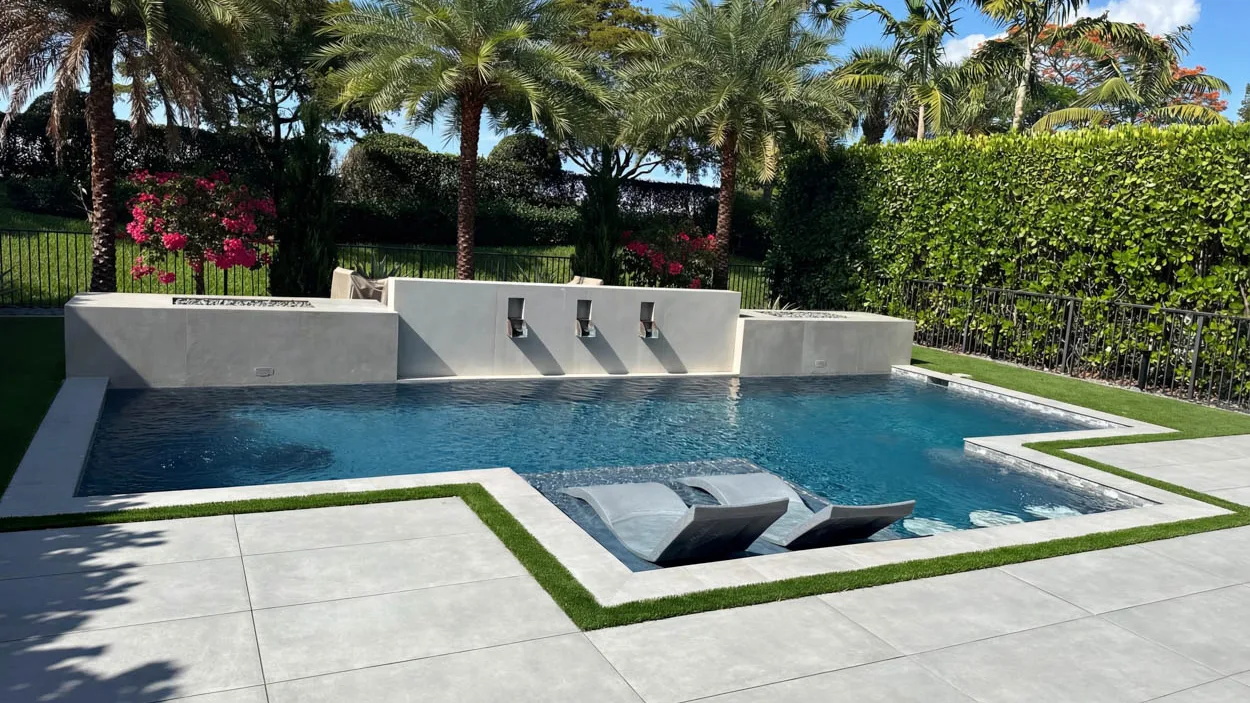
A spa set flush with the deck disappears from every photo taken at standing height. Raised, it becomes the second thing you see after the water, and the spillway edge gives the pool a moving line. The difference in our estimator is $12,000 integrated against $18,000 with a spillway — the same appliance, a different object in the yard.
A ledge changes the outline of the water, which is the shape your eye actually reads. It also changes where people sit, which changes how the yard looks when it is in use rather than staged. This is structural work — the shell gets cut and formed — so it belongs in the scope from the start, not in a second visit.
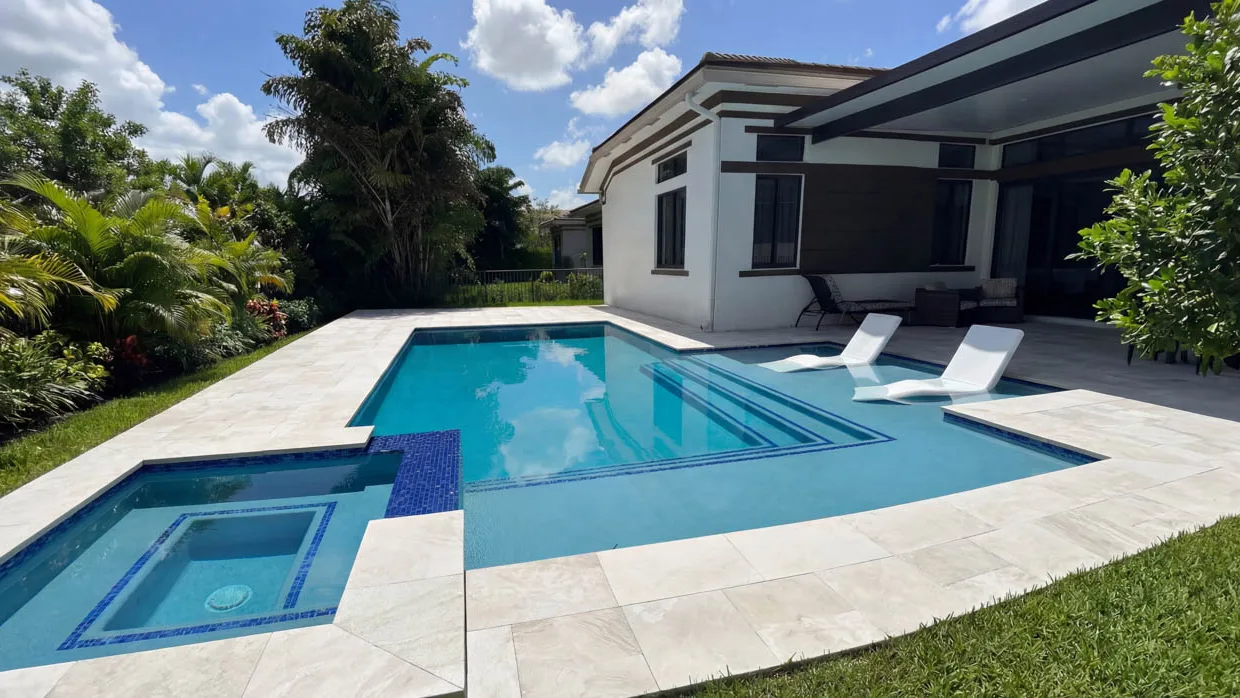
This is the one item on the list that changes the after photo without anything in it looking different. A pool ringed by an even walkway reads as a corridor in every frame, because there is nowhere in the picture for a person to be. Widen one side enough for a table or a pair of loungers and the same water, the same coping and the same surface read as a room.
So walk the footprint with a tape before anyone quotes a surface: area drives the deck budget far more than material does, and it also decides whether the finished yard has anywhere to sit. Which side to widen is a sun-and-use question rather than a visual one, and it is worked through in the decisions that make an old pool feel new.
The finish is the largest visual change from above and from the far end of the yard, and the smallest one from three feet away. That is not a reason to spend less on it. It is the item that sets how many years you get before the pool comes offline again, and our estimator prices a pebble finish at 1.15 times plaster and a premium finish at 1.35 times.
It is a reason to stop treating the color sample as the centerpiece of the design meeting. Pick it for service life first. Whatever color you land on, the water will read as sky from where you stand and as the finish from the drone.
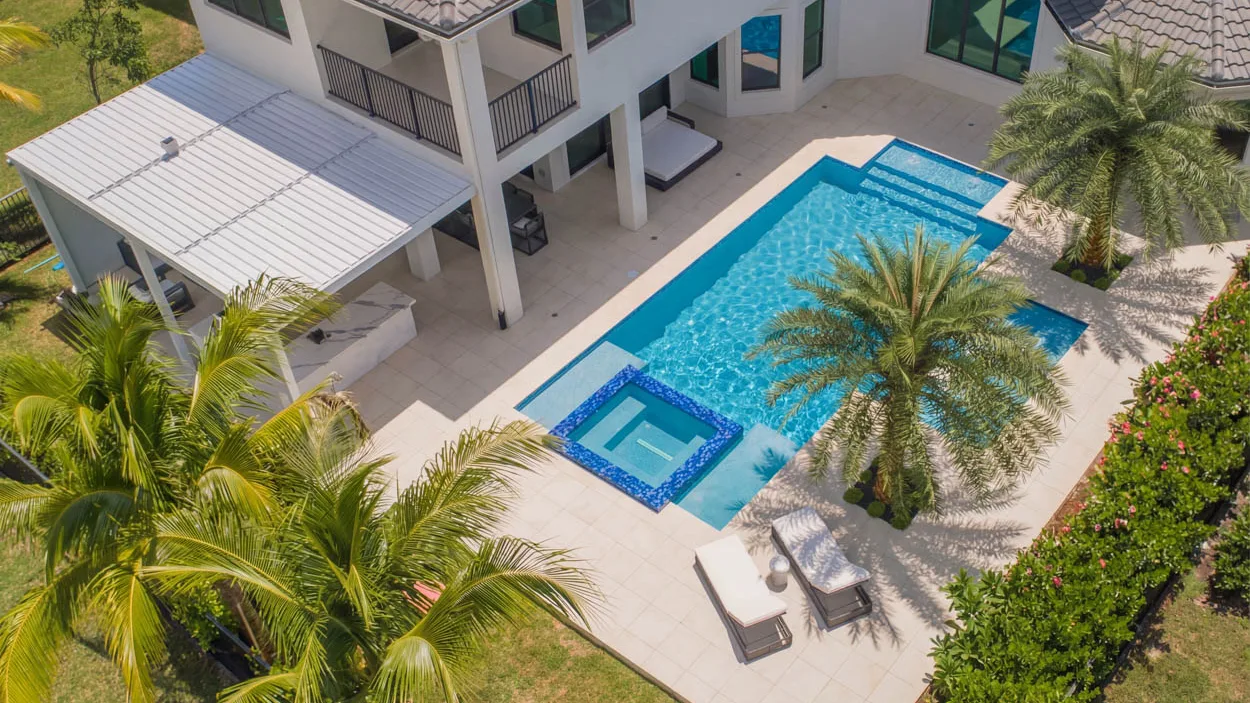
A good part of what sells an after photo is shot after dark, and none of it is possible without fixtures. A pool light is not a lamp — it is a niche in the shell wall with conduit behind it — so the moment to add one is while the shell is open. Our estimator prices pool LEDs at $450 per fixture.
The visual logic is simple. One light centered in a pool produces a glowing rectangle. Several, plus anything lighting the vertical surfaces behind the water, produces a yard with depth. One rule for the night photo: the light should hit what stands up, not only the water.
The cheapest change on this list is deleting things from the sightline. The equipment pad visible from the patio door. The white ladder and handrail on a pool that no longer needs them. The chain-link line into the neighbor's yard. The cleaner hose. The hose reel.
Screening the yard is where landscape spending earns its keep on the visual side: our estimator prices landscaping at $8,000, and a hedge that hides a pad and a fence line does more for the view than the same money spent on a surface upgrade. Much of what makes a finished backyard look finished is the absence of things, and that is the part no idea list covers because there is nothing to photograph.
Several of these lock each other: the tile band goes in while the shell is drained, and a light niche needs the shell wall open and the deck out for the conduit behind it.
That sequencing is a different axis from this one, and it is worked through in what belongs in the scope while the pool is open. Where the line sits between a surface job and a structural one is covered in resurfacing versus a full renovation, and the wider list of decisions — including the ones that change how the pool runs rather than how it looks — is in the decisions that make an old pool feel new.
One figure worth carrying into that conversation: our estimator prices a remodel at 82% of what the same work would cost as new construction, and shows every figure at plus or minus 10%. If your visual wish list has grown to a new spa, a new ledge, a full deck replacement and a raised wall, you are approaching new-build spending while keeping the one thing a remodel cannot change — the shape of the hole and where it sits in the yard. What that trade-off is worth is the subject of what actually changes a remodel's scope.
Ask for the design conversation in the order of this article rather than in the order of the quote:
Then ask for one thing at the end: a photograph from the spot you stand in most often — usually the patio door — and a sketch or render from that same spot. Not the drone view. If the design does not work from the doorway, it does not matter how it looks from forty feet up, because that is not where you will ever be standing.
Our own scope on a complete pool remodel is organized the same way, and the pool cost estimator uses the figures quoted throughout this article if you want to test a budget before anyone visits. A project estimate starts in the yard, at the doorway, looking at the same view you do.
The waterline tile and the coping, taken together. They sit at the edge of the water where the eye goes first, they draw the entire outline of the pool, and their area is small compared with the deck. Neither happens with the pool full and running, so both belong inside the remodel rather than after it.
It changes how deep the water reads and what it reflects, but mostly from above or from a distance. Standing on the deck you are looking at reflected sky either way. Choose the finish for how many years it buys before the next drain and chip — our estimator prices pebble at 1.15 times plaster and a premium finish at 1.35 times — and for color second.
Matching usually reads flat, because the deck is the largest surface in almost every view of the pool and a close match gives the eye nothing to separate. Area drives the cost far more than material does: our estimator prices decking at $12 per square foot for concrete, $22 for pavers and $35 for travertine.
Ask for the pair shot from the same position, at the same height, at the same time of day, with the water in the same state. Whatever difference survives that is the remodel. Whatever disappears was the camera.
What drives the review is structure, deck area, electrical and plumbing rather than a like-for-like surface swap, and exactly where that line sits is set by the county building department reviewing your job. The practical rule holds everywhere: settle the whole list before the file goes in, because scope added after a permit is issued goes back through review as a revision.