Nobody can give you an honest finish date before demolition. What you can get before you sign is the shape of the schedule: where it stops, what each stop waits on, and which of those are yours to shorten.
A complete pool remodel is not measured in crew days. Most of its calendar is spent waiting — on a selection you have not made, on an inspection, on a cure, on equipment that was ordered late — and the number of those waits is fixed by your scope before anyone touches the pool. That is why two remodels that look identical on paper can run on completely different calendars, and why the question worth asking a builder is not how many weeks, but how many stops your scope contains and what starts each one.
Any finish date offered before demolition is a best case. That is not dishonest; it is what happens when you work on something that is already built and cannot be fully seen until it is opened. What you can get before you sign is the shape of the schedule.
If your scope is a single item — resurfacing and nothing else — the calendar looks different from the one described here. Resurfacing versus a full renovation draws that line. Everything below assumes a complete remodel: surface, tile, coping and at least one system.
Our estimator prices a remodel at 82% of what the same work would cost as new construction. The calendar does not scale the same way, and expecting it to is the most common way homeowners get surprised.
A new pool is built in one direction, in an empty hole, with nothing to work around. A remodel is fitted to what is already in the ground: old plumbing runs, a deck someone else poured, an equipment pad sized for equipment nobody makes any more. Fewer crew days, similar number of stops, plus one thing new construction never has to absorb — discovery. The pool construction timeline covers the new-build sequence; this article is about where the two diverge.
Every day on a remodel belongs to one of three categories, and they are not controlled by the same person.
| Kind of day | Who controls it | What shortens it |
|---|---|---|
| Crew days | Your builder | Almost nothing. The trades take the time the work takes |
| Wait days | Nobody in the room: reviews, inspections, cures, lead times | Scope decisions made before the job starts |
| Decision days | You | Locking every selection before demolition |
In most complete remodels, crew days are the smallest of the three. That has a blunt implication: a bigger crew does not shorten a remodel. A builder who promises speed by promising manpower has misread their own schedule, because manpower does not shorten a plaster cure, an electrical inspection or a gas review.
Remodels run in the same order every time. Knowing the order is what lets you see where your own scope inserts a stop, and which steps cannot be pulled forward no matter how motivated everybody is.
| Step | Cannot start until | What sets its length |
|---|---|---|
| Site review and scope | — | Getting the pool looked at, and drained first if the shell itself has to be judged |
| Selections and design | The scope is on paper | You |
| Permit submission | Selections are final and the drawings match them | The county's review queue, and the HOA board if there is one |
| Chip-out | The permit set is in hand and a crew is booked | How deep the demolition has to go |
| Discovery | The shell is exposed | What the old surface was hiding |
| Plumbing, electrical, structural work | Discovery is resolved and priced | Rough inspections, which hold the job until they pass |
| Tile, coping, deck | The rough work has been signed off | Material availability and surface area |
| Equipment set | The pad and the power are ready | When the equipment was ordered, not when it is installed |
| Interior finish | Everything above is finished | The finish crew's calendar; the surface goes on in one go, not in stages |
| Fill and start-up | The finish is on | The finish manufacturer's procedure |
| Punch list | The water is in | Whether the final payment is still meaningful |
Two of those rows are where remodels actually slip. Discovery, because it lands in the middle of the job rather than at the start, and what it finds can need its own review. And permit submission, because it sits downstream of your selections: a drawing set that no longer matches what you finally chose goes back out and waits again, which is a delay caused entirely before anyone picked up a hammer.
The work in your scope divides cleanly into two groups: work that touches a permitted system, and work that does not. The first group stops and waits for someone outside your builder's crew. The second does not.
| Scope item | Adds a review or inspection stop | What its clock waits on |
|---|---|---|
| Interior finish: plaster, pebble, premium | No | The finish crew's sequence and the start-up procedure |
| Waterline tile and coping | No | Selection, then material availability |
| Deck resurfacing or replacement | Often | Surface area, and whether anything structural changes |
| Re-plumbing, new returns, drain work | Yes | A rough inspection before anything gets covered |
| New equipment pad, electrical, bonding | Yes | Electrical review, and the utility if service changes |
| Gas line for a heater | Yes | A separate gas review |
| Adding a spa to an existing pool | Yes | The same reviews a new shell gets: it is new construction attached to an old pool |
| Screen enclosure work | Yes | Its own permit and its own footings |
| HOA submission | Not an inspection, but a stop | A board's meeting calendar, not yours |
Which reviews apply, and in what order, is set by your county: the process in Alachua is not the process in Broward. What holds everywhere is that the work is permitted and inspected under the contractor's license, and that every line marked yes above is a point where the crew leaves the site until somebody else signs. What permits are required for pool construction in Florida shows what a full set looks like; a remodel pulls a subset of the same reviews, and which subset is decided entirely by what you choose to open.
The HOA line is the one people underestimate. Our estimator carries $1,500 for an HOA submission, and the money is the easy part — the calendar cost is a board that meets when it meets.
Every selection you have not made is a stop, and it is the only category of delay you own outright. Before chip-out, these should all be decided and in the contract:
The rule is simple and almost nobody follows it. Chip-out is the deadline for selections, not the start of shopping for them. Once the shell is open, every day spent deciding is a day the pool sits empty and the crew is on somebody else's job — and getting back onto a crew's calendar is its own wait, routinely longer than the decision that caused it.
Equipment is the selection whose clock starts at the order, not at the install. Our pool cost estimator prices a heater at $4,500, salt chlorination at $2,200 and automation at $3,500. What the prices do not show is that a remodel which adds any of them has to decide it at design, because the pad, the power and the plumbing get built around the choice. Which ones are worth adding is the subject of what to upgrade while the pool is open; the timeline argument is narrower — anything you add later means opening the same ground twice.
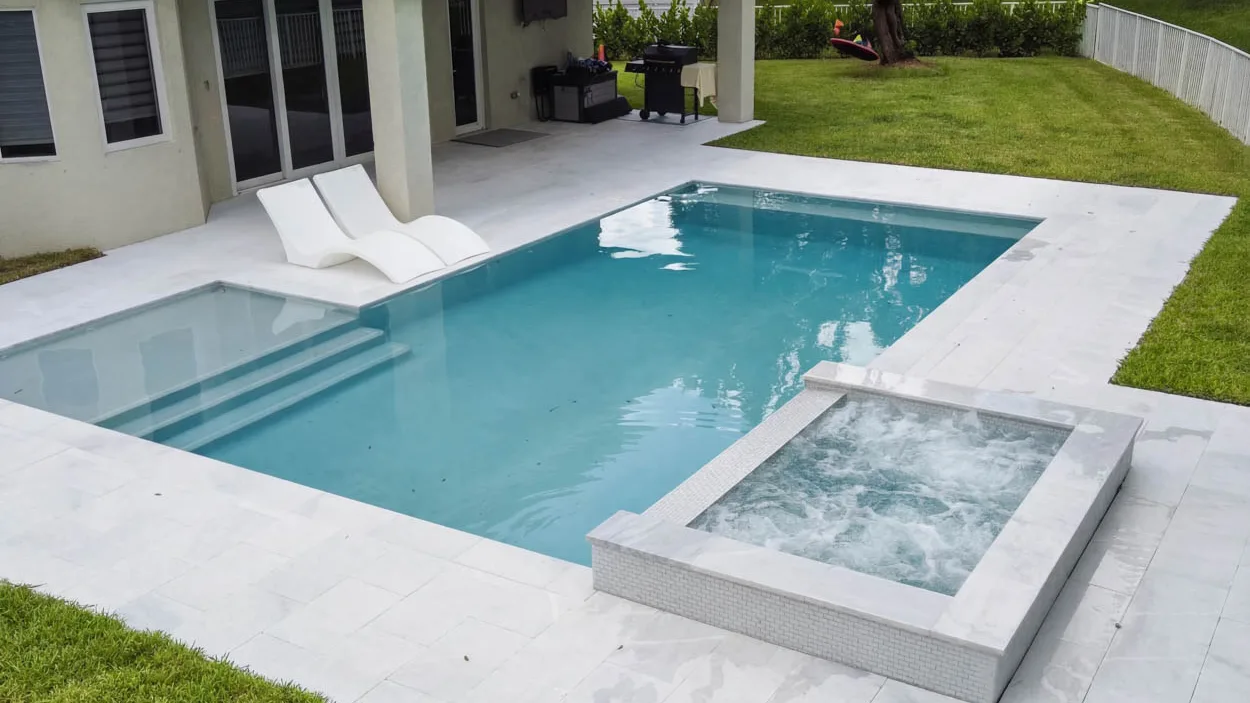
The moment the old surface is chipped out, the pool is empty, and an empty pool in Florida is a managed condition rather than a neutral one: groundwater sits high across much of the state, and a drained shell has water pressure on the outside and nothing pushing back on the inside. Managed is the operative word — the hydrostatic relief valve in the floor, dewatering when the site needs it, and above all keeping the window short. Keeping it short is a scheduling decision, which is why an open selection costs more after chip-out than it does before.
The practical consequence runs against instinct. It is better to delay the start of a remodel than to start it with three selections still open. Delaying costs you time with the pool you already have. Starting early costs you the same time with the pool out of service, and it moves the risk of every later delay into whatever season you land in.
Season affects a remodel twice, in two unrelated ways.
The first is weather. Chip-out, a deck pour and the application of a new interior finish are all work that cannot be done wet. Rain does not cancel those days, it pushes them, and a pushed day pushes everything sequenced behind it.
The second is demand. Remodels cluster in the months before summer, because that is when people notice they want the pool back. The same seasonal wave books the finish crews and the deck crews, so the wait to get onto a schedule is longest exactly when everybody wants one. The practical move is to sign in the season before the season you want to swim in — a job that starts when everyone else's is ending gets crews that are not stacked three deep.
A new interior finish has a start-up procedure. The pool is filled without stopping, the water is balanced and brushed on a schedule, and some equipment stays off until the surface has cured — salt chlorination and heaters are commonly held back for a period the finish manufacturer sets, not the builder. Ask for that procedure in writing on the day the finish is applied. The first weeks of a new surface are when it is easiest to damage permanently, and it is usually the homeowner who does it.
The punch list is the other tail. It is the short list of things that are not right at the end, and it closes quickly on jobs where the final payment still means something and slowly where it does not.
You are not checking the answers against a right answer. You are checking whether the builder has a schedule or an intention. A builder who can name the longest wait in your scope without looking anything up has run this before, and that is most of what you wanted to know.
Work backwards from the date you want to swim rather than forwards from today. There are two fixed anchors. At the end, the start-up window, which is set by the finish and is not negotiable. At the front, chip-out, which cannot happen until the selections are locked and the permit set is in.
Everything between those two anchors is where a scope decision can still buy time, and the cheapest cut is an item that adds a review rather than one that adds crew days. Dropping the gas heater removes a review; dropping a color you liked removes nothing. If the scope you want does not fit the date you want, the two honest options are a smaller scope or a later date. Adding people to the job is not on the list.
On our pool remodeling and renovation page the scope goes in writing, with a fixed project price, before any demolition starts — which is the same deadline this article keeps coming back to. If the scope itself is still open, what a complete remodel costs covers the money side of the same decisions. A project estimate starts with a site visit, because the schedule and the price both depend on what is already in the ground.
The honest answer is a schedule rather than a number, because most of a remodel's calendar is not crew days. It is wait days — county reviews, inspections, material lead times and the cure on a new interior finish — plus the days spent on selections that are still open. Before demolition nobody can see what is behind the old surface, so a finish date given at signing is a best case. What a builder can tell you at that point is how many of those stops your scope contains and what starts each one.
Very little. Almost all of the compression available happens before chip-out: locking every selection, ordering equipment at design rather than at installation, and trimming the scope items that add a review instead of the ones that add crew days. After demolition you are mostly waiting, and waiting cannot be staffed.
From chip-out until the new interior finish is filled, and the length of that window is set by what the scope opened up rather than by the surface itself. A drained shell in Florida is a managed condition because groundwater is high in much of the state, so ask your builder how the shell is handled while it sits and what would extend that window.
It usually has fewer crew days and not necessarily fewer stops. Everything in a remodel is fitted to something that already exists, and what demolition exposes can add scope in the middle of the job — which is the one thing a new build does not have to absorb.
After the start-up procedure, which is set by the finish manufacturer and not by the builder. The pool is filled without stopping, the water is balanced and brushed on a schedule, and some equipment stays off until the surface has cured. Ask for that procedure in writing the day the finish goes on.