Does a Pool Raise Your Home Insurance in Florida? What Insurers Ask and What the Barrier Has to Be
Nobody in Florida publishes how much a pool adds to a homeowners premium, and the state's own rate tool leaves pools out. What can be known is what insurers ask, the barrier they expect, and the coverage gap most pool owners miss: the screen enclosure.
A pool can raise your homeowners premium in Florida, but no state regulator publishes by how much. The Office of Insurance Regulation's rate comparison tool says its rates are illustrative only, and its model homes do not include a pool. What you can know before you build is what insurers ask about a pool, the barrier they expect, and which coverage lines a pool and a screen enclosure change.
That last part is where the money is. A premium you can shop. A gap in coverage you only find after a claim.
What the official sources actually say
| Fact | Source |
|---|---|
| Insurers commonly ask whether there is a swimming pool on the property | DFS, Applying for Homeowners Insurance |
| An insurer's underwriting inspection may look for hazards such as pools, and the insurer may refuse coverage if it finds them | DFS, Homeowners Insurance Overview |
| Underwriting guidelines vary between insurers | DFS, Homeowners Insurance Overview |
| Some insurers limit or exclude screened enclosures and sell an endorsement for hurricane damage to them | DFS, Policy Endorsements |
| Some cities and counties may require pool owners to carry liability coverage | DFS, Homeowners' Insurance Toolkit |
| CHOICES rates are for illustrative purposes only | OIR, CHOICES |
Notice what is missing from that list: a percentage. The figures that circulate online for "how much a pool adds" do not come from a Florida regulator, and we do not repeat them.
Why nobody can give you a percentage
Two reasons, both from the regulators themselves.
First, the Department of Financial Services says plainly that underwriting guidelines vary between insurers. One company may price a pool through the liability coverage, another may simply require a fence and change nothing else, and a third may decline the risk.
Second, the only state tool that compares premiums, OIR's CHOICES, is built on three pre-defined model homes and is labeled illustrative. It tells you how insurers compare on a standard house in your county. It cannot tell you what your pool will do to your quote.
So the useful question for your agent is not "how much does a pool add?" It is: what does this policy cover once the pool and the cage exist, and what does it require of them?
What insurers look at when you add a pool
Three lines of a standard homeowners policy are affected, and a fourth is the one most often missing.
| Policy line | What a pool changes |
|---|---|
| Personal liability (Coverage E) | Protects you against a claim or lawsuit for bodily injury or property damage to others for which you are legally liable. A pool is the main reason to review this limit |
| The dwelling or other structures (Coverage A or B) | Where the pool itself sits on the policy. On Citizens' HO-3 form, a pool that adjoins the house falls under Coverage A, and one separated by clear space under Coverage B |
| Medical payments to others (Coverage F) | The companion to liability for injuries to guests; check its limit alongside Coverage E |
| The screen enclosure | Often limited or excluded, and covered for hurricane damage only by endorsement |
Underwriting questions come first. The DFS guide to applying for a policy lists, among the common questions an agent may ask, whether there is a swimming pool, hot tub, trampoline or skateboard ramp on the property. Answer accurately: an inspection can verify it.
The barrier an insurer expects can be stricter than the law
This is the part that changes the design of the pool, which is why we raise it before construction rather than after.
Florida's Residential Swimming Pool Safety Act, section 515.27, lets a new residential pool pass final inspection with any one of five safety features: a barrier that meets section 515.29, an approved safety cover, exit alarms on the doors and windows that open to the pool, self-closing and self-latching devices on those doors, or a pool alarm. Our guide to Florida pool barrier requirements covers each option and the measurements the inspector checks.
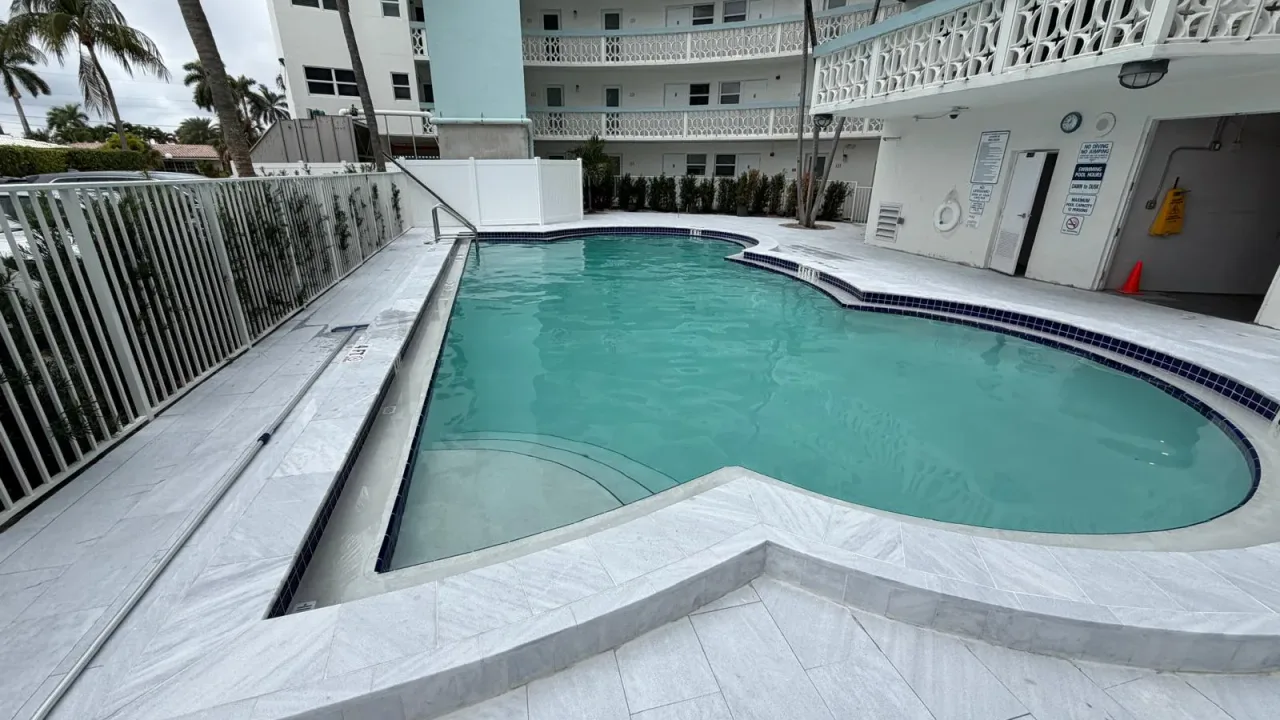
An insurer is not bound by that list. Citizens Property Insurance, the state-created insurer, says that properties with pools must be completely fenced, walled or screened, and that removable mesh safety fencing is not considered permanent and is not acceptable.
| Safety approach | Passes final inspection under 515.27 | Meets Citizens' pool rule |
|---|---|---|
| Permanent fence or wall around the pool | Yes, if it meets 515.29 | Yes |
| Screen enclosure around the pool | Yes, if its doors and screens meet the barrier rules | Yes |
| Removable mesh child-safety fence | It can, if it meets the barrier rules: the Florida Building Code has a provision for removable child barriers | No, by Citizens' own FAQ |
| Door alarms, self-closing doors, a safety cover or a pool alarm alone | Yes | Not by itself: Citizens asks for fencing, walls or screening |
Other insurers set their own rules, and they are not published in one place. The practical answer is to design the pool with a permanent barrier, a fence, a wall, a screen enclosure or a combination, so the same design passes the inspector and the underwriter.
The screen enclosure is the coverage gap most owners miss
A screen enclosure is a structure built to be open to the weather, and that is exactly the phrase policies use to exclude things.
- Citizens: its HO-3 worksheet says aluminum-framed screened enclosures and screen pool cages "constructed to be open to the weather" are not covered, and that this cannot be changed.
- Other insurers: the Department of Financial Services says some insurers limit or exclude screened enclosures and typically offer an endorsement for hurricane damage, with limits such as $10,000, $25,000 or $50,000. It also warns that the definition of a screened enclosure varies by company.
Put that next to the cost of the structure. Our pool cost estimator carries a screen enclosure built with a new pool at $15,000 as a planning figure. A $10,000 endorsement limit would not replace that cage, and a policy that excludes cages would not replace any of it. What the cage costs and why is in how much a pool screen enclosure costs in Florida, and what its permit requires is in whether a pool screen enclosure needs a permit.
Tell your insurer before the pool is filled
The Department of Financial Services advises telling your agent when you add structures so you are properly covered. Its homeowners toolkit is more direct about the risk of not doing it: after a policy has been in effect for 60 days, increasing your risks through new activities or home improvements is one of the listed reasons an insurer may cancel. Florida Statutes section 627.4133 allows cancellation after the first 60 days for a substantial change in the risk covered.
That makes the call to your agent part of the construction schedule, not an afterthought. We suggest making it twice: once at design, to learn what the insurer requires of the barrier and the cage, and once before the pool is filled, to add the structures to the policy.
Questions to ask your agent before you build
- Does this policy cover liability for a pool, and what is the limit?
- Does the insurer require a fence, a wall or a screen enclosure, and does it accept a screen enclosure as the barrier?
- Is the pool covered under the dwelling or under other structures, and is that limit enough?
- Is the screen enclosure covered for hurricane damage? If only by endorsement, at what limits?
- Are a diving board or a slide covered? Citizens, for one, lists both as not covered.
- Do the city or county where you live require pool owners to carry liability coverage? The DFS says some do.
If you are buying a home that already has a pool rather than building one, the same questions apply before closing, alongside the inspection points in buying a house with a pool in Florida.
In Gainesville and Ocala
The insurance questions are statewide. What is local is the permit office that inspects the barrier, and the choice of barrier itself: a fence, a wall, a cage or a mix of them, depending on the lot, the house wall and what your insurer will accept.
Which office reviews a pool, and what each one asks for, is in our guides to pool permits in Gainesville and Alachua County and pool permits in Ocala and Marion County. The full statewide set, from the shell to the electrical, is in what permits a Florida pool needs.
We design the barrier and the enclosure with the pool, so the gate swing, the door hardware and the cage footings are on the drawings before the permit is submitted. Our pages for pool builders in Gainesville and pool builders in Ocala explain how that fits into a full project. Our custom pool construction page covers the whole region.
Design the pool your insurer will accept
If you want the barrier, the cage and the pool designed together, with your insurer's requirements in hand before anything is drawn, start with a design-build evaluation. Bring your agent's answers to the six questions above, and we will design to them.
Common questions
Does having a pool increase home insurance in Florida?
It can, but no Florida regulator publishes by how much. The Office of Insurance Regulation's rate comparison tool is illustrative only, and its model homes do not include a pool. The only reliable answer is a quote for your home with the pool and the barrier it will have.
Do I have to tell my insurance company I built a pool?
You should. The Department of Financial Services advises telling your agent when you add structures so you are properly covered, and its homeowners guide lists increasing your risks through home improvements among the reasons an insurer may cancel a policy after the first 60 days.
Is a pool cage covered by homeowners insurance in Florida?
Often only partly, or not at all. The Department of Financial Services says some insurers limit or exclude screened enclosures and offer an endorsement to cover hurricane damage to them. Citizens' homeowners policies do not cover structures built to be open to the weather, which includes screen pool cages.
Does an insurer require a fence around a pool?
Many do, and the requirement can be stricter than the building law. Florida's pool safety act accepts any one of five safety features, including alarms or a safety cover. Citizens, for example, requires properties with pools to be completely fenced, walled or screened, and does not accept removable mesh safety fencing.
Does a diving board or slide affect home insurance?
It can affect what is covered. Citizens says a diving board does not make a property ineligible, but its homeowners coverage worksheet lists diving boards and pool slides as not covered. Ask your insurer before you put either in the design.
Sources
- Florida DFS — Homeowners' Insurance Toolkit (revised March 2024)
- Florida DFS — Homeowners Insurance Overview (Inspections, Underwriting)
- Florida DFS, Insurance Consumer Advocate — Homeowners Insurance Policy Endorsements
- Florida DFS, Insurance Consumer Advocate — Applying for Homeowners Insurance: What You Need to Know
- Florida OIR — CHOICES rate comparison tool (illustrative rates)
- Citizens Property Insurance — HO-3 Coverage Worksheet (11/25)
- Citizens Property Insurance — FAQ: Is property with a pool eligible for coverage?
- Florida Statutes 515.27 — Residential swimming pool safety feature options
About the author
Robert Wesley Brannen is the co-founder of Mr. & Mrs. Outdoor Living and a Florida-certified pool and spa contractor. Having started in his family's aluminum business at age 13 and previously led Happy House Outdoor Living, Robert brings extensive experience in custom pool construction, outdoor structures, and design-build project management.
Florida Licenses: CPC1460562 · CPC1461119 · SCC131153553.
Most Read Articles
Buying a House with a Pool in Florida: What to Inspect Before You Close
A home inspection looks at the house. The pool is a second structure with its own equipment, wiring and safety rules, and the problems that cost the most are the ones a quick look at clear water will not show.Read More: Buying a House with a Pool in Florida: What to Inspect Before You Close
Florida Pool Barrier Requirements: What a New Pool Needs to Pass Final Inspection
Florida law gives a new residential pool five ways to pass final inspection, and the building code turns the barrier option into a set of measurements. Most failed finals come from a short list: the gate, the doors in the house wall, and gaps nobody measured.Read More: Florida Pool Barrier Requirements: What a New Pool Needs to Pass Final Inspection
What Permits Are Required for Pool Construction in Florida?
A new inground pool in Florida needs a building permit from your city or county, with electrical and plumbing work covered under it, a set sequence of inspections, and a safety barrier that passes before the final. Here is what each piece is, who issues it and what slows it down.Read More: What Permits Are Required for Pool Construction in Florida?
Request a Design-Build Project Evaluation
Share your property details, project scope, and investment range. Our licensed design-build pool builders will review your request and confirm alignment before next steps.
Get a Free Estimate