Buying a House with a Pool in Florida: What to Inspect Before You Close
A home inspection looks at the house. The pool is a second structure with its own equipment, wiring and safety rules, and the problems that cost the most are the ones a quick look at clear water will not show.
Before you close on a Florida house with a pool, have the pool inspected on its own, not as a line in the home inspection. Look at seven things: the interior finish, the tile and coping, the deck, the equipment, the electrical and bonding, the suction outlets, and the barrier. Then ask for the pool's permit and final inspection.
Clear water tells you the pool was cleaned for the showing. It does not tell you how old the finish is, whether the heater works, or whether the barrier would pass today.
The facts a buyer should know
| Fact | Where it comes from |
|---|---|
| Florida's pool safety requirement applies when a pool passes **final inspection** | F.S. 515.27(1) |
| The information a buyer must receive is owed by a **pool contractor or home builder building the pool**, not by a seller of an existing home | F.S. 515.33 |
| A city or county can adopt a pool safety ordinance **equal to or stricter** than the state's | F.S. 515.37(4) |
| New suction outlets need **entrapment protection** to ANSI/APSP/ICC 7 | FBC R4501.6.6 |
| Pump circuits and underwater lights above the low-voltage limit need **ground-fault protection** | FBC R4501.16 |
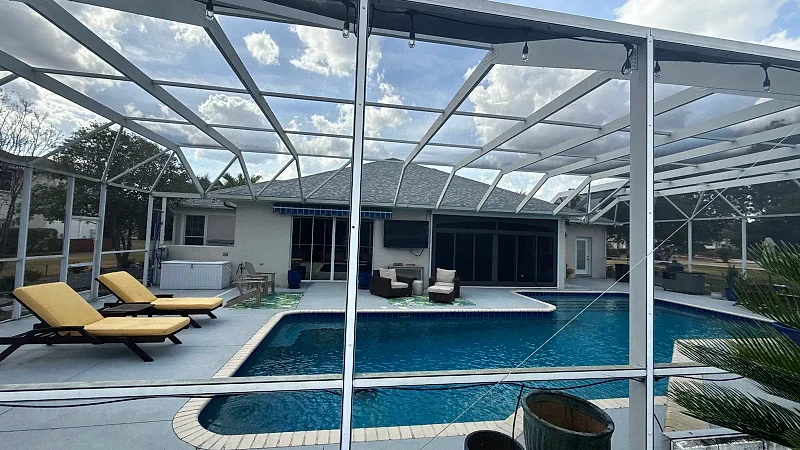
| A screen enclosure can serve as part or all of the barrier; its doors are gates | FBC R4501.17.1.11 |
What does Florida law require the seller to tell you about the pool?
Less than most buyers assume. Section 515.33 is titled "Information required to be furnished to buyers," but it applies to a licensed pool contractor or home builder who agrees to build a pool for a buyer. It requires them to hand over the chapter's requirements and the state's drowning-prevention information. On a resale, nobody is building anything, so that section does not reach the seller.
The same logic applies to the barrier. Section 515.27 sets the five safety-feature options a residential pool needs "to pass final inspection." An older pool passed its final, if it had one, under the rules of its day. Chapter 515 itself dates from 2000, so a pool built before it may have no safety feature that would pass today. Section 515.37(4) lets a city or county adopt a stricter ordinance, so the rule at your address is worth confirming with the permit office.
In practice, the barrier is what it is when you buy, and the decision about it becomes yours.
The checklist: what to inspect and what a failure means
This is the order we walk an existing pool in. The last column is what the problem usually leads to, so you can weigh it before you negotiate.
| What to look at | What a problem looks like | What it usually leads to |
|---|---|---|
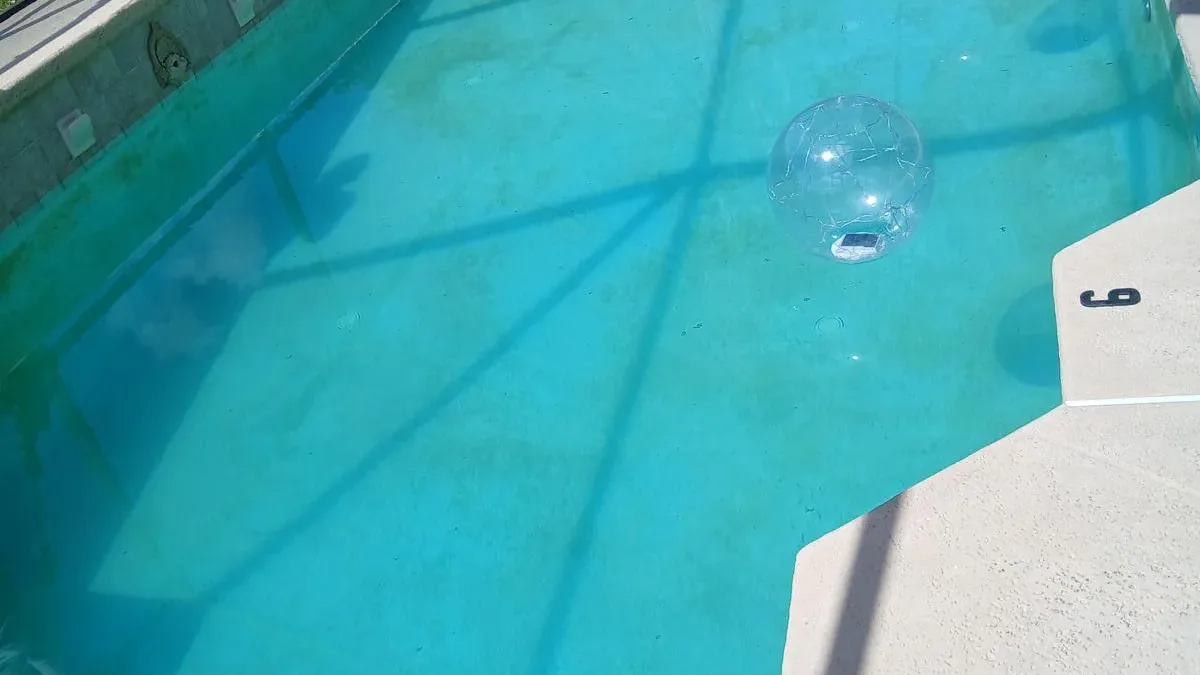
| **Interior finish** | Rough patches, stains that do not brush off, chalky residue, hollow-sounding or flaking areas | Resurfacing, or a full remodel if the tile and coping are also tired |
| **Tile and coping** | Cracked or loose coping stones, missing or hollow waterline tile, a gap between coping and deck | Coping and tile replacement, usually with the finish |
| **Deck** | Cracks that step up or down, settled sections, drainage toward the pool or the house | Deck repair or replacement |
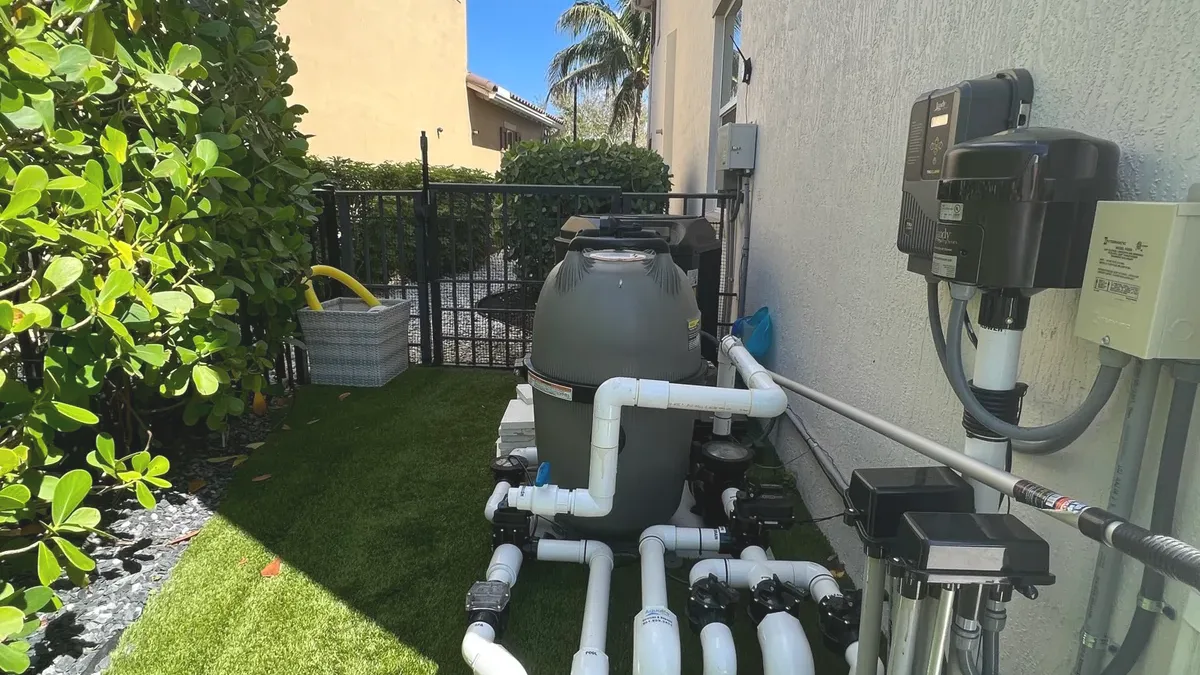
| **Equipment** | A pump that runs loud or hot, a filter that will not hold pressure, a heater that does not fire, labels showing original equipment | Equipment replacement, often all at once |
| **Electrical and bonding** | No ground-fault protection where the code requires it, corroded light niches, metal near the pool not tied into the bonding | A licensed electrical inspection and repair |
| **Suction outlets** | A single drain cover that is cracked, loose or of unknown date | Replacing covers, or replumbing during a remodel |
| **Barrier** | A gate or enclosure door that does not close and latch by itself, torn screens, a house door to the pool with no alarm | Hardware, alarms, screen repair or a new enclosure |
Two items deserve more than a glance.
The finish. The finish is what you feel and see, and it is often what forces the first big decision after closing. How long a finish lasts in Florida and the signs it is done are in our guide to how long pool resurfacing lasts.
The barrier. If you will have young children or grandchildren at the house, the barrier is not a negotiating point; it is the first thing to fix. The Florida Department of Health says drowning is the leading cause of unintentional death for Florida children ages 1 to 4, and that home pools are where most children are likely to drown. Our guide to Florida pool barrier requirements lists what a barrier has to measure up to today.
What does fixing each problem involve?
We price these as parts of a project, not as standalone repairs, and our pool cost estimator shows the same lines. These are its figures:
| Item in our estimator | What it prices |
|---|---|
| Heater | $4,500 |
| Salt chlorination system | $2,200 |
| Automation | $3,500 |
| LED pool light | $450 each |
| Pool deck | $12/sq ft concrete · $22 pavers · $35 travertine |
| Screen enclosure | $15,000 |
| Remodel | 82% of what the same pool would cost new |
For a sense of scale, the estimator's range for a basic remodel, a 450 sq ft standard pool with a plaster finish and 600 sq ft of concrete deck, no equipment or extras, is $37,000 – $45,000. Its default remodel, with a freeform shape, pebble finish, pavers, heater, salt system, three lights and landscaping, is $68,000 – $83,000.
These are our estimator's figures for remodel projects, shown with a ±10% band. They are not a quote for the house you are buying, and they do not price a single repair on its own. They are useful for one question: whether a pool that needs work changes what the house is worth to you. Our guide to what a pool remodel costs in Florida explains what moves each line.
Remodel or rebuild: the question an old pool raises
When the finish, the tile and the deck are all near the end, the inspection turns into a bigger question: is this pool worth remodeling, or does its layout no longer fit how you will use the yard? That is the decision in new pool construction vs. pool remodeling.
Two other costs belong in the same conversation before closing:
- Insurance. A pool can change what the policy costs and requires. Our guide to whether a pool raises home insurance in Florida covers what to ask the insurer.
- The enclosure. In Florida many pools sit under a screen enclosure, and its condition matters as much as the pool's. Our guide to screened-in pools in Florida covers what to look for.
Questions to ask the seller
- When was the pool built, and is there a permit and final inspection on record?
- When was it last resurfaced, and with what finish?
- Has the pool or any equipment been replaced or remodeled, and was that permitted?
- How old are the pump, filter and heater?
- Has the pool ever leaked or needed a leak repair?
- Does the house door to the pool have an alarm or self-closing hardware?
An answer of "I don't know" is information. It means the inspection has to answer the question instead.
In Gainesville and Ocala
Many of the pools in Alachua and Marion County that change hands are decades old, and they share a few patterns:
- Original equipment. Older pools often still run on a single pump and filter with no heater or automation. That is not a defect, but it is a budget line if you want a heated pool.
- Older decks. Cracked and settled concrete decks are common, and the deck is usually replaced in the same project as the finish.
- Permit history. Inside Gainesville or Ocala city limits, the city holds the permit records; outside them, the county. Our guides to pool permits in Gainesville and Alachua County and pool permits in Ocala and Marion County explain which office covers which address.
When a buyer or a new owner asks us to look at an older pool, we look at it the way we would before a remodel. That work is on our pages for remodeling an older pool in Gainesville and pool remodeling in Ocala. Our pool remodeling page covers the whole region.
Get a design-build evaluation
If you are under contract on a house with a pool that needs work, a design-build evaluation tells you what the pool needs, in what order, and whether remodeling it fits what you want from the yard.
Common questions
Should I get a separate pool inspection when buying a house in Florida?
It is worth it. A general home inspection may only look at the pool briefly. A pool inspection looks at the shell and finish, the coping and deck, the equipment, the electrical and bonding, the suction outlets and the barrier, which are the items that decide whether the pool needs work soon after closing.
Does the seller have to bring an older pool up to current barrier code?
Not under Florida's pool safety law by itself. Chapter 515 ties its safety-feature requirement to a new pool's final inspection. A city or county can adopt a stricter ordinance, and once you own the house, a remodel permit can bring the barrier back into review.
Is a pool cage part of the pool barrier?
It can be. The Florida Building Code allows a standard screen enclosure that meets the barrier requirements to serve as part or all of the barrier, with its doors treated as gates. A torn screen or a door that no longer closes and latches by itself is a safety problem, not just a cosmetic one.
How can I tell if the pool was permitted?
Ask the seller for the permit and the final inspection, and confirm with the permit office for the address: the city inside Gainesville or Ocala city limits, the county outside them. A pool or a later remodel with no permit on record is a question to resolve before closing, not after.
Sources
- Florida Statutes 515.27 — Residential swimming pool safety feature options; penalties
- Florida Statutes 515.33 — Information required to be furnished to buyers
- Florida Statutes 515.37 — Exemptions (local ordinances equal or more stringent)
- Florida Building Code, Residential, 8th Edition (2023) — Chapter 45, Private Swimming Pools (R4501.6.6, R4501.16, R4501.17)
- Florida Department of Health — Drowning Prevention
About the author
Robert Wesley Brannen is the co-founder of Mr. & Mrs. Outdoor Living and a Florida-certified pool and spa contractor. Having started in his family's aluminum business at age 13 and previously led Happy House Outdoor Living, Robert brings extensive experience in custom pool construction, outdoor structures, and design-build project management.
Florida Licenses: CPC1460562 · CPC1461119 · SCC131153553.
Most Read Articles
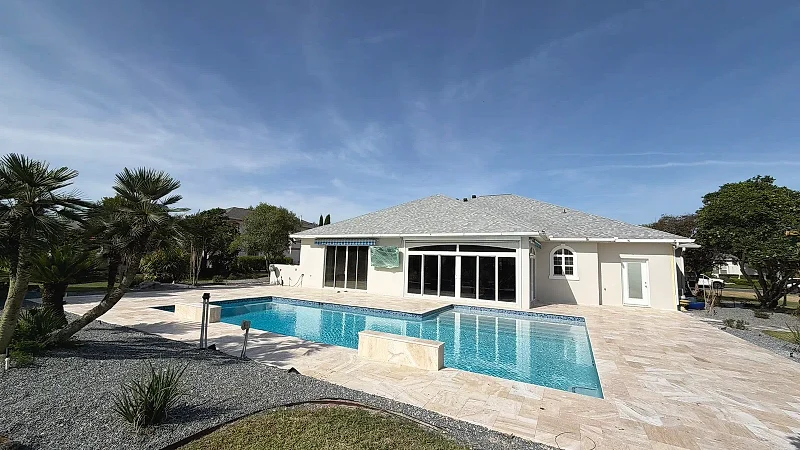
New Pool Construction vs Pool Remodeling: Which Is Right for You?
If you already own a pool, the question is not new versus remodel in the abstract. It is whether the shell, the location and the layout you have can carry what you want. Five questions settle it, and most Florida homeowners land on a complete remodel, not a new pool.Read More: New Pool Construction vs Pool Remodeling: Which Is Right for You?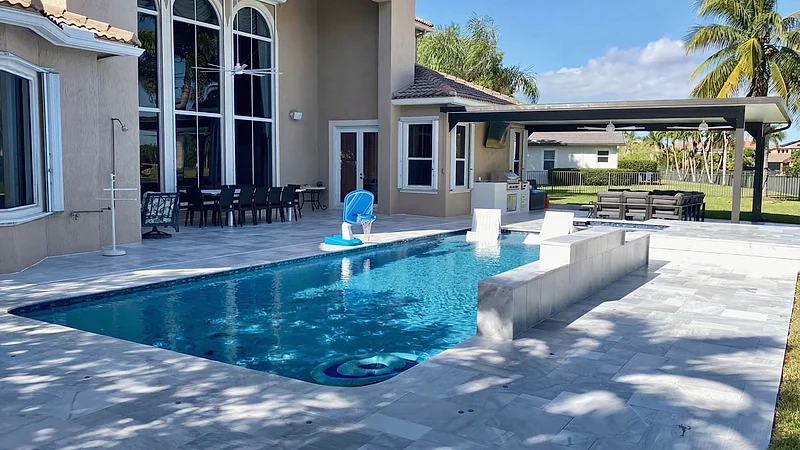
How Much Does a Pool Renovation Cost in Florida? Price Ranges and What Sets the Scope
A typical complete pool remodel in Florida runs about $68,000 to $83,000 on our estimator, a compact one starts near $27,000, and a large luxury remodel reaches $218,000. Four decisions explain the gap.Read More: How Much Does a Pool Renovation Cost in Florida? Price Ranges and What Sets the Scope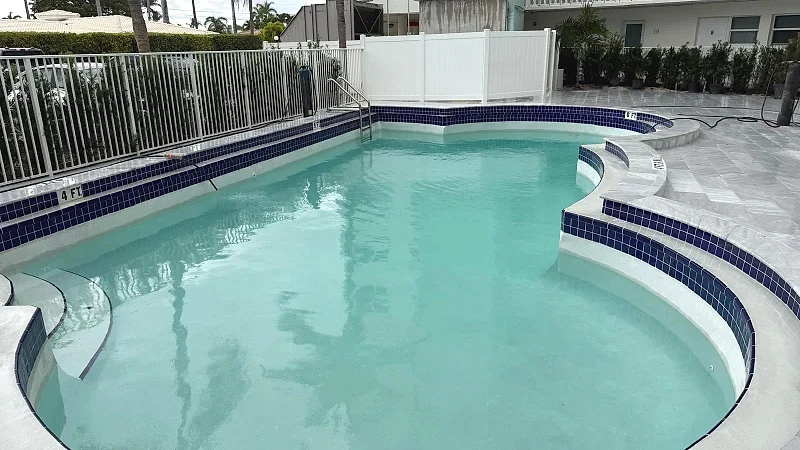
Florida Pool Barrier Requirements: What a New Pool Needs to Pass Final Inspection
Florida law gives a new residential pool five ways to pass final inspection, and the building code turns the barrier option into a set of measurements. Most failed finals come from a short list: the gate, the doors in the house wall, and gaps nobody measured.Read More: Florida Pool Barrier Requirements: What a New Pool Needs to Pass Final Inspection
Request a Design-Build Project Evaluation
Share your property details, project scope, and investment range. Our licensed design-build pool builders will review your request and confirm alignment before next steps.
Get a Free Estimate