Gunite vs. Fiberglass Pools in North Florida: An Honest Comparison from a Gunite Builder
We build gunite, and fiberglass is a legitimate choice for some yards. The honest comparison is less about which is better and more about your lot: the shape and size you want, the water table, the rock, and whether a 16-foot shell can reach the back yard.
We build gunite pools, so start with that: this comparison is written by a builder of one of the two. Fiberglass is a legitimate choice. Its shells are made in a factory under third-party quality control, and for a yard that fits one of its molds it can be the right pool. Gunite is built on site to any shape and size. In North Florida the choice is decided less by which material is better than by the lot: the shape you want, the water table, the rock, and whether a shell up to about 16 feet wide can reach the back yard.
Everything below comes from the Florida Building Code, the state geological survey, the ICC-ES reports that evaluate the major fiberglass shells, and the fiberglass manufacturers' own published material. Where only a manufacturer says something, we say so.
The comparison at a glance
| Question | Gunite (shotcrete) | Fiberglass |
|---|---|---|
| How the shell is made | Concrete sprayed over steel, on site | One piece, "shop-formed over a mold" (ICC-ES ESR-2014) |
| Shape and size | Any shape the lot allows | The manufacturer's models only |
| Largest sizes | Set by the lot and the engineering | Widest about 16 ft to 16 ft 10 in; longest 40 to 44 ft, in the reports we read |
| Quality control | On site, by the builder and the inspector | Factory inspections and surveillance of the supplier's quality system (ICC-ES PMG-1620) |
| Standard it meets | ANSI/PHTA/ICC-5 | ANSI/PHTA/ICC-5, plus ICC-ES acceptance criteria AC274 |
| Interior surface | Plaster, quartz or pebble, renewed over time | Gel coat; manufacturers say it rarely needs refinishing |
| Delivery | Materials arrive in trucks; the shell is built in place | A finished shell over the 102-inch legal width, set by crane |
| Water level | Can be drained with care, with hydrostatic relief | "Designed to remain full of water at all times" |
Both sides have real advantages. The rest of this article is about which ones matter on a Gainesville or Ocala lot.
Shape and size: the clearest difference
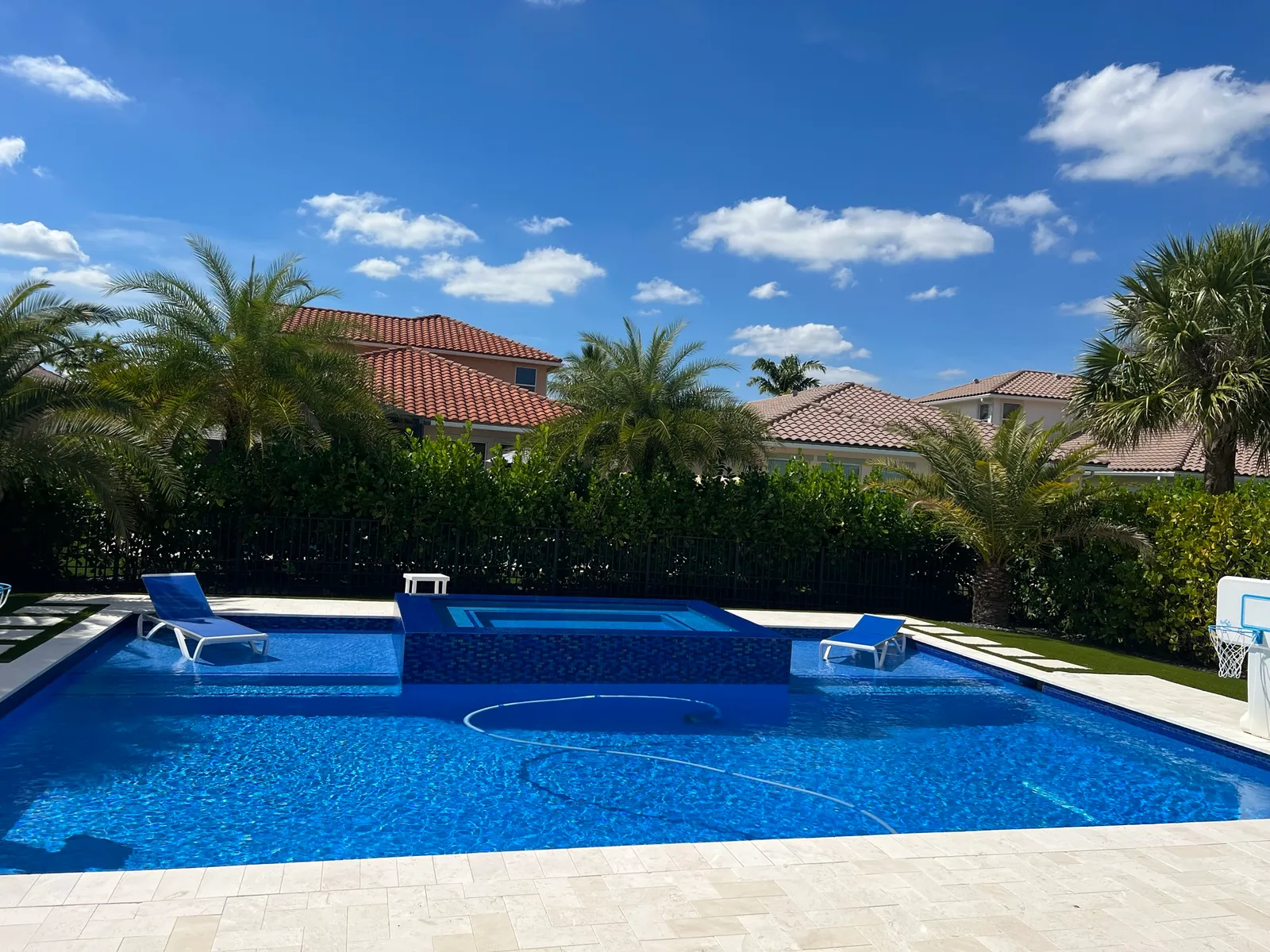
Gunite has no mold. The American Shotcrete Association describes shotcrete pools as buildable in "virtually any size and shape", and the American Concrete Institute's guide to pool shotcrete speaks of "infinite shapes, curves, and features". A raised spa, a sun shelf of a particular depth, a wall for a water feature, a lap lane that runs the length of the yard: each is drawn and built for that site.
Fiberglass comes in models. River Pools, a fiberglass manufacturer, says it plainly: "A pre-built pool can't be made into a custom shape and size." The selection is wide, and a model that suits the yard is a perfectly good pool. The limit is when the yard, or the plan, does not suit any model.
Delivery and access: a shell has to travel
A fiberglass shell is built in a factory and moved to your yard in one piece, so its width meets the road before it meets the lot.
- On the highway. Federal rules (23 CFR 658.15) and Florida Statutes section 316.515 limit a vehicle and its load to 102 inches, or 8.5 feet, wide. Anything wider needs a special permit under section 316.550.
- In the yard. Latham's own installation timeline says the pool "is then set by crane or other equipment", and River Pools says that if the pool does not fit around the side of the house, it can be hauled over the home by crane.
So for any shell wider than 8.5 feet, the questions are the route to the house, the crane's position, overhead power lines and the trees between the street and the hole. Latham's timeline also notes that excavators, dump trucks, concrete trucks and cranes need access to the yard, which can mean temporarily removing fencing. On large, wooded North Florida lots, that last item can decide the answer. A gunite pool still needs access for an excavator and for the concrete, but nothing arrives in one 16-foot piece.
Groundwater: what the code and the manufacturers say
Much of Florida has groundwater close to the surface, and both pool types have to respect it.
- The code, for both. Florida Building Code, Residential, section R4501.21.4: "In areas of anticipated water table an approved hydrostatic relief device shall be installed." The only exception it names is plastic-liner pools.
- Fiberglass, during installation. The ICC-ES reports for Leisure and Latham shells require a registered design professional's review when there is groundwater in the excavation where the pool floor will meet the soil. Backfill and filling happen together, with the water and backfill levels kept "approximately the same".
- Fiberglass, afterwards. The same reports carry a notice: "The pool shells are designed to remain full of water at all times. The shell may be damaged if the water level is allowed to drop below the skimmer."
River Pools makes the fair counterpoint that groundwater has no effect in most cases as long as the pool stays full, and that groundwater has to be removed before emptying any vessel, gunite pools included. We agree. The practical difference is where the site enters the design: a gunite shell is designed for the lot, while a fiberglass model was designed before anyone saw it, and the site's conditions enter through its installation rules instead.
Limestone: a dig is a dig
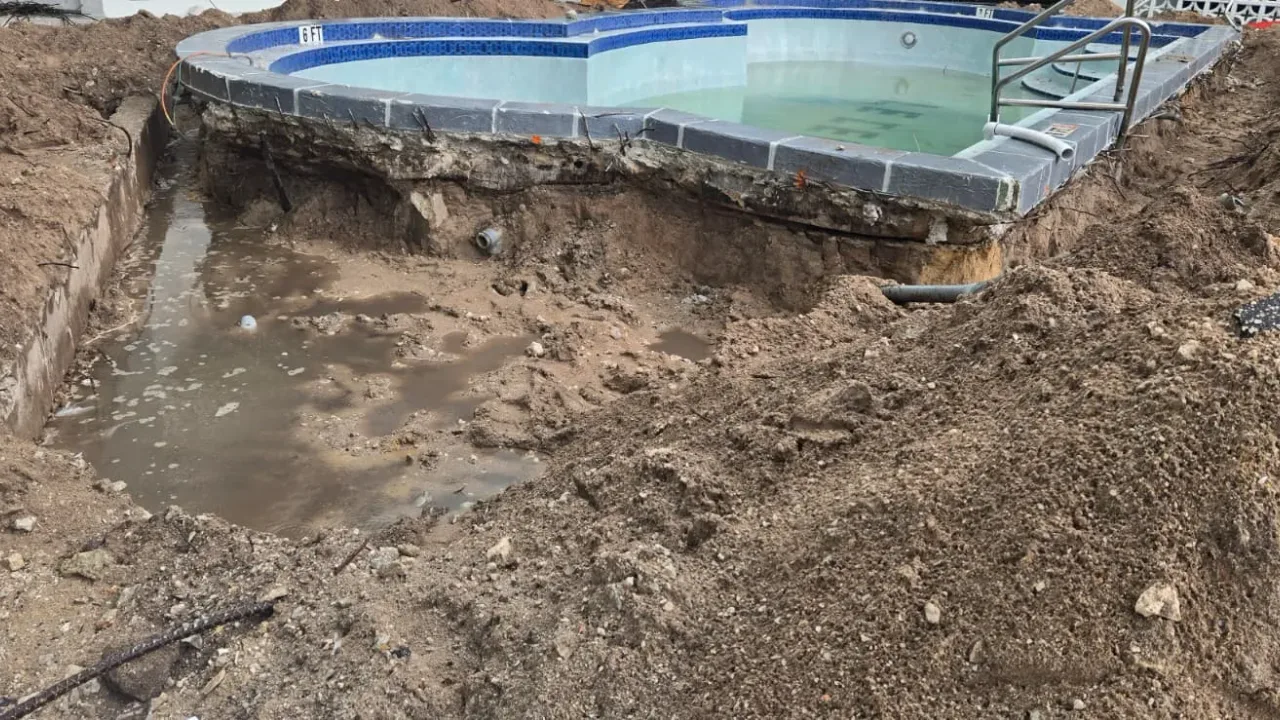
The Florida Geological Survey says the whole state is underlain by carbonate rocks, and that sinkhole activity is higher where limestone is close to the surface. Its sinkhole leaflet lists "land clearing, heavy loads on the surface, and earth shaping and excavation" among the activities that can raise the risk.
That applies to any pool, because both types need a hole of similar depth. What differs is the design's room to move. A gunite pool is drawn for the site, so what is known about the ground before design can shape its depths. A fiberglass shell has a fixed shape, so the hole has to match it. In both cases the honest contract says whether rock is priced or is a change order. Our estimator adds 12 percent to the whole project for rock excavation, which is covered in building a pool in North Florida.
The surface you touch
A gunite pool is finished with a cementitious interior: plaster, plaster with quartz, or pebble. These are renewed over the pool's life. We do not quote a number of years, because no standards body we found publishes one. The National Plasterers Council says that "water chemistry greatly affects the life expectancy" of a cementitious finish, and that is the honest variable. How plaster, quartz and pebble compare is in pool finishes compared.
A fiberglass pool is finished with a gel coat applied in the factory. River Pools says its pools typically do not require refinishing even after several decades when maintained, and that gel coat is not reapplied in the back yard. That is a manufacturer's claim, but a reasonable one, and it is the strongest argument for fiberglass. The same manufacturer's care guide asks owners to keep pH at 7.2 to 7.4 and calcium hardness below 120 ppm to protect the gel coat. Neither surface is maintenance-free.
Inspection and quality control
The way each pool is checked is different, and it is worth understanding.
A fiberglass shell is checked twice before it reaches you: the ICC-ES certification "involves factory inspections, and assessment and surveillance of the supplier's quality system". On site, Florida's code treats it differently from concrete. Section R4501.19 requires the final barrier and electrical inspections before a pool is filled, but exempts fiberglass and vinyl-liner pools, because they are "required to be filled with water upon installation".
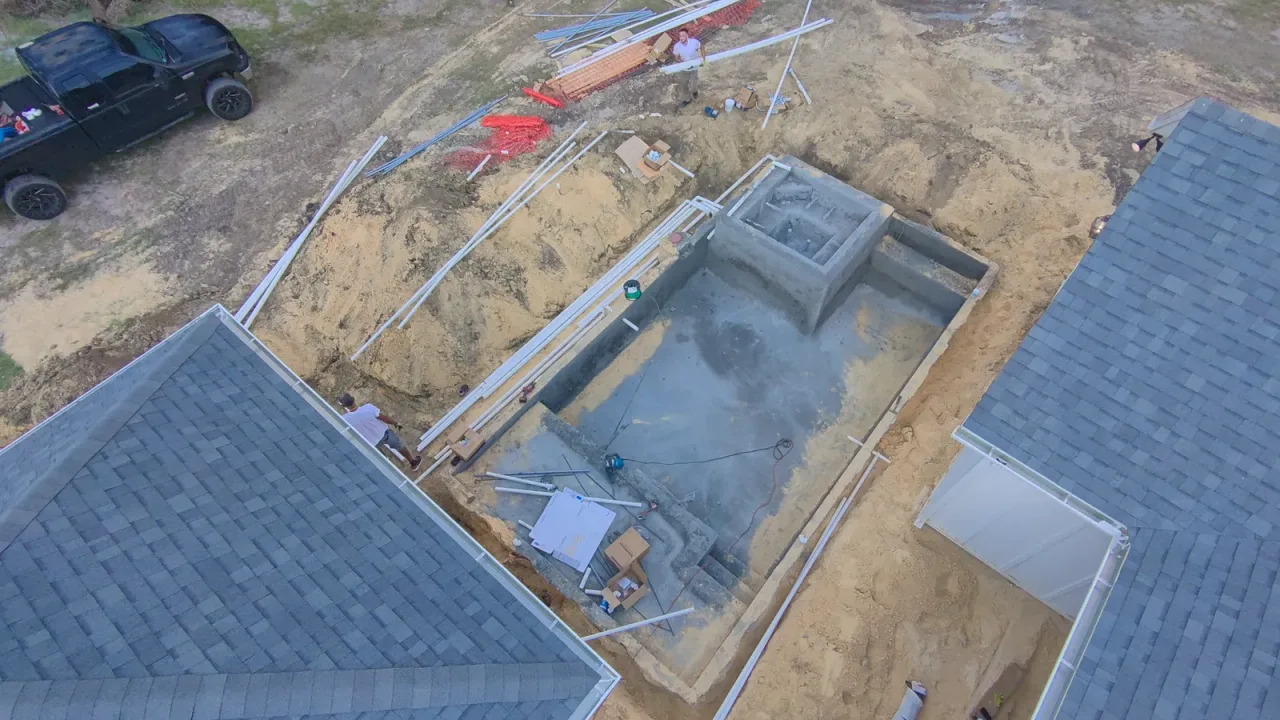
A gunite shell is made in your yard, so its quality control is the builder and the building inspector. Under section 110.3 of the Florida Building Code, Building, the first pool inspection happens after excavation and the installation of the steel, the bonding and the main drain, and before the concrete is placed. The American Concrete Institute is candid that oversight and quality control "are, however, not often encountered with pool building in the residential market". That is a fair caution, and the answer to it is choosing a builder who documents each stage. Our guide to choosing a pool builder in Florida lists what to ask.
What it costs
We can only give you figures for what we build. Our pool cost estimator prices a gunite pool from $85 per square foot of water for a standard shape, $110 for freeform and $145 for a luxury design, with a pebble finish at 1.15 times plaster. A plain 400 sq ft rectangle with plaster, a 600 sq ft concrete deck and three lights, with no heater, salt system or landscaping, comes out at about $42,000 – $51,000. How every option moves that number is in how much a custom pool costs in Florida.
We do not publish fiberglass prices, because we do not build fiberglass pools and would only be repeating someone else's numbers. When you compare quotes, compare the same scope: the deck, the equipment, the electrical, the barrier, the permit and the delivery are all outside the shell, and they cost much the same whichever shell sits in the middle.
In Gainesville and Ocala: how to decide
Four questions settle most of it.
- Does a fiberglass model fit the shape and size you want? If it does, fiberglass is on the table. If you want a raised spa, a custom shelf, a particular length or a shape that follows the house, gunite is the answer.
- Can a wide shell reach the hole? Walk the route from the street to the back yard with the crane in mind: trees, power lines, the house itself.
- What is under the yard? Rock and groundwater affect both types. Ask each builder how their contract handles them.
- Who checks the work? With fiberglass, most of the shell's quality control happens at the factory. With gunite, ask how each stage is documented before it is covered.
We build custom gunite pools across the region. Our pages on pool builders in Gainesville and building a pool in Ocala and Marion County explain how a project runs from site review to startup, and the complete guide to pool construction in Florida covers the full sequence. Our custom pool construction page covers the whole region.
A note on the code edition
The Florida Building Code sections quoted here are from the 8th Edition (2023). The 9th Edition takes effect on December 31, 2026, and permits are reviewed under the edition in effect when they are submitted. We will update this comparison if these sections change.
Price the gunite version
If you want to see what the pool you have in mind costs as a gunite build, set its size, shape and finish in our pool cost estimator. It returns a range in a minute, from the same price table we use.
Common questions
Is gunite or fiberglass better in Florida?
Neither is better everywhere. Fiberglass shells are factory-made under third-party quality control and come in fixed models. Gunite is built on site to any shape and size. On a North Florida lot, the deciding questions are the shape you want, the water table, the rock under the yard and whether a wide shell can be delivered and craned into place.
Can a fiberglass pool be installed where the water table is high?
Yes, with care. The evaluation reports for major fiberglass shells require a design professional's review when groundwater is in the excavation, and they state the shell is designed to stay full of water at all times. Florida's building code requires a hydrostatic relief device in areas of anticipated water table for pools other than plastic-liner pools.
How big can a fiberglass pool be?
It is limited to the manufacturer's molds. In the ICC-ES evaluation reports we read for Leisure, Latham and Barrier Reef shells, the widest models are about 16 to 16 feet 10 inches and the longest are 40 to 44 feet. Gunite has no mold, so its size is set by the lot and the design.
Do fiberglass pools need resurfacing?
Less often than plaster, by the manufacturers' account: River Pools says its pools typically do not need refinishing for decades when maintained. Plaster and pebble finishes on gunite are eventually renewed. For both, the National Plasterers Council and the fiberglass makers say water chemistry is what most affects how long the surface lasts.
Does fiberglass or gunite pass inspection differently in Florida?
The sequence differs. The Florida Building Code requires the final barrier and electrical inspections before a pool is filled, but exempts fiberglass and vinyl-liner pools, because they are filled with water as they are installed. A gunite pool gets its first inspection after the steel, bonding and main drain are in and before the concrete is placed.
Sources
- Florida Building Code, Residential, 8th Edition (2023) — Chapter 45, R4501.6.1, R4501.19, R4501.21.4
- ICC-ES ESR-2014 — Latham fiberglass pools (evaluation report)
- American Concrete Institute — PRC-506.8-24, shotcrete for swimming pools (preview)
- Florida Statutes 316.515 — Maximum width, height, length
- ICC-ES PMG-1620 — Thursday Pools / River Pools fiberglass pools (product certification)
- Florida Geological Survey — Sinkhole FAQ
- River Pools — Fiberglass pool installation FAQ
- National Plasterers Council — What happened to my pool's interior finish?
About the author
Robert Wesley Brannen is the co-founder of Mr. & Mrs. Outdoor Living and a Florida-certified pool and spa contractor. Having started in his family's aluminum business at age 13 and previously led Happy House Outdoor Living, Robert brings extensive experience in custom pool construction, outdoor structures, and design-build project management.
Florida Licenses: CPC1460562 · CPC1461119 · SCC131153553.
Most Read Articles
Building a Pool in North Florida? What Gainesville & Ocala Homeowners Should Plan For
Four things make a North Central Florida pool different from a South Florida one: the rock, the well, the swim season and which office reviews the permit. All four are cheaper to settle before the contract than during the dig.Read More: Building a Pool in North Florida? What Gainesville & Ocala Homeowners Should Plan For
How Much Does It Cost to Build a Pool in Florida? 8 Decisions That Set the Price
A typical custom pool in Florida runs about $83,000 to $102,000 on our estimator, a compact plain pool starts near $33,000, and a large luxury build passes $217,000. Eight decisions explain the gap.Read More: How Much Does It Cost to Build a Pool in Florida? 8 Decisions That Set the Price
Complete Guide to Pool Construction in Florida: Costs, Timeline & Process
Building a pool in Florida is a design-build process: evaluate the lot, design and engineer the pool, permit it, build it in a fixed sequence of inspected stages, and start it up. This guide walks the whole path and tells you where the price and the schedule are actually decided.Read More: Complete Guide to Pool Construction in Florida: Costs, Timeline & Process
Request a Design-Build Project Evaluation
Share your property details, project scope, and investment range. Our licensed design-build pool builders will review your request and confirm alignment before next steps.
Get a Free Estimate