Four things make a North Central Florida pool different from a South Florida one: the rock, the well, the swim season and which office reviews the permit. All four are cheaper to settle before the contract than during the dig.
Building a pool in Gainesville or Ocala is the same project as building one in Fort Lauderdale for most of its length. The parts that differ are the parts that move money and dates, and there are four: what is under the yard, where the fill water comes from, how many months the pool is warm enough to use, and which office reviews the permit.
None of the four changes how a pool is designed. All four change what it costs and how long it takes, and all four are cheaper to settle before the contract than during the dig.
The decisions that apply anywhere in the state — siting, drainage, the equipment pad, lighting, when you actually want to swim — are covered in 12 decisions to make before excavation. This article is only the part that changes once you are north of Orlando.
Trees and access come after those, because in this part of the state they are usually the same problem.
Alachua and Marion County sit on a limestone belt. That is why the springs are here, why sinkhole activity is a known feature of the region, and why the depth to rock in a back yard is a real question rather than a formality.
The part homeowners underestimate is that rock does not arrive evenly. Depth to rock can change across a single back yard, so one end of the hole finds it and the other does not. That matters because a pool is not a hole of uniform depth — the deep end, the spa footing and the plumbing trenches all reach lower than the shallow end, so rock can affect part of the excavation and leave the rest alone. It also means a test boring tells you about the spot it was taken in, not about the lot.
When rock does show up, the cost is not extra hours with the same machine. It is a different method: heavier equipment, hammering, and hauling out material that a standard dig would have pushed aside. That is why it is priced as a surcharge on the project rather than as a line item.
Ask one question and listen carefully to the answer: is rock priced in this contract, or is it a change order?
Both answers are legitimate. A builder who has priced it is carrying the risk and the number reflects that. A builder who treats it as a change order is quoting you a lower figure that may not survive the excavation. What is not legitimate is a contract that is silent, because silence resolves in the builder's favor at the worst possible moment — when the machine is already in the yard.
If you are comparing two quotes and one is noticeably cheaper, this is the first place to look. The other places are in what a custom pool really costs.
Much of Alachua and Marion County is on private well and septic. That changes two things about a pool, and neither is obvious from a rendering.
Water from the Floridan aquifer is hard — high in dissolved calcium, which is what limestone is made of — and in many wells it also carries iron. Both matter at exactly one moment: the first fill.
A pool holds tens of thousands of gallons, and on a well that whole volume comes out of the ground in one draw — the largest the well will ever be asked for. If that water carries iron, the iron goes in with it and does not stay dissolved. It comes out of solution on the walls and floor as brown or rust-colored staining, early rather than late, and once it has set into a fresh interior finish it is not something you scrub off. Hard water has the opposite failure mode: scale, which builds slowly and shows first at the waterline.
The fix is cheap and has to happen before the water goes in — test the well, pre-filter the fill, and treat the water from the first day rather than from the first complaint. Finish choice buys a margin, not an exemption: our estimator prices a pebble interior at 1.15 times plaster, and a textured surface hides minor discoloration that smooth plaster shows plainly. It does not stop iron from staining. That is dealt with in the fill or it is not dealt with.
None of that is a reason to avoid filling from a well. It is a reason to have the conversation before startup rather than after, because the same problem costs a filter before and a drain-and-refinish after.
On a septic lot, the drainfield is not a soft constraint. You cannot build a pool over it, you cannot deck over it, and you cannot drive an excavator across it — which means the drainfield often decides both where the pool sits and how the equipment reaches the back yard.
Two more things follow from it. Backwash from a sand filter has to go somewhere that is not the septic system, so where the water goes is a design question on these lots rather than an afterthought. And if the pool has to move to clear the field, that usually moves the deck, the equipment pad and the plumbing runs with it. That is a site-plan conversation, not a change you make later.
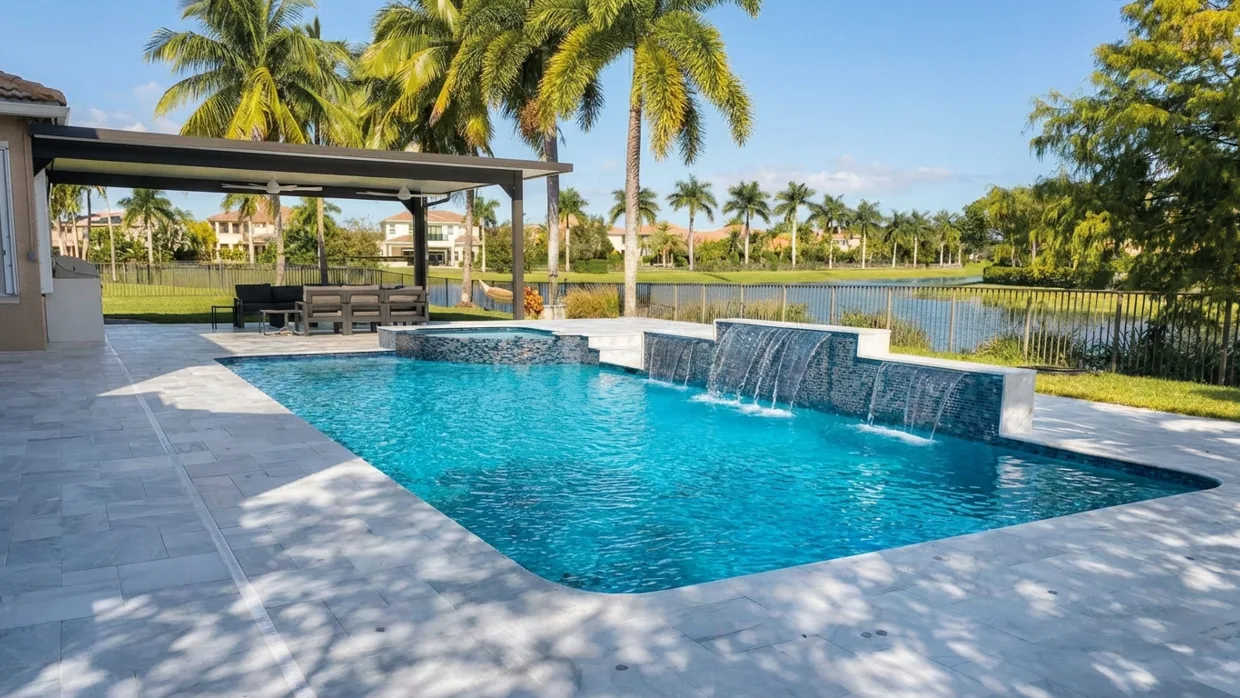
This is the difference people from further south are least prepared for. A pool in Broward County is comfortable for most of the year without help. A pool in Gainesville or Ocala is not — the unheated season is meaningfully shorter, and the months at the edges, when the air is pleasant and the water is not, are exactly when a back yard is most usable.
So heating here is not an upgrade that extends a long season. It is what determines whether you get spring and fall at all. Our estimator prices a heater at $4,500. What it does not price is the supply that heater needs, and that is where the North Florida difference sits:
| Option | What it does well here | What to check before choosing |
|---|---|---|
| Electric heat pump | Low running cost across a season, with no fuel to have delivered | Output falls as the air gets colder, which is precisely when you want it. Also confirm the electrical service can carry it |
| Gas | Heats on demand regardless of air temperature, so it suits weekend use | Natural gas service is not a given outside the city limits here, so gas often means propane, a tank and a delivery schedule |
| Solar assist | Almost nothing to run; pairs with a heat pump rather than replacing one | Needs unshaded roof area, which the tree canopy in both areas often does not allow |
There is a second cold-weather item that belongs in the same conversation. When the temperature drops toward freezing, water sitting still in pool plumbing is a problem; water that keeps moving is not. Automated controls run the pump when that happens, without anyone waking up to do it. Our estimator prices automation at $3,500, and in this part of the state it is closer to protection than to convenience.
A pool permit in Florida is issued by whoever has jurisdiction over the parcel. In this region that is one of four offices, and which one it is has nothing to do with what your mail says.
| If the property is | The permit goes to |
|---|---|
| Inside Gainesville city limits | The city |
| Unincorporated Alachua County | The county |
| Inside Ocala city limits | The city |
| Unincorporated Marion County | The county |
Plenty of homes with a Gainesville or Ocala address are in the unincorporated county. Plenty of subdivisions sit right at the line. The practical consequence is that submittal requirements, review queues and inspection scheduling are not the same from one to the next, so a timeline quoted before anyone has confirmed jurisdiction is a guess.
Two other things worth knowing here. The pool is not one permit — the shell, the electrical, the plumbing and any barrier or enclosure are separate reviews, and what permits are required for pool construction in Florida covers what a full set looks like. And our estimator prices permits and engineering at 9 percent of the pool and deck combined, which on a typical project is a four-figure line rather than a rounding error.
If you are in a newer subdivision, an HOA architectural review usually sits in front of all of that. The estimator prices that submittal at $1,500, and the thing to plan for is not the fee but the calendar: an HOA review happens before the permit application, not alongside it.
Lots in this region tend to be larger than their South Florida equivalents, which sounds like it should make construction easier. It rarely does, because the constraint is never the size of the yard — it is the width of the gap between the house and the fence, and what is standing in it.
Live oaks are the usual complication. They are the reason the yard is worth building in, they are often exactly where the equipment needs to pass, and their root zones extend well beyond what the canopy suggests. Before you commit to a pool location, ask whether the trees you would need to remove are regulated where you are. In this part of the state that question has a real answer more often than homeowners expect, and the answer can move a pool several feet.
Access itself is priced. Our estimator applies an 8 percent surcharge for difficult access, and what counts as difficult is specific: a gate too narrow for the machine, a slope that has to be built up, a septic field that cannot be crossed, a tree that cannot come out. On rural Marion County properties the pinch point is often further out — a long driveway, a fence line, or the reach a concrete pump needs to get to the back of the parcel.
One thing that genuinely does get easier on a larger lot: the equipment pad and the future structures have room. If a screen enclosure is likely later — and under oak canopy, leaf load makes it more likely here than at the coast — its footings belong in the deck plan now.
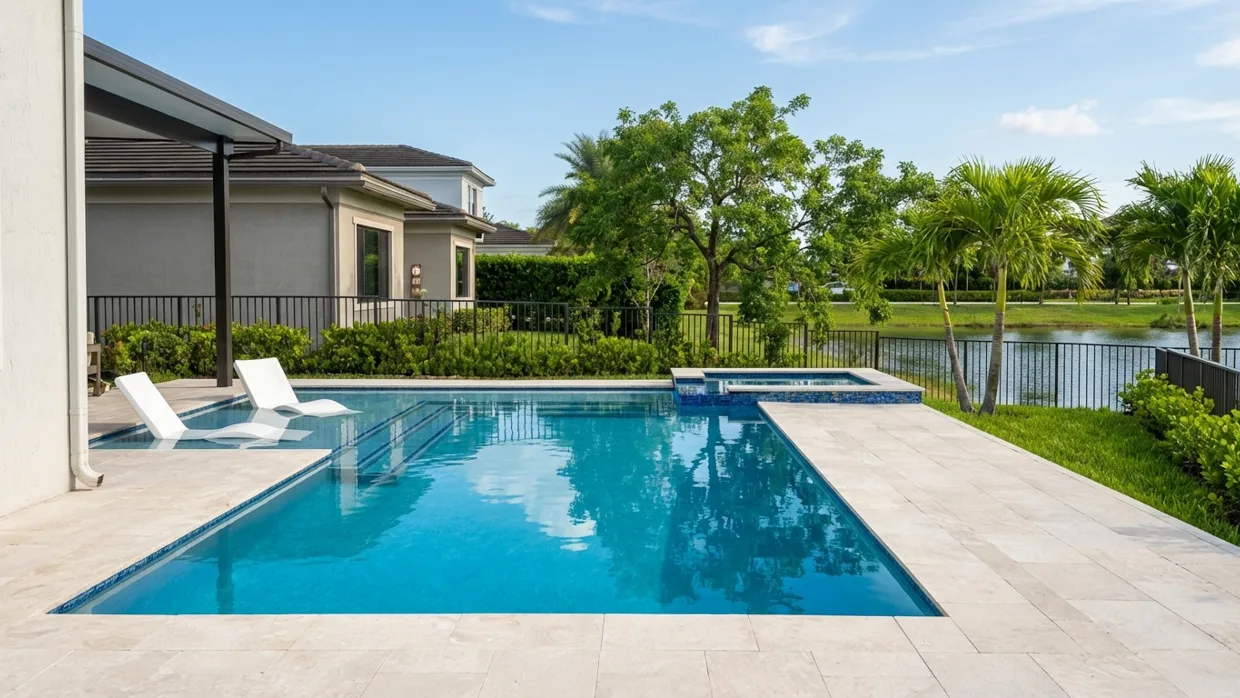
What sets the base price of a Florida pool — size, style, interior finish, deck, spa — is worked through in what a custom pool really costs. What belongs here is how the two North Florida surcharges attach to that base, because it is not where most people assume.
Rock excavation and difficult access are not priced against the excavation. In our pool cost estimator they multiply the project: the shell, the deck, the spa, the equipment, the outdoor features and the permit line, all of it. So the same rock costs more on a bigger job. A pool with a large travertine deck, an outdoor kitchen and landscaping carries the 12 percent on all of that, not on the hole — and because permits are themselves 9 percent of pool and deck, the surcharge lands on the permit line too.
On the estimator's own default configuration the shape is clear: ticking rock excavation and nothing else adds roughly $11,000, and ticking difficult access as well puts the pair at about $18,500, for a pool of identical design.
So the North Florida difference is not a different pool and not a different price per square foot. It is the same pool with two site conditions attached, and they are the two lines most likely to arrive later as a change order if nobody looked first. Every figure here comes from the same approved price table the estimator uses, and what it returns is a range of plus or minus 10 percent, not a quote.
A builder who answers those four quickly is a builder who has worked in this region. If the answers are vague, the questions in how to choose a pool builder in Florida are the next thing to read.
We build across this region — Gainesville and Ocala, Alachua County and Marion County, and the rest of North Florida. How our custom pool and spa construction is sequenced, from site review through permitting to startup, is on the service page, and a project estimate starts with someone walking the yard — which, given everything above, is the only place it can start.
Often, yes. This part of the state sits on limestone that can be shallow, and shallow rock changes the excavation method rather than just the hours. Our estimator applies a 12 percent rock-excavation surcharge to the project, which on its own default configuration is about $11,000.
Usually, but test the water first. Well water in this region is hard and can carry iron, and iron that goes into a pool on the first fill can stain a new interior finish within weeks. The fix is pre-filtering the fill and treating the water from day one, which is easy before startup and expensive afterward.
It depends on whether the property is inside city limits or in the unincorporated county, not on the mailing address. A Gainesville or Ocala address can fall under either. Confirm which authority has jurisdiction before anyone promises you a start date, because the submittal and inspection process is not the same.
If you want to swim outside the warmest months, yes. This is not South Florida: the unheated season is shorter, and a heater is what decides whether the pool gets used in spring and fall. Our estimator prices a heater at $4,500, with the gas supply or electrical capacity it needs priced separately.